Overturned Soviet I-16 type 29 fighter abandoned by the roadside, inspected by a German soldier, USSR, 1941.
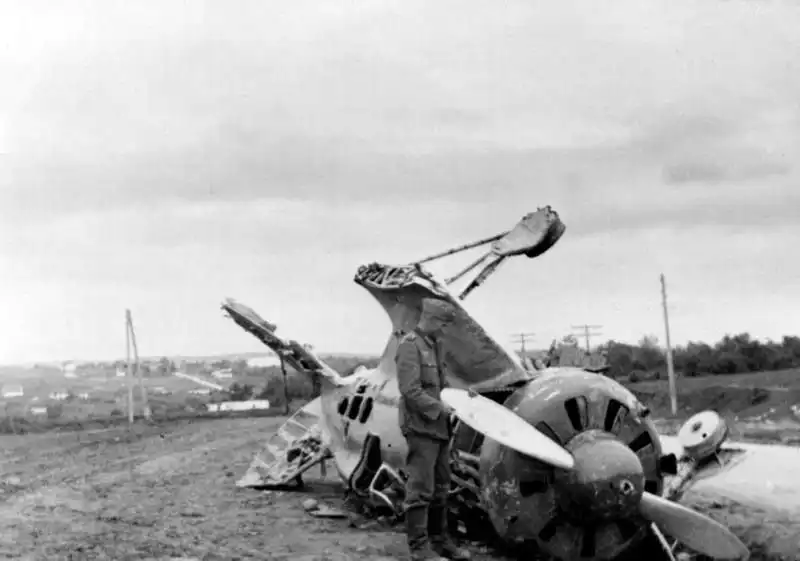
This unusual wartime photograph shows the overturned wreck of a Soviet Polikarpov I-16 Type 29 fighter lying beside a roadside somewhere in the Soviet Union during 1941. A German soldier examines the abandoned aircraft, which appears damaged but not completely destroyed. Unlike many photographs of aircraft burned on their airfields, this machine raises several intriguing questions about how it came to rest in such an unusual position.
One striking detail is that both wings had already been removed before the aircraft was overturned. This strongly suggests that the fighter had been deliberately disassembled, most likely for transportation by road. During the chaotic summer of 1941, damaged aircraft were often moved to repair depots or rear-area workshops whenever recovery was still considered worthwhile. Whether this particular I-16 was being evacuated, salvaged for parts, or simply relocated cannot be established with certainty, but its condition indicates that it was not abandoned immediately after an aerial battle.
Another remarkable feature is the absence of rubber tires on the landing gear wheels. Their removal was almost certainly intentional. In wartime conditions, valuable materials such as tires, instruments, weapons, and engine components were routinely salvaged from damaged aircraft before they were left behind. Even when an airframe could no longer be saved, its parts often continued to serve on other aircraft or military vehicles.
The Polikarpov I-16 occupied an important place in Soviet aviation history. Introduced in the mid-1930s, it was the world's first low-wing monoplane fighter with retractable landing gear to enter large-scale service. Fast and innovative when first introduced, it had become increasingly outdated by 1941, facing newer German fighters such as the Messerschmitt Bf 109F. Nevertheless, Soviet pilots continued to fly the "Ishak" ("Donkey"), relying on its agility and rugged construction in desperate defensive battles during the opening months of Operation Barbarossa.
This photograph also illustrates the enormous logistical challenges confronting the Red Army Air Force in 1941. Retreating units attempted to save as much equipment as possible, recovering damaged aircraft whenever circumstances allowed. Yet rapid German advances, Luftwaffe attacks, fuel shortages, and collapsing supply lines frequently forced Soviet personnel to abandon machines that might otherwise have been repaired and returned to service.
Today, the overturned I-16 serves as more than a simple image of wartime destruction. It reflects the difficult choices made during one of the most chaotic periods of the war, when every serviceable aircraft, spare part, and trained mechanic was desperately needed. Rather than depicting a conventional combat loss, the photograph captures the complex reality of retreat, evacuation, and survival that defined the summer of 1941.
Technical photo data:
📍 Location: USSR (exact location unknown)
📅 Date: 1941
📝 Event: Early phase of Operation Barbarossa during the German advance into Soviet territory
📷 Source: WWII German soldier photograph archives
Recommended literature:
- Gordon & Dexter – Polikarpov I-16 Fighter
- Mikhail Maslov – Polikarpov I-16: The Fighter that Changed Aviation
- Von Hardesty & Ilya Grinberg – Red Phoenix: The Rise of Soviet Air Power 1941–1945
- Christer Bergström – Barbarossa: The Air Battle, July–December 1941