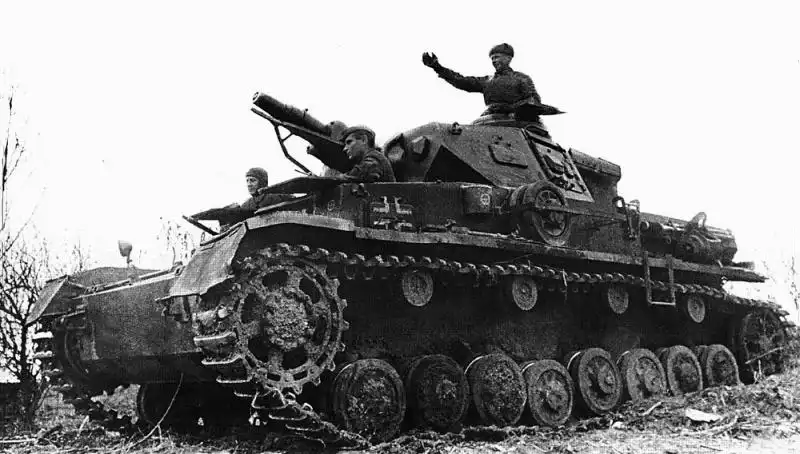
Soviet tank crew of the 151st Tank Brigade drives a captured German Pz.Kpfw. IV Ausf. F1 on the North Caucasus Front, March 1943.
A German Tank in Soviet Service
This World War II photograph shows a Soviet tank crew of the 151st Tank Brigade operating a captured German Pz.Kpfw. IV Ausf. F1 medium tank on the North Caucasus Front in March 1943. The vehicle, once used by the Wehrmacht, had been captured during the intense fighting that accompanied the Soviet advance against German forces in the Caucasus region.
Captured enemy equipment was not uncommon on the Eastern Front. Both the Red Army and Wehrmacht regularly repaired and reused abandoned or damaged vehicles whenever possible. A captured tank could provide an immediate addition to combat strength, while also allowing crews and engineers to study enemy technology firsthand.
The Panzer IV: Germany’s Main Battlefield Tank
The Pz.Kpfw. IV became one of the most important German tanks of the Second World War. The early Ausf. F1 version was equipped with a short-barreled 75 mm KwK 37 gun, originally designed mainly for infantry support and fighting fortified positions.
By 1943, newer Soviet tanks and anti-tank weapons had made early Panzer IV variants increasingly vulnerable. However, when captured and placed back into service, these vehicles still provided valuable firepower and mobility, especially during periods when the Red Army was rebuilding its armored forces after the catastrophic losses of 1941–1942.
Trophy Vehicles on the Eastern Front
For Soviet tank crews, operating a German vehicle was not only a practical decision but also a unique opportunity. Such tanks helped soldiers understand enemy technology, study armor protection, evaluate weapons, and learn the strengths and weaknesses of German designs.
Captured tanks were sometimes used in reconnaissance missions, training exercises, propaganda photographs, and even frontline combat. Their presence reflected the brutal reality of the Eastern Front, where every serviceable vehicle could become a valuable weapon regardless of its original owner.
The Caucasus Campaign of 1943
The photograph was taken during a crucial period of the war. After the failure of the German offensive toward the Caucasus oil fields, Soviet forces launched counteroffensive operations aimed at pushing Axis troops back from occupied territory.
Scenes like this demonstrate the adaptability of Red Army units during a difficult stage of the conflict, when experience, captured equipment, and battlefield improvisation all contributed to the gradual shift of strategic initiative toward the Soviet side.
Technical photo data
📍 Location: North Caucasus, USSR
📅 Date: March 1943
📝 Event: Soviet crew operating captured German Pz.Kpfw. IV Ausf. F1 tank
🛡️ Unit: 151st Tank Brigade
📷 Author: Viktor Temin
Recommended literature
- Thomas L. Jentz — Panzer Truppen: German Armored Troops 1933–1942
- David M. Glantz — From the Don to the Dnieper: Soviet Offensive Operations, December 1942–August 1943
- Steven J. Zaloga — Panzer IV vs T-34: Ukraine 1943
- Robert Forczyk — Tank Warfare on the Eastern Front 1941–1942
- Christopher A. Lawrence — The Battle of the Caucasus