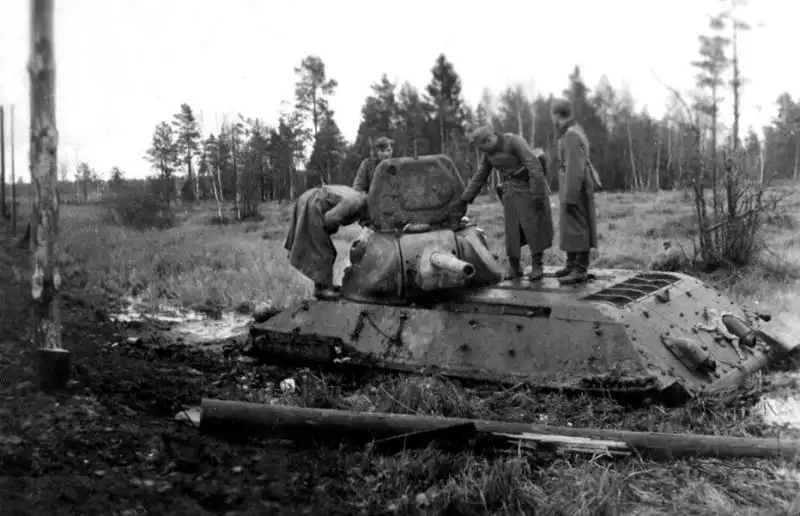
German soldiers inspect a Soviet T-34/76 medium tank abandoned after becoming trapped in swampy terrain during Operation Barbarossa, autumn 1941.
The T-34 Meets the Reality of War
This remarkable World War II photograph shows German soldiers examining an early-production Soviet T-34/76 medium tank abandoned after becoming immobilized in marshy ground during the autumn of 1941. Rather than destroyed in battle, the vehicle appears to have fallen victim to one of the greatest enemies of armored warfare on the Eastern Front—terrain itself.
When Germany invaded the Soviet Union in June 1941, the appearance of the T-34 came as an unpleasant surprise for the Wehrmacht. Its sloped armor, wide tracks, and powerful 76.2 mm gun outclassed most contemporary German tanks. Many anti-tank weapons struggled to penetrate its frontal armor, forcing German crews to rely on artillery, anti-aircraft guns, or attacks from vulnerable angles.
When Mud Defeated Armor
Despite its revolutionary design, the T-34 could not overcome every obstacle. The vast marshes, forests, and poorly developed road network of the Soviet Union created enormous logistical challenges. Heavy rains transformed dirt roads into deep mud, while seemingly solid ground often concealed soft bogs capable of trapping even tracked vehicles.
Once immobilized, recovery became extremely difficult. During the chaotic retreats of 1941, Soviet units frequently lacked heavy recovery tractors, spare parts, or sufficient fuel. If German forces were approaching, crews often had no alternative but to destroy sensitive equipment if possible and abandon their tanks before withdrawing.
More Than a Battlefield Loss
Photographs like this remind us that not every armored loss resulted from enemy fire. Throughout Operation Barbarossa, hundreds of Soviet tanks were abandoned because of mechanical failures, broken transmissions, lack of fuel, or impossible terrain. German photographers eagerly documented such vehicles, presenting them as trophies of victory, although many had never been knocked out in combat.
The T-34 would soon prove its true value. As Soviet industry expanded production, crew training improved, and logistics became more effective, the tank evolved into the backbone of the Red Army's armored forces. By the end of the war, tens of thousands had been built, playing a decisive role in the Soviet advance from Moscow to Berlin.
This image therefore captures an important paradox of 1941: one of the finest tanks of the Second World War rendered useless not by superior enemy technology, but by mud, mechanical limitations, and the immense logistical difficulties of fighting across the vast landscapes of the Soviet Union.
Technical photo data:
📍 Location: USSR (exact location unknown)
📅 Date: Autumn 1941
📝 Event: German soldiers inspect an abandoned Soviet T-34/76 immobilized during Operation Barbarossa
📷 Author: Unknown German military photographer
Recommended reading:
- T-34 abandoned during Operation Barbarossa
- Captured early-production T-34 tanks
- Captured T-34s in Wehrmacht service
- Early T-34 combat losses
- T-34 recovery operations during WWII
- Operation Barbarossa armored warfare