Unexploded German Aerial Bomb on the Streets of Besieged Leningrad, 1942
December 14, 2025 - Reading time: 4 minutes
Unexploded German aerial bomb guarded by Soviet civil defense on a street in besieged Leningrad, 1942.
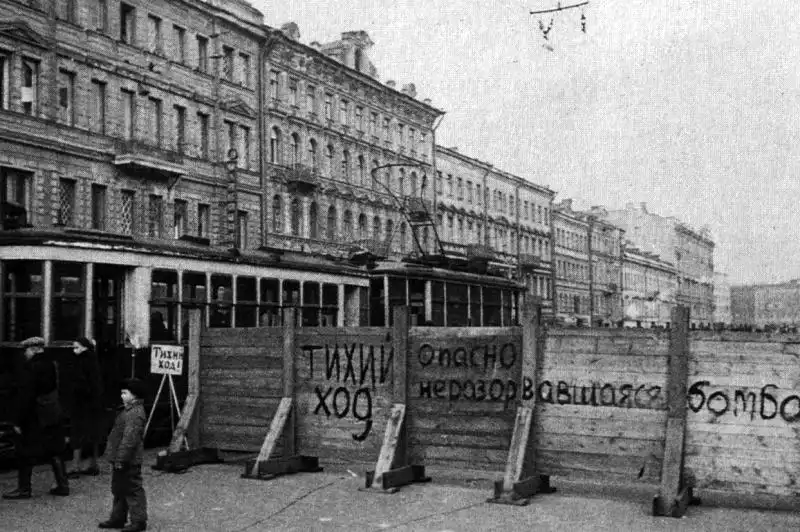
This photograph documents an unexploded German aerial bomb lying on a city street in besieged Leningrad in 1942. Dropped by Luftwaffe aircraft during bombing raids against civilian targets, the bomb failed to detonate and remained a deadly threat in the middle of the starving, blockaded city.
The device is surrounded by a temporary warning barrier bearing handwritten signs addressed to urban traffic: “Slow speed! Danger! Unexploded bomb.” Such improvised markings were common during the blockade, when time, materials, and manpower were critically limited, yet the city continued to function under constant danger.
Nearby, fighters of the Soviet civil defense and the People’s Militia stand guard, preventing civilians and vehicles from approaching the bomb. These units were responsible not only for air-raid response and firefighting, but also for securing unexploded ordnance — often at great personal risk — until sappers could safely neutralize it.
During the Siege of Leningrad (1941–1944), thousands of aerial bombs and artillery shells struck residential districts. Many failed to explode immediately, turning streets, courtyards, and tram lines into lethal traps. This image starkly illustrates the everyday reality of life under blockade: danger was not only falling from the sky, but lying silently underfoot.
Photographed by Boris Kudoyarov, the image serves as a powerful reminder of the constant threat faced by civilians in one of the most devastating sieges in modern history.
Technical Photo Data:
📍 Location: Leningrad, USSR
📅 Date: 1942
📝 Subject: Unexploded Luftwaffe aerial bomb under civil defense guard
📷 Photographer: Boris Kudoyarov
📚 Source: photoarchive.spb.ru
- Leningrad blockade 1942
- German air raids USSR
- Civilian life under siege
- WWII unexploded bombs
- Soviet home front defense
Related Pages
Tags
Category
Search
Categories
- Unidentified WWII Photos (14)
- World War II Photos 1937 (1)
- World War II Photos 1938 (1)
- World War II Photos 1939 (3)
- World War II Photos 1940 (5)
- World War II Photos 1941 (103)
- World War II Photos 1942 (60)
- World War II Photos 1943 (56)
- World War II Photos 1944 (77)
- World War II Photos 1945 (44)
- WWII and Postwar Photos 1946 (1)