A rare view looking directly up into the empty bomb bay of a Soviet Tupolev SB (ANT-40) fast bomber with open doors, summer 1941.
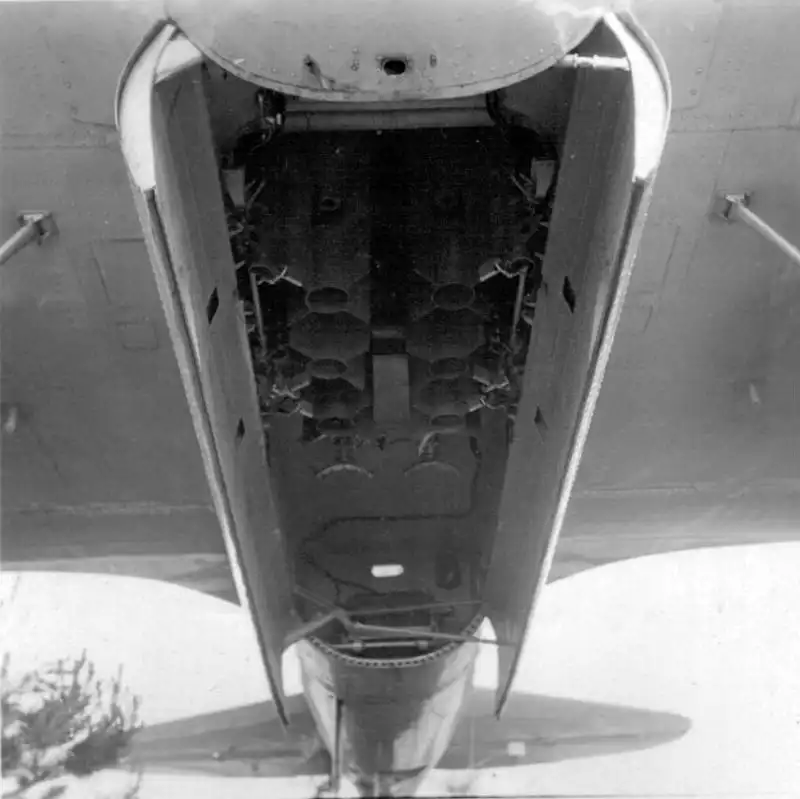
Rare Technical View of a Soviet Tupolev SB Bomb Bay:
This remarkable low-angle photograph offers a rare technical look directly into the open, empty internal bomb bay of a Soviet Tupolev SB (ANT-40) front-line high-speed bomber. Taken during the grueling summer of 1941, the image highlights the internal structure, door actuation mechanisms, and specialized bomb rack system of the Red Army Air Force's (VVS) most numerous pre-war tactical bomber.
Designed in the mid-1930s under the leadership of Alexander Arkhangelsky within the Tupolev Design Bureau, the SB was a pioneer of modern stressed-skin, all-metal monoplane bomber design. Its internal bomb bay was a crucial aerodynamic feature that allowed the aircraft to achieve impressive speed for its era by keeping external drag to a minimum.
The Internal Bomb Rack System and Vertical Suspension:
A defining feature clearly visible inside the fuselage bay is the arrangement of internal bomb cassette racks (such as the KD-1 and KD-2 systems). Unlike many Western contemporary bombers that carried all ordnance horizontally, the Tupolev SB utilized a vertical and horizontal internal suspension system:
- Vertical Bomb Racks: For smaller and medium ordnance, such as 50 kg (FAB-50) and 100 kg (FAB-100) general-explosive bombs, ordnance was suspended vertically inside the fuselage, nose-up. This compact layout maximized interior space while maintaining a slim fuselage cross-section.
- Horizontal Heavy Loads: Larger armor-piercing or demolition bombs, such as the FAB-250 or FAB-500 (250 kg and 500 kg), were suspended horizontally along the central fuselage axis, with doors slightly modified or partially open for extreme loads.
The total normal bomb load for the Tupolev SB was 600 kg, though it could be pushed to a maximum capacity of 1,000 kg for short-range missions.
The Tupolev SB in the Summer Campaign of 1941:
When Nazi Germany invaded the Soviet Union in June 1941 during Operation Barbarossa, the SB remained the backbone of the VVS tactical bomber force, accounting for over half of all operational Soviet bombers on the Western front.
Despite being increasingly outclassed by modern Luftwaffe fighters like the Messerschmitt Bf 109F, SB crews fought heroically under desperate conditions. Operating frequently without fighter escort, SB regiments carried out relentless low- and medium-altitude bombing strikes against advancing German mechanized columns, river crossings, and airfield hubs across the borderlands.
Maintenance, Logistics, and Ordnance Shortages:
An empty bomb bay in the summer of 1941 often told two very different stories of frontline warfare. On one hand, it represented a successful combat sortie where the crew managed to deliver their full payload onto enemy targets and return to base.
On the other hand, severe logistical disruption during the initial chaotic weeks of the war left many VVS bomber units stranded on forward airfields without aviation fuel or suitable ordnance. Ground crews worked tirelessly under constant threat of enemy air attack, rearming and refueling surviving aircraft as fast as supplies could reach the operational bases.
📍 Location: USSR
📅 Date: Summer 1941
📷 Photographer: Unknown
Recommended reading:
- Design and operational evolution of the Tupolev SB (ANT-40)
- Soviet VVS tactical bombing doctrine in 1941
- Internal ordnance cassette racks (KD-1) and Soviet aerial bombs
- The defense of Soviet airfields during Operation Barbarossa