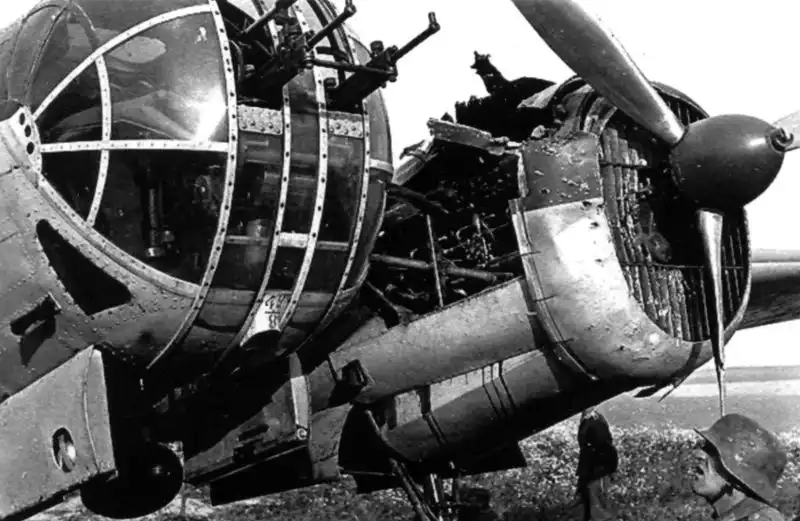
Damaged Soviet SB 2M-100A bomber with visible twin machine-gun mount and M-100 engine captured by German forces during the 1941 campaign on the Eastern Front.
Damaged Soviet SB Bomber Captured in 1941:
This wartime photograph shows the damaged remains of a Soviet SB 2M-100A bomber abandoned during the summer campaign of 1941 on the Eastern Front. German troops captured the aircraft after the rapid retreat of Red Army forces from the western regions of the Soviet Union.
Visible in the image are a twin defensive machine-gun mount and a heavily damaged M-100 engine, components that once formed part of one of the most widely used Soviet bombers of the late 1930s and early years of the war.
Photo Information:
-
Location: USSR
-
Date: 1941
-
Photographer: Unknown
What the Photo Shows:
The photograph captures several notable details:
-
A twin machine-gun defensive mount from the SB bomber
-
The damaged M-100 aircraft engine
-
Structural damage indicating the aircraft was abandoned or disabled
-
German forces inspecting the captured aircraft
The aircraft was likely left behind due to mechanical damage, airfield capture, or the inability to evacuate equipment during the rapid German advance.
The SB Bomber:
The Tupolev SB (“Skorostnoy Bombardirovshchik” – “High-Speed Bomber”) was one of the Soviet Union’s most important bombers in the late 1930s.
At the time of its introduction it was considered extremely advanced.
Key Characteristics
-
Twin-engine light bomber
-
High speed for its era
-
Crew of three
-
Defensive machine-gun armament
-
Internal bomb bay
When first introduced, the SB was actually faster than many contemporary fighter aircraft, allowing it to conduct bombing missions with limited escort.
The M-100 Engine:
The SB 2M-100A variant was powered by M-100 engines, Soviet-built licensed versions of the French Hispano-Suiza 12Y liquid-cooled V-12 engine.
Engine Features
-
12-cylinder V-type configuration
-
Liquid-cooled system
-
Approximate power: around 860 hp
-
Widely used in Soviet aircraft of the late 1930s
Despite its reliability, the engine was vulnerable to combat damage and difficult to repair in field conditions.
Why Aircraft Were Abandoned in 1941:
During the opening months of the German invasion, many Soviet aircraft were lost on the ground.
Common reasons included:
-
Rapid capture of forward airfields
-
Lack of fuel during retreat
-
Combat damage preventing flight
-
Shortage of spare parts and maintenance crews
-
Airfields destroyed during bombing
As Soviet forces withdrew eastward, damaged aircraft were often left behind and captured intact or partially destroyed by German troops.
The SB in the Early War:
By 1941, the SB bomber was already becoming obsolete.
Problems included:
-
Insufficient defensive armament
-
Increasing vulnerability to modern fighters
-
Limited armor protection
-
Relatively light bomb load compared with newer designs
Nevertheless, thousands remained in service when the war began.
Historical Significance:
Photographs like this one illustrate several realities of the early Eastern Front:
-
The rapid collapse of Soviet forward airbases
-
The large quantity of equipment captured by German forces
-
The transitional state of Soviet aviation in 1941
-
The technological gap between pre-war designs and evolving combat conditions
They also provide valuable visual documentation of aircraft equipment rarely preserved today.
Conclusion:
The damaged SB 2M-100A bomber shown in this photograph reflects the chaotic conditions of the Eastern Front in 1941. As Soviet forces retreated under pressure, damaged aircraft like this one were abandoned and later examined by German troops.
Once one of the fastest bombers in the world, the SB had already begun to show its age by the time the war reached Soviet territory — yet it remained a crucial part of Soviet aviation during the first months of the conflict.