An American Douglas A-26 Invader twin-engine light bomber in flight during testing in the United States, circa 1943.
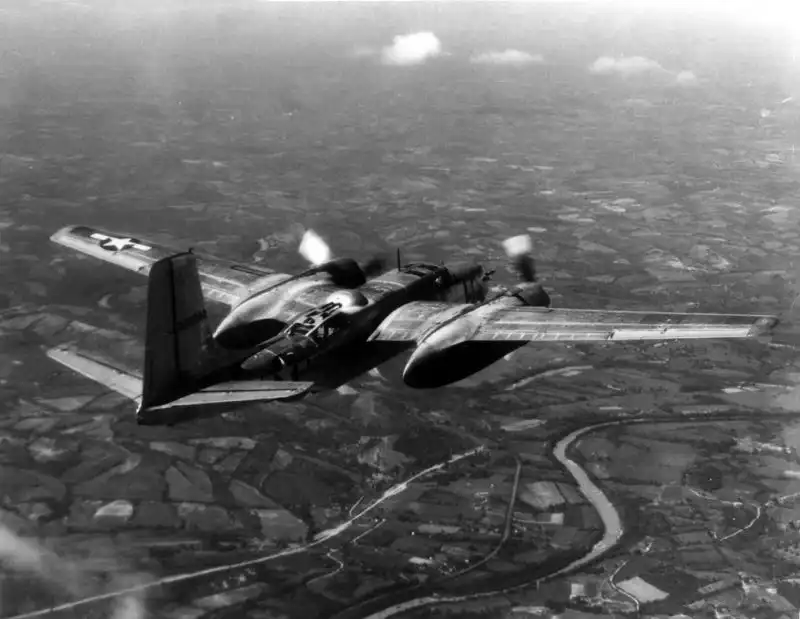
American Douglas A-26 Invader Bomber in Flight:
This striking aerial photograph captures a Douglas A-26 Invader twin-engine light attack bomber cruising in flight during test operations over the United States in 1943. Designed as a fast, heavily armed replacement for earlier light bombers like the A-20 Havoc and B-25 Mitchell, the A-26 Invader was one of the most technologically advanced American aircraft designs to emerge during World War II.
Featuring a sleek aerodynamic airframe, powerful twin Pratt & Whitney R-2800 Double Wasp radial engines, and remote-controlled gun turrets, the Invader represented the pinnacle of late-war American light bomber development.
Development and First Flight in 1942:
The Douglas Aircraft Company initiated design work on the A-26 in the early 1940s to fulfill a US Army Air Forces (USAAF) requirement for a high-speed attack aircraft. The prototype (XA-26) made its maiden flight on July 10, 1942, piloted by legendary test pilot Ben O. Howard.
Despite its superior speed and heavy payload capacity, production and combat deployment were delayed due to extensive flight testing and airframe refinements requested by the USAAF. Key modifications included redesigned cockpit canopies to improve pilot visibility and specialized interchangeable nose configurations (a solid nose fitted with up to eight heavy machine guns for strafing, or a glass nose for high-altitude bombing).
Combat Service in World War II:
Because of these delays, the A-26 Invader was a relatively rare sight in the skies over Western Europe compared to established medium bombers. It made its operational combat debut in September 1944 with the 553rd Bombardment Squadron based at Great Dunmow, England.
Despite entering the war during its final stages, the Invader compiled an impressive operational record in the European Theater of Operations (ETO):
- Combat Missions: European-based A-26 units flew a total of 11,567 combat sorties.
- Bomb Tonnage: A-26 crews dropped over 18,054 tons of bombs on tactical German targets, including rail yards, supply dumps, and troop concentrations.
- Low Loss Rate: Thanks to its exceptional speed and defensive armament, only 67 Invaders were lost to all causes in the European theater, making it one of the most survivable USAAF aircraft of the war.
A Long Post-War Career:
Although only around 2,500 units were built during the World War II period, the A-26 Invader proved so versatile and durable that its service career extended far beyond 1945. Redesignated as the B-26 Invader in 1948, the aircraft saw extensive combat service during the Korean War (1950–1953) and later played a significant role during the early years of the Vietnam War and various regional Cold War conflicts throughout the 1950s and 1960s.
📍 Location: USA
📅 Date: 1943
📷 Photographer: Unknown
Recommended reading:
- Development and test flight history of the Douglas A-26 Invader
- Operations of the 553rd Bombardment Squadron in Great Dunmow
- Tactical air support and strafing missions in the European Theater
- The transition from A-26 to B-26 Invader in Korea and Vietnam