A massive American 240 mm howitzer M1 of Battery B, 697th Field Artillery Battalion prepares to fire near Mignano, Italy, in January 1944.
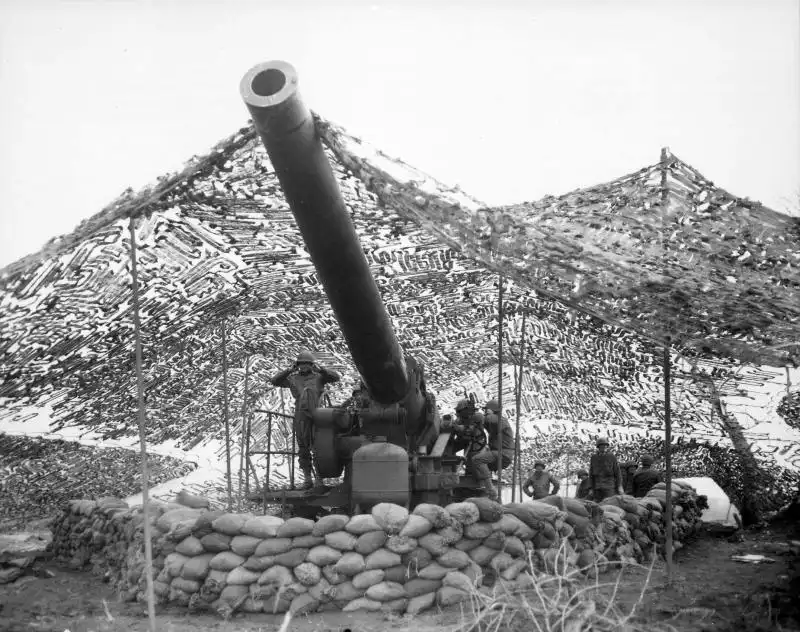
US 240 mm Howitzer M1 Prepared for Action Near Mignano:
This impressive wartime photograph shows a massive American 240 mm Howitzer M1 positioned under extensive camouflage netting near Mignano Monte Lungo, Italy, on January 30, 1944. Belonging to Battery B of the 697th Field Artillery Battalion, the gun crew is pictured conducting final checks as they prepare to open fire on entrenched German forces during the grueling Italian Campaign.
Surrounded by sandbag revetments and sheltered under a large patterned camouflage canopy, the artillery position demonstrates the high level of field preparation required to operate and conceal these siege-caliber weapons from enemy aerial reconnaissance and counter-battery fire.
The Mighty 240 mm Howitzer M1: "Black Dragon":
The 240 mm Howitzer M1, affectionately nicknamed the "Black Dragon" by its artillery crews, was the most powerful mobile field artillery piece deployed by the United States Army during World War II.
Firing a formidable 360-pound (163 kg) high-explosive shell to a maximum range of over 23 kilometers (14 miles), this heavy howitzer was designed specifically to destroy heavily fortified concrete bunkers, deep pillboxes, and strategic bridge crossings that standard field artillery could not penetrate.
Breakthrough at the Winter Line and Mignano Gap:
In January 1944, Allied forces were locked in heavy fighting along the German Gustav Line and Winter Line defenses in central Italy. The area around Mignano formed a critical geographical bottleneck—known as the Mignano Gap—blocking the direct highway route toward Rome.
German forces had fortified the surrounding mountains and valleys with concrete strongpoints and deeply dug-in artillery positions. To smash these formidable fortifications, the US Fifth Army deployed heavy corps-level artillery assets like the 697th Field Artillery Battalion, utilizing 240 mm howitzers to pave the way for advancing Allied infantry.
Transport, Deployment, and Camouflage Tactics:
Deploying a 240 mm howitzer required exceptional logistical effort. The weapon weighed over 29 tons in firing position and was moved in two separate loads—the barrel and the carriage—transported by heavy artillery tractors.
Once at the firing position, a specialized crane setup was used to assemble the weapon on a dug-in pit. Because setting up and dismantling the howitzer took several hours, effective concealment was vital. As shown in the image, the crew used elaborate overhead netting and sandbag protection to safeguard the valuable gun against Luftwaffe strikes and German counter-battery bombardment.
📍 Location: Mignano Monte Lungo, Campania, Italy
📅 Date: January 30, 1944
📷 Photographer: Unknown
📖 Information Source: US National Archives
Recommended reading:
- The deployment of the 240 mm Howitzer M1 in the Italian Campaign
- Combat operations of the 697th Field Artillery Battalion
- Breaching the Winter Line and Gustav Line at Mignano Gap
- Heavy siege artillery tactics of the US Fifth Army in WWII