American soldiers of the 1st Infantry Division wearing improvised snow suits march near Faymonville, Belgium, during the Battle of the Bulge in January 1945.
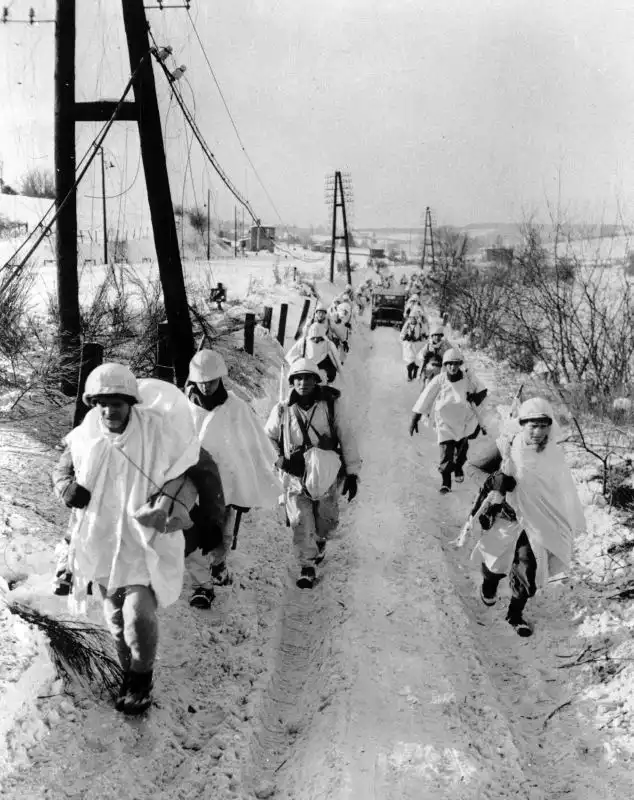
US 1st Infantry Division Troops in Improvised Winter Camouflage:
This evocative photograph captures American infantrymen of Company C, 2nd Battalion, 16th Infantry Regiment, 1st Infantry Division ("The Big Red One") marching along a narrow, snow-covered road near Faymonville, close to Malmedy, Belgium. Taken on January 16, 1945, during the counteroffensive phase of the Battle of the Bulge, the image highlights the harsh winter realities faced by US troops in the Ardennes.
Noticeable on almost every soldier is the white outer garments improvised to blend into the heavy snow. Because factory-made white camouflage parkas and suits were not distributed to most US front-line infantry units until late January 1945, GIs had to rely on extreme ingenuity to survive on the battlefield.
Improvised Camouflage in the Ardennes: Sheets and Whitewash:
When the German Ardennes Counteroffensive struck in December 1944, US forces were completely unprepared for winter camouflage warfare. Unlike the German Wehrmacht, which had years of Eastern Front experience and standardized reversible snow smocks, American infantry entered the winter wearing standard olive drab M-1943 field jackets and wool trousers.
To overcome this tactical disadvantage, soldiers took matters into their own hands:
- Bedsheets and Tablecloths: Troops requisitioned white linens from Belgian civilians, converting them into makeshift capes, ponchos, and helmet covers. Quartermaster units also mobilized local Belgian tailoring shops to mass-produce simple snow suits from white cloth stocks.
- Paint and Whitewash: Vehicle crews painted their tanks and trucks with whitewash or lime paint. Infantrymen often used the same paint to cover their steel M1 helmets, field packs, and weapon stocks.
The Counteroffensive at Faymonville:
Faymonville and the surrounding sector near Malmedy were vital bottlenecks during the Battle of the Bulge. The 16th Infantry Regiment saw fierce combat against heavily fortified German positions, clearing enemy strongpoints in deep snow and sub-zero temperatures.
By mid-January 1945, the Allied forces turned the tide, launching a coordinated counteroffensive to push back the German salient. Advancing through heavily mined terrain and thick forests required constant reconnaissance on foot, making visual concealment essential for infantry survival.
Human Ingenuity in the Face of Winter Warfare:
The column of infantrymen seen here demonstrates the adaptability of the American soldier under severe logistical constraints. Carrying heavy field packs, M1 Garand rifles, and specialized winter gear, these men of the "Big Red One" pushed forward despite frostbite, deep snowdrifts, and persistent enemy artillery fire.
This photograph remains one of the most iconic visual records of field-expedient adaptations used by US forces during the final brutal winter campaign of World War II in Western Europe.
📍 Location: Faymonville, Liège Province, Wallonia, Belgium
📅 Date: January 16, 1945
📷 Photographer: Unknown
🌐 Image Source: www.telegram.com
📖 Information Source: www.fdmuseum.org
Recommended reading:
- The 16th Infantry Regiment during the Battle of the Bulge
- US Army winter equipment and clothing shortages in WWII
- The liberation of Faymonville and Malmedy in January 1945
- Improvised field camouflage tactics of the 1st Infantry Division