A dynamic photograph of a German StuG III Ausf. B assault gun from Sturmgeschütz-Abteilung 192 kicking up dust in Opochka, 1941.
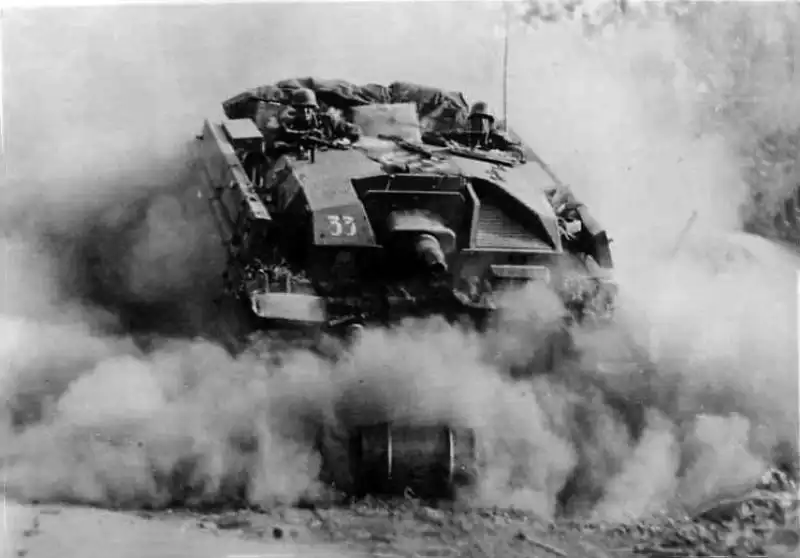
German StuG III Ausf. B Advancing in Opochka, 1941:
This dramatic photograph captures a German StuG III Ausf. B (Sturmgeschütz III) assault gun moving at full speed during the opening weeks of Operation Barbarossa, the Axis invasion of the Soviet Union in the summer of 1941. Enveloped in a dense cloud of dust, the vehicle is depicted passing through the town of Opochka in the Pskov Oblast.
The vehicle belonged to Sturmgeschütz-Abteilung 192, an independent assault gun battalion attached to Army Group Center during the Blitzkrieg offensive toward Leningrad and Moscow. The prominent tactical number "33" is visible on the front superstructure alongside combat stowage, including blankets and gear strapped to the engine deck.
The Role of Assault Guns in the Blitzkrieg:
Unlike conventional tanks designed for mobile armored warfare, the Sturmgeschütz III was created as a low-profile infantry support vehicle. Assigned directly to infantry divisions, StuGs provided immediate, heavy direct fire against fortified enemy positions, machine-gun nests, and bunkers.
During the rapid advance through the Soviet Union in the summer of 1941, the StuG III proved remarkably effective. Its low silhouette made it a difficult target for Soviet anti-tank gunners, while its reliable chassis, based on the Panzer III, allowed assault gun units to keep pace with fast-moving motorized columns despite dusty and unpaved Russian roads.
The StuG III Ausf. B Variant:
The vehicle pictured is an early-war Ausf. B variant, produced between June 1940 and May 1941. Key distinguishing features of this version include wider tracks and rubber-tired road wheels designed to improve off-road mobility over the initial Ausf. A model.
It is armed with the short-barreled 7.5 cm StuK 37 L/24 gun, designed primarily for firing high-explosive shells against infantry fortifications rather than long-range anti-tank combat. Despite its infantry-support primary role, the 75 mm gun was capable of defeating many early Soviet tanks using HEAT (high-explosive anti-tank) rounds at close ranges.
History of Sturmgeschütz-Abteilung 192:
Formed in late 1940, Sturmgeschütz-Abteilung 192 was one of the premier independent assault gun units involved in the initial invasion of the USSR. The battalion saw heavy action in Poland, the Baltic Region, and across northern Russia during the 1941 campaign.
Following months of intense combat, the battalion was officially reorganized in April 1942. Its experienced personnel and surviving equipment became the core of the newly formed assault gun battalion for the elite Infantry Division Großdeutschland (later Panzer-Grenadier-Division Großdeutschland), which played a central role in major Eastern Front operations until the end of the war.
📍 Location: Opochka, Pskov Oblast, USSR
📅 Date: Summer 1941
📷 Photographer: Unknown (Published in Allen Gewalten Zum Trotz, Berlin, 1942)
Photo source: Allen Gewalten Zum Trotz magazine, Zeitgeschichte Verlag, Berlin W 35, 1942.
Recommended reading:
- The deployment of Sturmgeschütz-Abteilung 192 in Operation Barbarossa
- Design and combat evolution of the StuG III Ausf. B
- The assault gun units of the Großdeutschland Division
- German armored logistics and dust conditions on Eastern Front roads