A German crewman painting victory rings on the massive 128 mm gun barrel of a Sturer Emil self-propelled gun on the Eastern Front, autumn 1942.
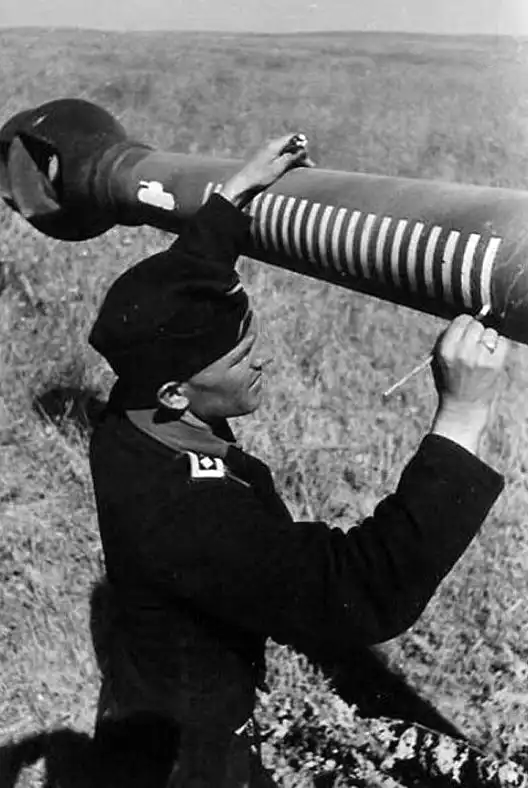
German Crewman Marking Victories on a 128 mm Sturer Emil:
This striking historical photograph captures a German tank destroyer crewman carefully applying a white victory ring (Abschussringe) to the massive barrel of a 12.8 cm PaK 40 L/61 gun. The vehicle in question is one of only two experimental heavy tank destroyers officially designated as the 12.8 cm Selbstfahrlafette auf VK 30.01 (H), widely known as the Sturer Emil ("Stubborn Emil").
Taken during the intense combat in the Great Bend of the Don River in the autumn of 1942, this image provides a rare glimpse into the operational life of Germany's most heavily armed experimental tank destroyers on the Eastern Front.
The Sturer Emil: A Rare Experimental Giant:
Only two prototype units of the Sturer Emil were ever constructed by Henschel and Rheinmetall in 1942. Built on modified VK 30.01 (H) heavy tank chassis, these vehicles were designed as long-range tank destroyers capable of destroying any Soviet armor from distances well beyond the range of enemy guns.
The two vehicles were nicknamed "Max" and "Moritz" after famous German storybook characters. Both were deployed to the Eastern Front with the 521st Heavy Tank Destroyer Battalion (Schwere Panzerjäger-Abteilung 521) to participate in Operation Blue (Unternehmen Braunschweig).
The 128 mm K.40 L/61 Cannon and Victory Markings:
The defining feature of the Sturer Emil was its massive 128 mm K.40 anti-tank gun, adapted from a heavy anti-aircraft design. The weapon possessed unprecedented armor penetration capabilities for 1942, easily destroying Soviet T-34 and KV-1 tanks at extreme ranges.
As visible in the photograph, the barrel is covered with a long series of white tally marks, along with a small tank silhouette painted near the muzzle. Each ring represented a confirmed kill against enemy armored vehicles or fortified positions, illustrating the high tactical effectiveness of this single vehicle during the summer and autumn battles of 1942.
Fate in the Don Bend and Stalingrad Campaign:
Operating in the vast, open steppe terrain near the Don River, the long-range capabilities of the 128 mm gun proved exceptionally dangerous to advancing Soviet forces. However, the vehicle suffered from significant mechanical limitations, including low ammunition capacity (only 18 rounds), slow speed, and a heavy, underpowered chassis.
The vehicle depicted here, likely "Moritz," accumulated dozens of armor victories before the Axis collapse in the region. One prototype was destroyed during combat, while the second was captured intact by the Red Army during the Battle of Stalingrad in early 1943, later being placed on display at the Kubinka Tank Museum.
📍 Location: Don Bend, USSR
📅 Date: Autumn 1942
📷 Photographer: Unknown
Recommended reading:
- The 12.8 cm PaK 40 L/61 heavy anti-tank gun
- The Schwere Panzerjäger-Abteilung 521 on the Eastern Front
- German heavy tank destroyers in the Battle of Stalingrad
- Tally marks and victory symbols on WWII German armor