Abandoned Soviet T-35 heavy multi-turret tank in a roadside ditch during the opening weeks of Operation Barbarossa, summer 1941.
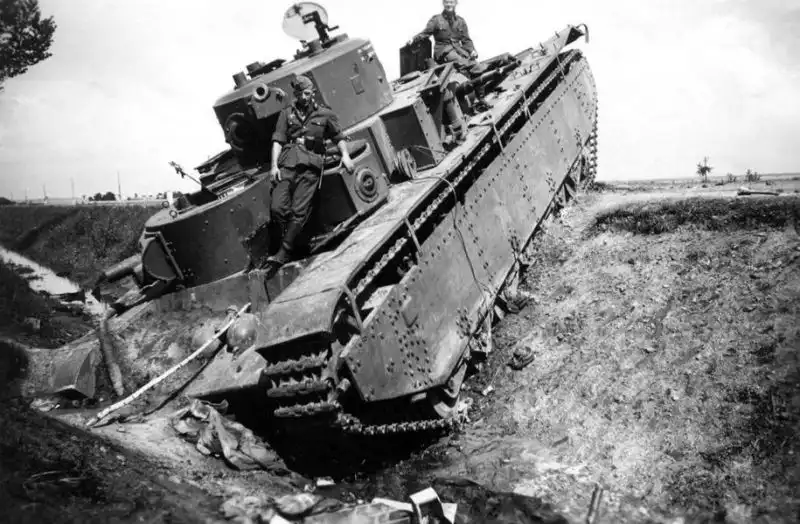
This World War II photograph shows a Soviet T-35 heavy multi-turret tank abandoned in a roadside ditch during the chaotic retreat of the Red Army in the opening weeks of Operation Barbarossa in the summer of 1941. Once regarded as one of the most impressive armored vehicles in the world, the T-35 became a symbol of the dramatic challenges faced by Soviet armored forces during the first months of the German invasion.
A Giant of the Interwar Era
Designed in the early 1930s, the T-35 reflected the military thinking of the interwar period, when many armies believed that multiple gun turrets would provide overwhelming firepower against infantry, fortifications, and lightly armored vehicles. Similar concepts were explored in several countries before combat experience demonstrated that a single powerful main gun, better armor, and improved mobility offered a far more effective solution on the modern battlefield.
The T-35 remains the only five-turret heavy tank ever produced in significant numbers. Measuring almost ten meters in length and operated by a crew of up to eleven men, it was one of the largest and most visually distinctive tanks of its era. Because of its extraordinary appearance, modern military historians and enthusiasts have sometimes referred to it as "Stalin's Land Battleship", although this was never an official Soviet designation.
Operation Barbarossa and the Fate of the T-35
When Germany invaded the Soviet Union in June 1941, the T-35 had already become outdated. During the opening weeks of Operation Barbarossa, many of these tanks were lost not because of direct enemy fire but due to mechanical failures, shortages of fuel, lack of spare parts, or the inability to recover damaged vehicles while Soviet forces were conducting a rapid retreat. Once immobilized, their enormous size made them easy targets for German artillery, anti-tank guns, and Luftwaffe aircraft.
Only a little over sixty production vehicles were built, and by the end of 1941 virtually all had been destroyed, abandoned, or captured. Although the T-35 never achieved major battlefield success, it remains one of the most recognizable armored vehicles of the interwar period.
A Symbol of Changing Armored Warfare
This photograph illustrates the rapid evolution of tank warfare during the Second World War. The T-35 embodied the experimental concepts of the early 1930s, when engineers believed that multiple turrets could dominate the battlefield. Combat experience quickly proved otherwise, leading every major military power to abandon multi-turret designs in favor of faster, more reliable, and more heavily armored single-turret tanks.
Today, images of abandoned T-35s serve not only as records of the catastrophic summer of 1941 but also as reminders of how quickly military technology and battlefield doctrine evolved during one of history's most destructive conflicts.
Technical photo data:
📍 Location: Western USSR (exact location unknown)
📅 Date: Summer 1941
🛡 Vehicle: Soviet T-35 heavy multi-turret tank
🎯 Context: Operation Barbarossa, Red Army retreat
📷 Author: Unknown German soldier
Recommended literature:
- Steven J. Zaloga — Soviet Tanks and Combat Vehicles of World War Two
- Mikhail Baryatinskiy — T-35 Heavy Tank
- Richard M. Ogorkiewicz — Tanks: 100 Years of Evolution
- David M. Glantz — Barbarossa: Hitler's Invasion of Russia 1941
- Steven J. Zaloga — Armored Champion: The Top Tanks of World War II