British sailors board the damaged German submarine U-110 in the Atlantic Ocean, capturing an Enigma machine and secret naval codebooks in one of the most important intelligence coups of World War II.
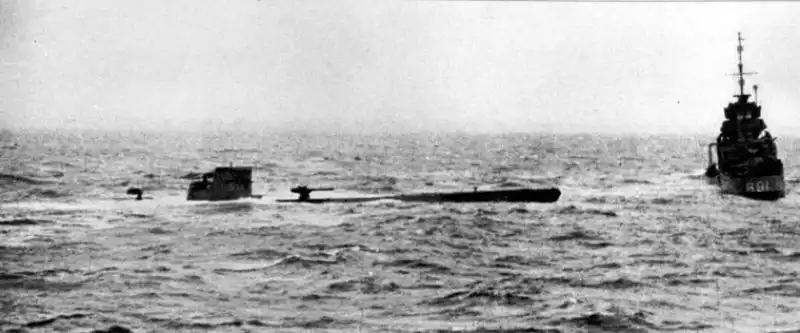
One of the Most Valuable Prizes of the Second World War:
This extraordinary photograph shows the German submarine U-110 shortly after being forced to the surface by British warships in the North Atlantic on 9 May 1941.
What appeared at first to be merely another successful anti-submarine action soon became one of the most important intelligence victories of the entire war. A British boarding party led by Lieutenant D. E. Balme entered the abandoned submarine and discovered something of immense value: an Enigma cipher machine together with codebooks, signal logs, operating instructions, and other classified naval documents.
The capture of these materials provided Allied cryptanalysts with critical information that helped them read German naval communications and wage a more effective campaign against the U-boat fleet.
The Battle of the Atlantic:
From 1939 to 1945, the Atlantic Ocean became the scene of the longest continuous military campaign of the war.
Germany relied heavily on submarines to cut Britain's maritime lifelines. Food, fuel, weapons, and raw materials all had to cross the Atlantic by ship. If the U-boats could sink enough merchant vessels, Britain might be starved into submission.
At times the campaign came dangerously close to succeeding.
German submarines operated in coordinated groups known as "wolf packs," attacking Allied convoys and disappearing into the vastness of the ocean. Their effectiveness depended heavily upon secure radio communications protected by the Enigma encryption system.
What Was Enigma?
The Enigma machine was an electro-mechanical cipher device used by the German armed forces to encrypt military messages.
To German commanders, Enigma appeared virtually unbreakable. Each message was scrambled using a combination of rotors, plugboard settings, and daily code procedures that produced an enormous number of possible configurations.
In practice, however, the security of any cipher depends not only upon mathematics but also upon access to operating procedures and key documents.
This is precisely why the capture of U-110 proved so valuable.
The Last Mission of U-110:
U-110 was a Type IXB submarine commanded by Kapitänleutnant Fritz-Julius Lemp, one of Germany's most experienced U-boat commanders.
On 9 May 1941 the submarine was attacking Allied convoy OB-318 when British escort vessels counterattacked with depth charges. Severely damaged, the boat was forced to surface in the middle of enemy warships.
Believing the submarine was about to sink, the crew abandoned ship. Thirty-four sailors were rescued from the water, while fourteen crewmen, including Commander Lemp, were lost.
The British quickly realized that the submarine remained afloat and dispatched a boarding party to investigate.
The Discovery That Changed Naval Intelligence:
Inside the submarine, British sailors found a treasure trove of classified material.
The boarding party recovered:
- An Enigma cipher machine.
- Current naval codebooks.
- Signal procedures.
- Radio traffic records.
- Various operational documents.
Most importantly, German naval authorities never learned immediately that these materials had fallen into British hands.
Because the Germans assumed the submarine had sunk with its secrets, many code systems continued to be used, allowing Allied codebreakers to exploit the captured information.
Did U-110 Win the Battle of the Atlantic?
Popular accounts sometimes claim that the capture of U-110 single-handedly doomed the German submarine campaign.
The reality is more complex.
British success against Enigma was the result of years of work by Polish, British, and later American cryptanalysts. The seizure of U-110 did not instantly unlock every German message. However, the captured machine and documents provided valuable assistance during a critical stage of the war and significantly accelerated codebreaking efforts.
Combined with radar, sonar, improved convoy tactics, long-range patrol aircraft, escort carriers, and growing Allied industrial strength, intelligence obtained from Enigma helped shift the balance against the U-boat fleet.
A Photograph of a Turning Point:
The image captures a moment that seemed insignificant at the time.
A damaged submarine floats helplessly in the Atlantic while British sailors search its interior. Yet within that vessel lay information that would influence naval operations across an entire ocean.
Few photographs from World War II illustrate the power of intelligence warfare so clearly. Tanks, ships, and aircraft determined battles, but information often determined who would win them.
The capture of U-110 remains one of the greatest intelligence successes in naval history and a powerful reminder that sometimes the most decisive weapons are not guns or torpedoes, but secrets.
Recommended Reading:
- The Code Book
- Enigma
- The Battle of the Atlantic
- Ultra Goes to War
- Hitler's U-Boat War
- The Hut Six Story
Photo details:
📍 Location: Atlantic Ocean
📅 Date: 9 May 1941
📷 Photographer: Unknown