German submarine U-185 sinking in the Atlantic Ocean after being attacked by American naval aircraft from the escort carrier USS Core during the Battle of the Atlantic on August 24, 1943.
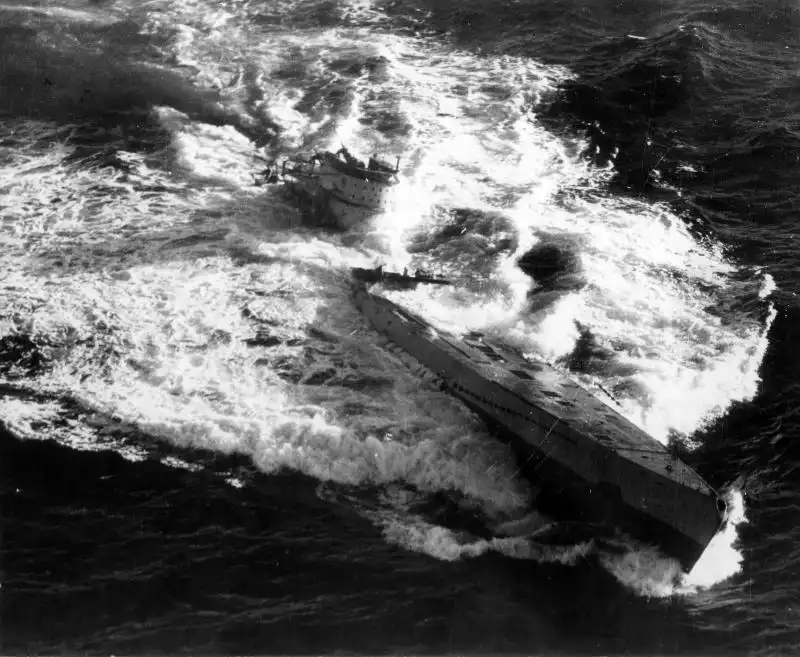
Final Seconds of German Submarine U-185:
This dramatic World War II photograph captures the final moments of the German submarine U-185 as it disappears beneath the waters of the Atlantic Ocean after an American anti-submarine attack.
The image shows a rare scene from the Battle of the Atlantic — a German U-boat caught in the process of destruction after being attacked by aircraft from the American escort carrier USS Core (CVE-13). The attacking aircraft included a Grumman TBF Avenger and supporting F4F Wildcat fighters from Composite Squadron 13 (VC-13). :contentReference[oaicite:1]{index=1}
Frozen in time, the photograph reveals the violence of underwater warfare: explosions, smoke, damaged equipment, and a submarine crew fighting for survival as their vessel begins its final descent.
The Battle of the Atlantic:
The destruction of U-185 occurred during one of the longest and most important campaigns of World War II — the Battle of the Atlantic.
From 1939 to 1945, German U-boats attempted to cut Allied supply routes by attacking merchant shipping crossing the Atlantic Ocean.
- destroying Allied cargo ships
- disrupting military supply convoys
- isolating Great Britain from overseas resources
- preventing the movement of troops and equipment to Europe
The Atlantic became a battlefield where thousands of sailors fought in extremely dangerous conditions far from land.
German Submarine U-185 — A Long-Range Hunter:
U-185 belonged to the German Type IXC/40 class of submarines, a group of large ocean-going U-boats designed for long-range operations.
Unlike smaller Type VII submarines that operated mainly in European waters, Type IX boats were built for extended patrols deep into the Atlantic.
- greater operational range
- larger fuel capacity
- increased torpedo storage
- ability to conduct independent missions far from Germany
U-185 was commissioned in June 1942 under the command of Kapitänleutnant August Maus. During its career, the submarine completed three patrols and sank nine Allied ships before being destroyed in August 1943. :contentReference[oaicite:2]{index=2}
The Final Patrol of U-185:
In August 1943, U-185 was returning from operations in the Atlantic after assisting the damaged German submarine U-604.
The submarine was carrying additional personnel when American aircraft detected it southwest of the Azores.
On August 24, 1943, aircraft from USS Core located the surfaced U-boat and launched an attack using depth charges. The submarine suffered severe damage, flooding, and internal failures that made escape inevitable. :contentReference[oaicite:3]{index=3}
The American Attack:
The attack was carried out by U.S. Navy aircraft equipped specifically for anti-submarine warfare.
The attacking aircraft used:
- radar detection systems
- depth charges
- machine-gun attacks against exposed submarine positions
- coordinated carrier-based tactics
By 1943, Allied anti-submarine warfare had improved dramatically. Escort carriers, long-range aircraft, radar, and better coordination transformed the Atlantic campaign and placed increasing pressure on German submarine crews.
How U-185 Was Destroyed:
Depth charges were designed to explode underwater near a submarine, creating powerful pressure waves capable of damaging the hull.
The explosions against U-185 caused:
- damage to the pressure hull
- flooding of internal compartments
- damage to engines and electrical systems
- dangerous conditions caused by leaking batteries
The submarine could no longer continue fighting. Captain August Maus ordered the crew to abandon the vessel as it began sinking beneath the Atlantic. :contentReference[oaicite:4]{index=4}
Life and Death Inside a U-Boat:
Service aboard German submarines was among the most dangerous military duties of World War II.
U-boat crews lived in extremely difficult conditions:
- confined spaces
- poor ventilation
- high humidity and heat
- constant danger from enemy aircraft and ships
- the threat of sudden destruction underwater
For submariners, every patrol carried the possibility of never returning to the surface.
Casualties and Survivors:
The sinking of U-185 resulted in heavy losses. According to wartime records, 29 German sailors were killed and 22 survivors were rescued after the submarine went down. :contentReference[oaicite:5]{index=5}
The surviving crew members were taken prisoner by Allied forces and transferred aboard American ships after spending hours in the Atlantic waters.
The Turning Point of the Atlantic War:
The loss of U-185 occurred during a critical period of the Battle of the Atlantic.
By mid-1943, Germany’s submarine offensive was facing major challenges because of:
- improved Allied radar technology
- escort carriers protecting convoys
- long-range patrol aircraft
- better anti-submarine tactics
- successful intelligence operations
The balance of power in the Atlantic was changing rapidly, and German U-boats increasingly became the hunted rather than the hunters.
A Rare Photograph of Naval Warfare:
This photograph remains one of the most powerful images of the Atlantic conflict because it captures destruction at the exact moment it occurred.
Unlike images showing abandoned ships or damaged equipment after battle, this photograph shows a submarine in its final seconds — still visible on the surface before disappearing forever beneath the waves.
The image represents both a military event and a reminder of the human cost of submarine warfare during World War II.
Historical Photograph Information:
Location: Atlantic Ocean
Date: August 24, 1943
Photographer: Unknown (official U.S. Navy photograph)
Recommended Books About the Battle of the Atlantic:
1. The Battle of the Atlantic — Jonathan Dimbleby
A comprehensive history of the naval campaign that shaped the outcome of World War II.
2. Iron Coffins — Herbert A. Werner
A memoir describing life aboard German U-boats from the perspective of a former submarine officer.
3. Black May — Michael Gannon
A detailed study of the crisis that changed the course of the U-boat war in 1943.
4. The Hunters — Donald Macintyre
An analysis of Allied anti-submarine warfare and the battle against German U-boats.