Senior Waffen-SS commanders Fritz Witt, Max Wünsche, and Kurt Meyer near Kharkov during the brutal fighting on the Eastern Front in early 1943.
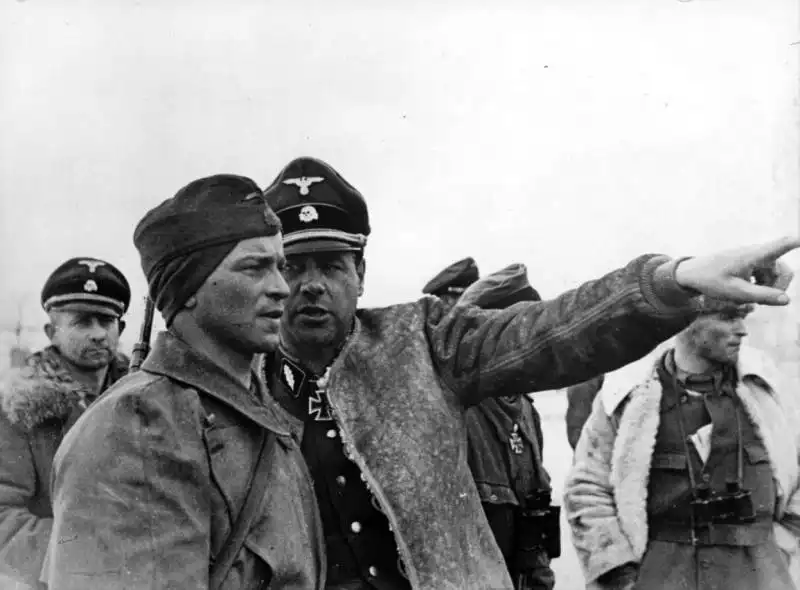
Waffen-SS Commanders During the Third Battle of Kharkov
This remarkable World War II photograph shows senior officers of the Waffen-SS during the fierce fighting near Kharkov in early 1943.
At the center of the image stands Fritz Witt, commander of a regimental combat group from the elite 1st SS Panzer Division Leibstandarte SS Adolf Hitler.
The photograph also includes two other famous Waffen-SS officers:
- Max Wünsche on the right
- Kurt Meyer second from the right
The image was taken during one of the bloodiest phases of combat on the Eastern Front.
The Battle for Kharkov
The photograph dates to the period of the Third Battle of Kharkov fought in February and March 1943.
After the destruction of the German 6th Army at Stalingrad, Soviet forces launched massive offensives across southern Russia and Ukraine.
German front lines partially collapsed, and Soviet troops rapidly advanced westward.
However, German armored formations under Erich von Manstein counterattacked with great force near Kharkov.
The result was one of the Wehrmacht’s last major operational victories on the Eastern Front.
Fritz Witt
Fritz Witt was regarded as one of the capable battlefield commanders within the Waffen-SS.
A veteran of earlier campaigns, he commanded combat formations during:
- the invasion of France
- Balkan operations
- the Eastern Front
Later in the war he became commander of the 12th SS Panzer Division Hitlerjugend.
Witt was killed in Normandy in 1944 during Allied artillery bombardment shortly after the D-Day landings.
Max Wünsche and Kurt Meyer
The officers standing beside Witt later became well-known figures in Waffen-SS history.
Max Wünsche
Max Wünsche served as a tank commander and later commanded armored units in Normandy.
He received the Knight’s Cross of the Iron Cross and Oak Leaves to the Knight’s Cross.
He survived the war and spent time in Allied captivity.
Kurt Meyer
Kurt Meyer, nicknamed “Panzermeyer”, became one of the most famous Waffen-SS commanders.
He was known for:
- aggressive tactics
- rapid armored assaults
- personal bravery
Meyer later commanded the Hitlerjugend Division in Normandy.
After the war he was convicted by a Canadian military court for responsibility connected to the murder of Canadian prisoners of war.
The SS Division “Leibstandarte Adolf Hitler”
The 1st SS Panzer Division Leibstandarte SS Adolf Hitler began as Adolf Hitler’s personal bodyguard unit before expanding into a major armored combat formation.
By 1943 the division had become one of Germany’s elite mechanized formations and played an important role in:
- Kharkov
- Kursk
- Normandy
- the Ardennes
The division developed a reputation for:
- aggressive combat effectiveness
- fanatic discipline
- involvement in war crimes
Like many Waffen-SS units, its battlefield reputation remains deeply controversial.
The Eastern Front in Early 1943
The period when this photograph was taken represented a temporary German recovery after the catastrophe at Stalingrad.
Despite tactical successes near Kharkov, Germany faced growing strategic problems:
- enormous casualties
- fuel shortages
- industrial strain
- increasing Soviet manpower and production
The Eastern Front was becoming a war of exhaustion Germany could no longer win.
Details Within the Photograph
One especially interesting detail is the unusual headgear worn by the German soldier in the foreground.
Improvised clothing and non-standard equipment became increasingly common on the Eastern Front because of:
- harsh weather
- supply shortages
- battlefield adaptation
Photographs like this provide historians with valuable insight into the everyday appearance of frontline German troops.
Kharkov — A City Destroyed Repeatedly
Kharkov became one of the most heavily contested cities of the Eastern Front.
The city changed hands multiple times during the war and suffered:
- enormous destruction
- mass civilian casualties
- starvation
- executions
- deportations
The fighting around Kharkov symbolized the brutality and scale of the German-Soviet war.
A Photograph of Confidence Before Defeat
The image captures experienced German commanders during one of the final periods when Germany still believed victory in the East remained possible.
Within two years:
- the Red Army would enter Berlin
- the Waffen-SS would collapse
- Nazi Germany would cease to exist
Today the photograph remains an important historical record of the men and formations involved in some of the fiercest fighting of World War II.
Source
Official archival source of the photograph:
Nationaal Archief
Historical Photograph Information
Location: Peresichne settlement, Kharkov region, Ukrainian SSR, USSR
Date: February–March 1943
Photographer: Unknown
Recommended Books About the Battle of Kharkov and the Waffen-SS
1. Kharkov 1943 — Lloyd Clark
Detailed study of the Third Battle of Kharkov.
2. The Waffen-SS — Martin Windrow
General history of the Waffen-SS and its combat formations.
3. Panzer Battles — Friedrich von Mellenthin
German perspective on armored warfare on the Eastern Front.
4. The Eastern Front 1941–1945 — David Stahel
Excellent overview of the German-Soviet war.