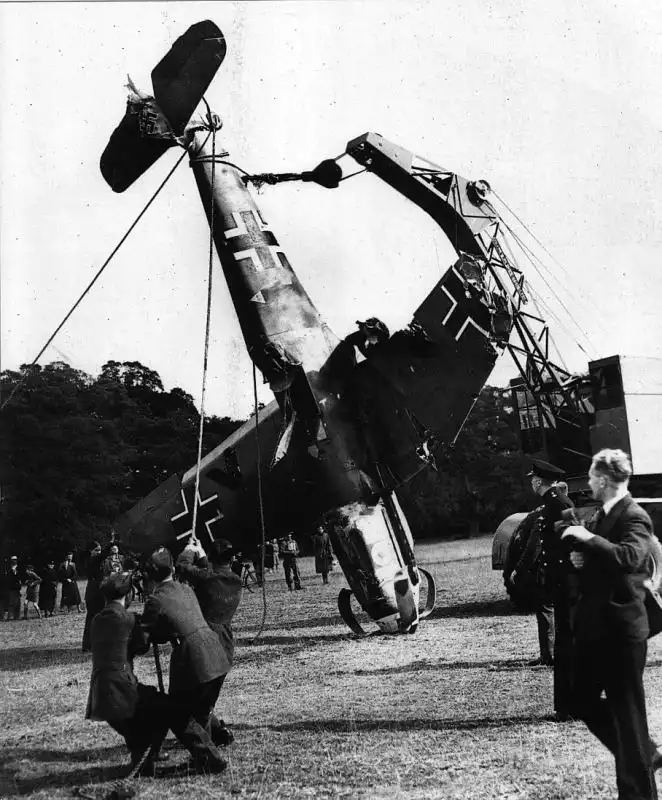
British recovery crews remove a damaged German Messerschmitt Bf 109 fighter after a forced landing in Windsor Great Park during the Battle of Britain in October 1940.
A Luftwaffe Fighter Brought Down Over Britain:
This fascinating World War II photograph captures British recovery crews loading a damaged German Messerschmitt Bf 109E-1 fighter aircraft onto a crane truck after its forced landing in Great Windsor Park during the Battle of Britain.
The aircraft belonged to the Luftwaffe and was piloted by Oberleutnant Karl Fischer of Jagdgeschwader 27.
The image perfectly illustrates one of the defining realities of the Battle of Britain: German aircraft falling directly onto British soil after violent air combat with the Royal Air Force.
The Battle of Britain:
The photograph dates from October 1940 — one of the most critical periods of the Battle of Britain.
After defeating France in the summer of 1940, Nazi Germany attempted to gain air superiority over Britain as preparation for a possible invasion.
The Luftwaffe launched massive air attacks against:
- RAF airfields
- radar stations
- aircraft factories
- British cities
But the British defense system proved far more effective than German planners expected.
Messerschmitt Bf 109E-1 — Germany’s Main Fighter:
The Messerschmitt Bf 109 served as the primary German fighter throughout much of World War II.
The Bf 109E series — often called the “Emil” — was one of the Luftwaffe’s most important aircraft during 1940.
It combined:
- high speed
- strong climb performance
- heavy armament
- modern monoplane design
This particular aircraft, factory number 4851, carried four machine guns and belonged to a frontline German fighter unit operating against Britain.
Air Combat Over Southern England:
During the Battle of Britain, German fighter pilots frequently escorted bombers deep into British airspace.
Combat conditions were extremely dangerous:
- constant RAF interception
- fuel limitations
- anti-aircraft fire
- navigation problems
Many damaged German aircraft could not return across the English Channel and were forced to land in Britain.
Some pilots survived and became prisoners of war.
Oberleutnant Karl Fischer:
According to historical records, pilot Karl Fischer survived the forced landing after combat with RAF fighters.
For German pilots, survival after being shot down over Britain often meant captivity instead of death.
Unlike aircrews lost at sea, captured pilots at least had a chance to survive the war.
Recovering Enemy Aircraft:
British authorities carefully recovered crashed German aircraft whenever possible.
Captured planes provided valuable intelligence about:
- weapons systems
- armor protection
- radio equipment
- engine performance
- tactical design features
Some recovered German aircraft were later repaired and test-flown by British pilots.
Great Windsor Park During Wartime:
Windsor Great Park became an unexpected wartime landing site because aerial combat during 1940 spread across much of southern England.
The contrast visible in photographs like this is striking:
- peaceful British countryside
- damaged warplanes
- military recovery vehicles
- evidence of violent air combat overhead
The war had reached Britain directly.
Germany’s Failure to Defeat Britain:
The Battle of Britain became the first major strategic defeat suffered by Nazi Germany during World War II.
Despite heavy bombing, the Luftwaffe failed to destroy:
- the RAF fighter force
- British radar infrastructure
- British industrial resistance
Germany eventually abandoned plans for invasion.
The survival of Britain allowed it to continue the war and later become the main base for Allied operations in Western Europe.
A Valuable Historical Image:
This photograph is especially interesting because it shows not destruction in battle, but the aftermath:
- the aircraft intact enough for recovery
- organized British salvage operations
- the practical side of wartime intelligence gathering
It offers a rare behind-the-scenes glimpse into what happened after German aircraft came down on British territory.
Historical Photograph Information:
Location: Great Windsor Park, United Kingdom
Date: October 1940
Photographer: Unknown
Recommended Books About the Battle of Britain:
1. The Most Dangerous Enemy — Stephen Bungay
One of the best modern histories of the Battle of Britain.
2. Fighter Boys — Patrick Bishop
Human stories of RAF fighter pilots during 1940.
3. Battle of Britain — Richard Overy
Detailed study of the campaign and its strategic importance.
4. The Narrow Margin — Derek Wood & Derek Dempster
Classic account of the air battle over Britain.