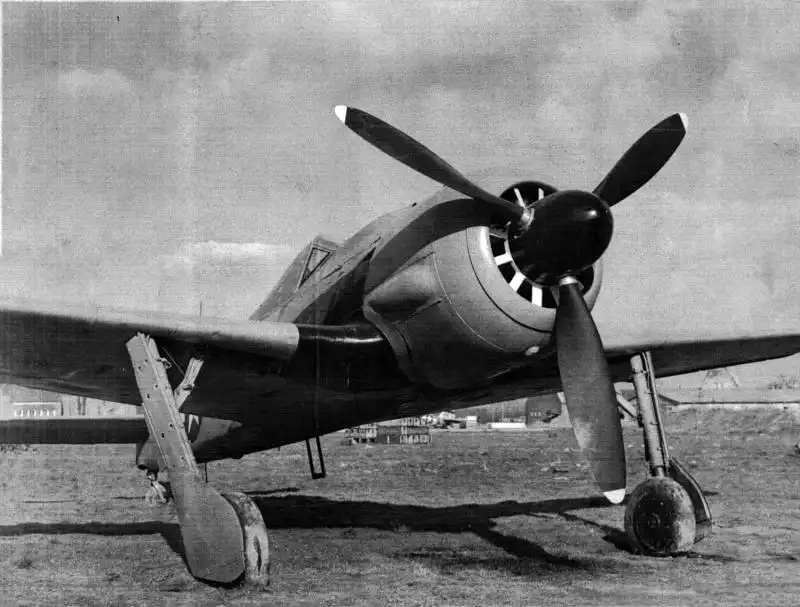
Captured German Focke-Wulf Fw 190A-8 fighter aircraft at the Allied airfield of Saint-Trond in Belgium after the failed Luftwaffe offensive of January 1945.
A Captured Luftwaffe Fighter in Allied Hands:
This striking World War II photograph shows a captured Focke-Wulf Fw 190A-8 fighter aircraft at Saint-Trond airfield in Belgium after falling into American hands during the final months of the war in Europe.
The aircraft was photographed after the failed German air offensive of January 1945, when the Luftwaffe attempted one last large-scale attack against Allied air power in Western Europe.
Unlike many destroyed German aircraft from this stage of the war, this fighter survived relatively intact and became a valuable Allied trophy.
The Luftwaffe’s Final Offensive:
The aircraft became connected to Operation Bodenplatte — one of the last major offensive operations carried out by the Luftwaffe.
On January 1, 1945, German fighters launched surprise low-level attacks against Allied airfields in:
- Belgium
- France
- the Netherlands
The goal was to destroy Allied aircraft on the ground and reduce pressure on German forces fighting during the Battle of the Bulge.
Saint-Trond Airfield:
The airfield at Saint-Trond served as an important Allied fighter base during the final campaigns in Western Europe.
German pilots attacked the base during Operation Bodenplatte, but many became disoriented because of:
- poor weather
- navigation problems
- anti-aircraft fire
- low-altitude flight conditions
Several aircraft were damaged or forced to land behind Allied lines.
Focke-Wulf Fw 190A-8 — One of Germany’s Most Dangerous Fighters:
The Fw 190A-8 represented one of the most powerful piston-engine fighters fielded by Germany during World War II.
The aircraft gained a formidable reputation because of:
- heavy armament
- rugged construction
- strong low-altitude performance
- excellent roll rate
Pilots respected the Fw 190 as a dangerous opponent even late in the war.
Germany’s Air War in 1945:
By early 1945 Germany’s air force faced overwhelming problems:
- fuel shortages
- lack of trained pilots
- destroyed industry
- Allied numerical superiority
Even advanced fighters like the Fw 190 could no longer significantly alter the balance of the air war.
The Luftwaffe increasingly relied on desperate operations and risky missions.
Captured German Aircraft:
Allied forces highly valued intact German aircraft for intelligence purposes.
Captured fighters allowed engineers and pilots to study:
- flight performance
- engine technology
- weapons systems
- design innovations
Some captured German aircraft were repainted and flown by Allied test pilots for evaluation purposes.
A Symbol of the Luftwaffe’s Collapse:
Photographs like this illustrate the dramatic reversal of fortune experienced by Germany during the war.
Only a few years earlier, the Luftwaffe dominated much of Europe.
By 1945:
- German airfields were under attack
- pilots were exhausted
- aircraft shortages worsened daily
- enemy troops occupied former Luftwaffe bases
A captured Fw 190 standing on an Allied-controlled airfield became a visible symbol of Germany’s defeat.
The Human Story Behind the Machine:
Behind every captured aircraft stood a pilot whose fate was often uncertain.
Many Luftwaffe pilots in 1945 faced:
- death in combat
- capture
- emergency landings
- impossible missions against overwhelming odds
The final months of the war proved catastrophic for German fighter units.
A Rare Survivor:
Most German aircraft photographed in 1945 appear destroyed, burned, or abandoned.
This Fw 190 survived largely intact, making the image especially valuable for historians and aviation researchers interested in late-war Luftwaffe operations.
Related Photograph:
Detailed history of this specific aircraft, including its repainting and capture during Operation Bodenplatte, can be found in the related photograph article about the same fighter aircraft.
Historical Photograph Information:
Location: Saint-Trond, Belgium
Date: 1945
Photographer: Unknown
Recommended Books About the Luftwaffe:
1. The Luftwaffe War Diaries — Cajus Bekker
Detailed history of German air operations during World War II.
2. JG 26: Top Guns of the Luftwaffe — Donald Caldwell
Excellent study of German fighter units in Western Europe.
3. The Rise and Fall of the German Air Force — Horst Boog
Comprehensive analysis of the Luftwaffe’s collapse.
4. Bodenplatte: The Luftwaffe’s Last Hope — John Manrho & Ron Pütz
Focused study of Germany’s final major air offensive.