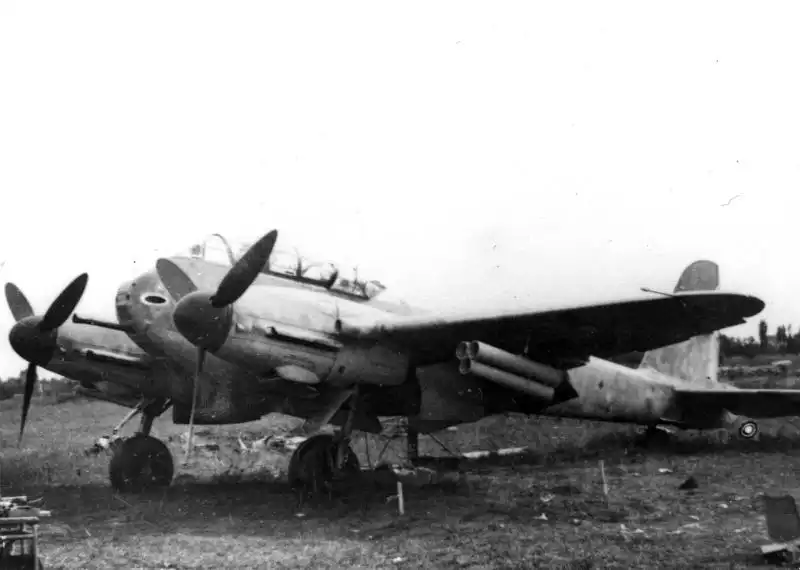
Hungarian-operated Messerschmitt Me 210 heavy fighter equipped with rocket projectiles and a 40 mm cannon, photographed in late 1944 as Germany attempted desperate anti-bomber solutions.
A Heavy Fighter in Germany’s Final Air War:
This unusual World War II photograph shows a Messerschmitt Me 210 in Hungarian service, modified with rocket projectiles and heavy cannon armament during the autumn of 1944.
The aircraft represents one of Germany’s late-war attempts to create powerful multi-role fighters capable of stopping Allied bombing raids over the Reich.
By this stage of the war, however, German aviation technology was no longer enough to counter overwhelming Allied air superiority.
The Role of Hungary in the Luftwaffe War Effort:
By late 1944, Hungary remained one of Germany’s last major Axis partners in Central Europe.
Hungarian forces and air units operated:
- German-designed aircraft
- Mixed German-Hungarian formations
- Rear-area air defense systems
The Me 210 in the photograph reflects this cooperation, as Hungary produced and operated variants of German aircraft under license.
Messerschmitt Me 210 — A Troubled Design:
The Messerschmitt Me 210 was intended to replace the earlier Me 110 as a long-range heavy fighter.
However, the aircraft quickly developed a poor reputation due to:
- unstable flight characteristics
- handling problems
- structural issues in early models
- difficult takeoff and landing behavior
Despite improvements in later versions, the aircraft never fully overcame its flawed early design.
Rocket Armament and the Nebelwerfer Concept:
The photograph shows the aircraft equipped with rocket projectiles associated with the Nebelwerfer system.
Originally, Nebelwerfer weapons were:
- ground-based multiple rocket launchers
- designed for area saturation bombardment
- effective against infantry formations and soft targets
In the air warfare context, similar rocket concepts were adapted for aircraft use as an attempt to disrupt tightly packed Allied bomber formations.
Anti-Bomber Strategy of the Luftwaffe:
By 1944–1945, the primary threat to Germany was the Allied strategic bombing campaign.
Mass formations of Allied bombers:
- targeted industrial centers
- attacked oil facilities
- destroyed transportation networks
German fighters increasingly experimented with:
- rockets
- heavy cannon armament
- upward-firing weapons
- interceptor tactics
The idea behind rocket-equipped fighters was simple:
fire into dense bomber formations and rely on blast effects rather than precision aiming.
The 40 mm “Bofors” Cannon:
The aircraft is also described as being armed with a 40 mm automatic cannon, likely derived from the Bofors 40 mm gun design.
Such heavy cannon armament was intended to:
- destroy bombers with a single hit
- penetrate heavy aircraft structures
- compensate for pilot skill shortages
However, mounting such heavy weapons on aircraft created additional problems:
- recoil instability
- reduced maneuverability
- increased weight
- structural stress on airframes
Desperate Innovation in 1944:
By autumn 1944, the Luftwaffe was fighting a defensive war.
Germany faced:
- overwhelming Allied air superiority
- fuel shortages
- pilot shortages
- destroyed infrastructure
As a result, many experimental weapon configurations were tested in an attempt to reverse the situation.
The Me 210 in this photograph reflects that desperation.
Technical and Tactical Limitations:
Although heavily armed, aircraft like the Me 210 faced serious operational issues:
- difficult handling
- vulnerability to Allied fighters
- inaccurate rocket delivery systems
- limited effectiveness against fast bomber formations
In practice, rocket-armed fighters rarely achieved decisive results.
The Collapse of German Air Defense:
By late 1944, Allied bombing raids were largely uncontested over many parts of Germany.
The Luftwaffe struggled to:
- replace lost aircraft
- train new pilots
- maintain fuel supplies
Even heavily armed experimental aircraft could not change the overall trajectory of the air war.
A Snapshot of Late-War Military Innovation:
Despite its flaws, the aircraft illustrates the rapid technological experimentation of the late war period.
Germany was simultaneously developing:
- jet fighters
- rocket weapons
- radar-guided systems
- heavy interceptors
But these innovations arrived too late and in insufficient numbers.
Historical Photograph Information:
Location: Hungary
Date: Autumn 1944
Photographer: Unknown
Recommended Books About Luftwaffe Late-War Development:
1. The Luftwaffe War Diaries — Cajus Bekker
Overview of German air operations and technology.
2. German Aircraft of World War II — J.R. Smith & Antony Kay
Technical analysis of Luftwaffe aircraft designs.
3. The Rise and Fall of the German Air Force — Horst Boog
Comprehensive study of the Luftwaffe’s evolution.
4. Luftwaffe Secret Projects — Dan Sharp
Explores experimental and late-war German aircraft concepts.