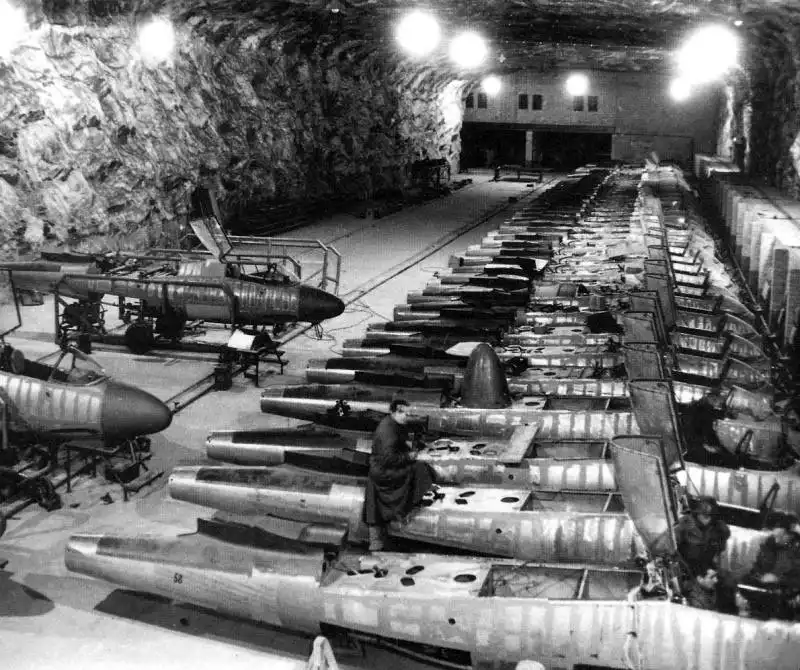
Assembly line of Heinkel He 162 “Salamander” jet fighters inside a massive underground German aircraft factory discovered by American forces in 1945.
Germany’s Underground Jet Fighter Factory:
This remarkable World War II photograph shows the assembly line of Heinkel He 162 jet fighters inside a huge underground aircraft factory operated by Junkers in Tartun, Germany, discovered by the U.S. First Army in 1945.
The enormous halls visible in the image were built inside former salt mines, part of Nazi Germany’s desperate attempt to protect war production from devastating Allied bombing campaigns during the final stage of the war.
The scene looks almost futuristic:
unfinished jet aircraft standing deep underground beneath collapsing Nazi Germany.
Germany’s Shift to Underground Industry:
By 1944 Allied strategic bombing had severely damaged German industry.
Factories producing:
- aircraft
- engines
- fuel
- ammunition
were under constant attack from Allied bombers.
To survive, Germany increasingly moved military production underground into:
- tunnels
- mines
- caves
- reinforced bunkers
The Tartun facility became one of many hidden industrial complexes designed to continue aircraft production despite air raids.
The Underground Plant at Tartun:
The factory photographed here occupied huge chambers inside a former salt mine near Tartun.
These underground halls offered several advantages:
- Protection from bombing
- Stable temperatures
- Concealed production lines
- Space for large-scale assembly
American troops discovered the site during their advance toward Magdeburg in 1945.
The discovery shocked Allied forces because hundreds of partially completed jet fighters remained hidden underground.
Heinkel He 162 — The “People’s Jet Fighter”:
The aircraft under construction was the Heinkel He 162, nicknamed “Salamander.”
The He 162 emerged during the final desperate phase of the war as part of Germany’s “Volksjäger” (“People’s Fighter”) program.
The idea behind the aircraft was radical:
- cheap production
- simplified assembly
- minimal use of strategic materials
- rapid pilot training
Germany hoped the aircraft could be mass-produced quickly enough to challenge Allied air superiority.
A Fighter Designed for Emergency Conditions:
The He 162 reflected the catastrophic condition of German industry by 1944–1945.
Engineers intentionally designed it for:
- fast manufacturing
- simplified maintenance
- reduced labor requirements
One of the aircraft’s most distinctive features was its engine placement above the fuselage.
This unusual layout provided several advantages:
- simpler installation
- easier maintenance
- rapid engine replacement in field conditions
In the photograph, the aircraft visible on the assembly line lack engines because the powerplants were installed separately.
Advanced but Too Late:
Despite being developed under desperate wartime conditions, the He 162 possessed impressive performance.
The aircraft was:
- extremely fast
- highly maneuverable
- technologically advanced
However, the program faced major problems:
- inexperienced pilots
- fuel shortages
- collapsing logistics
- lack of training time
- rushed manufacturing
The aircraft entered service far too late to influence the outcome of the war.
The Final Months of the Luftwaffe:
By 1945 the Luftwaffe was collapsing.
Germany still possessed advanced technology:
- jet aircraft
- guided weapons
- innovative engineering
But technology alone could no longer compensate for:
- overwhelming Allied production
- air superiority
- fuel shortages
- exhausted manpower
The underground factory symbolizes both German engineering skill and the hopelessness of the Nazi war effort in its final stage.
More Than One Thousand Aircraft Underground:
Only about 116 He 162 aircraft were completed before the war ended.
Yet inside underground facilities like this one, more than 1,000 unfinished aircraft reportedly existed in various stages of assembly.
This demonstrates the enormous scale of German late-war aircraft ambitions — even as the country itself was collapsing militarily.
Forced Labor and Underground Production:
Like many underground German wartime factories, facilities of this type were often connected to forced labor systems.
Workers frequently included:
- concentration camp prisoners
- foreign laborers
- prisoners of war
- civilians working under harsh conditions
Conditions inside underground industrial sites could be brutal:
- dust
- poor ventilation
- exhaustion
- malnutrition
- constant pressure to maintain production
Behind the advanced aircraft stood immense human suffering.
A Strange Vision of the Future:
Photographs like this are fascinating because they almost resemble scenes from the early Cold War rather than World War II.
Rows of jet fighters hidden deep underground hint at the coming technological age:
- jet aviation
- underground military complexes
- industrialized modern warfare
The He 162 itself became one of the last symbols of Nazi Germany’s attempt to use advanced technology to escape inevitable defeat.
Historical Photograph Information:
Location: Tartun, Germany
Date: 1945
Photographer: Unknown
Recommended Books About German Jet Aircraft and Underground Industry:
1. The Luftwaffe War Diaries — Cajus Bekker
Comprehensive history of the German air war.
2. German Jets Against the RAF — Alfred Price
Detailed study of German jet fighter development.
3. The Rise and Fall of the German Air Force — Horst Boog
Excellent analysis of the Luftwaffe’s wartime evolution.
4. Arming the Luftwaffe — Edward Homze
Study of German aircraft production and wartime industry.