Captured German Focke-Wulf Fw 190A-8 fighter repainted in bright Allied colors after an emergency landing at the Belgian airfield of Saint-Trond during Operation Bodenplatte in January 1945.
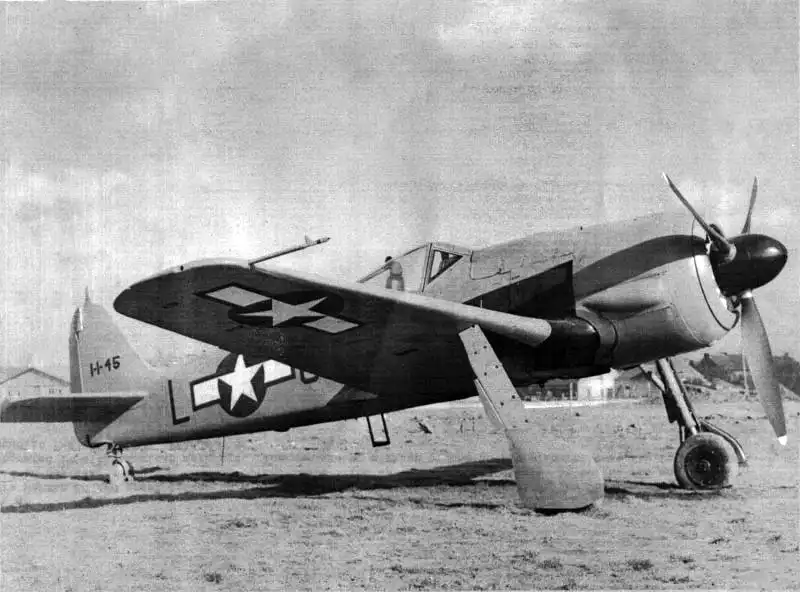
A German Fighter in American Hands:
This fascinating World War II photograph shows a captured German Focke-Wulf Fw 190 fighter aircraft repainted by American forces after being captured at Saint-Trond airfield in Belgium in January 1945.
The aircraft stands out because of its unusual bright red-orange paint scheme applied by Allied personnel after capture.
Originally flown by Gefreiter Walter Wagner of II./JG4, the fighter became an unexpected trophy of one of the Luftwaffe’s final major offensives in Western Europe.
Operation Bodenplatte:
The story of this aircraft is directly connected to Operation Bodenplatte.
Launched on January 1, 1945, the operation was a desperate attempt by the Luftwaffe to destroy Allied aircraft on the ground during the final phase of the war in Western Europe.
German fighter units attacked numerous Allied airfields in:
- Belgium
- The Netherlands
- France
The goal was to weaken Allied air superiority supporting the Battle of the Bulge.
The Attack on Saint-Trond Airfield:
The American 404th Fighter Group and its 508th Fighter Squadron were based at the airfield of Saint-Trond when the attack occurred.
German aircraft struck the base in a surprise low-level assault.
Although some Allied aircraft were destroyed or damaged, the Luftwaffe suffered devastating losses:
- Experienced pilots killed
- Aircraft shot down by anti-aircraft fire
- Navigation failures
- Confusion during attacks
By early 1945 Germany could no longer replace veteran pilots or lost aircraft efficiently.
Focke-Wulf Fw 190A-8 — One of Germany’s Best Fighters:
The aircraft in the photograph was a Focke-Wulf Fw 190A-8, one of the most effective German fighters of World War II.
The Fw 190 earned a formidable reputation because of:
- Heavy armament
- Excellent roll rate
- Strong low-altitude performance
- Rugged construction
The A-8 variant became one of the most widely produced versions of the aircraft.
Walter Wagner’s Mistake:
The aircraft belonged to Gefreiter Walter Wagner of 5./II./JG4.
During the confusion of the operation, Wagner mistakenly attacked the wrong airfield.
He believed Saint-Trond was the Allied base at Le Culot.
After suffering minor anti-aircraft damage, Wagner landed directly on the enemy-controlled airfield — effectively delivering his aircraft to the Americans intact.
It was one of the many examples of chaos surrounding Operation Bodenplatte.
Catastrophic German Losses:
The unit to which Wagner belonged suffered heavily during the operation.
II./JG4 lost numerous pilots:
- killed
- wounded
- missing
- captured
The Luftwaffe simply could not absorb such losses by 1945.
Although some tactical damage was inflicted on Allied airfields, strategically the operation became a disaster for Germany.
Why the Aircraft Was Painted Bright Red-Orange:
After capture, American personnel repainted the aircraft in a striking red-orange color scheme.
Several reasons existed for repainting captured enemy aircraft:
- Preventing friendly fire incidents
- Testing and evaluation
- Identification during ground operations
- Psychological effect and display
The Americans also painted a fake identification code:
“1-1-45” — marking the date of capture.
Captured Aircraft as Intelligence Sources:
Captured German aircraft were extremely valuable to Allied intelligence.
Technicians and pilots studied them to evaluate:
- Flight characteristics
- Armament
- Engine technology
- Weaknesses and strengths
Many captured Luftwaffe aircraft were later flown in testing programs by Allied pilots.
However, according to available information, this particular aircraft never flew in its new American colors.
The Fading Power of the Luftwaffe:
By January 1945 the Luftwaffe was already collapsing under overwhelming Allied pressure.
Germany faced:
- fuel shortages
- pilot shortages
- destroyed industry
- constant bombing campaigns
Even advanced aircraft like the Fw 190 could no longer change the course of the war.
Operation Bodenplatte became one of the last desperate offensives of a dying air force.
A Strange and Symbolic Photograph:
The image is historically fascinating because it shows:
- a German fighter
- in Allied hands
- painted in absurdly bright colors
- sitting on a captured airfield during the final months of the war
It perfectly symbolizes the collapse of Nazi Germany in 1945.
Historical Photograph Information:
Location: Saint-Trond, Belgium
Date: January 1945
Photographer: Unknown
Recommended Books About the Luftwaffe and Air War in Europe:
1. The Luftwaffe War Diaries — Cajus Bekker
Detailed history of German air operations during World War II.
2. JG 26: Top Guns of the Luftwaffe — Donald Caldwell
Excellent study of German fighter operations in Western Europe.
3. The Rise and Fall of the German Air Force — Horst Boog
Comprehensive analysis of the Luftwaffe’s strengths and collapse.
4. Bodenplatte: The Luftwaffe’s Last Hope — John Manrho & Ron Pütz
Focused study of Operation Bodenplatte.