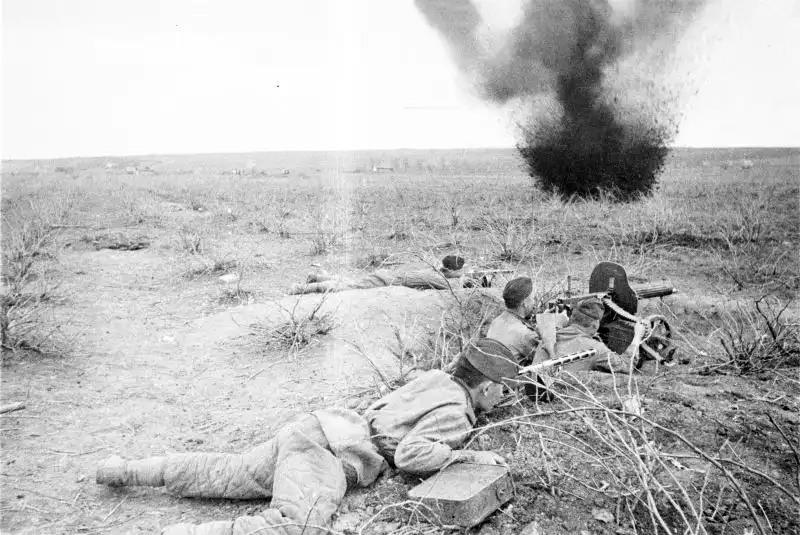
A Soviet Maxim machine gun crew fights under German artillery fire during the brutal battles for Crimea in the spring of 1944.
Under Shellfire in Crimea:
This dramatic World War II photograph captures a Red Army Maxim machine gun crew fighting from a poorly prepared defensive position while German artillery shells explode nearby in Crimea during the spring of 1944.
A Soviet soldier in the foreground rushes forward carrying ammunition belts for the machine gun despite the danger of shrapnel and incoming fire.
The image perfectly conveys the chaos, courage, and physical exhaustion of frontline combat on the Eastern Front.
The Battle for Crimea in 1944:
The photograph was taken during the Soviet offensive to liberate Crimea from German and Romanian forces in 1944.
After the strategic victories at Battle of Stalingrad and Battle of Kursk, the Red Army seized the initiative across the Eastern Front.
In Crimea, Soviet forces launched major operations aimed at:
- Destroying Axis defensive positions
- Retaking Sevastopol
- Eliminating German control of the peninsula
The fighting became extremely intense, especially around fortified positions and open terrain vulnerable to artillery fire.
PM M1910 Maxim — The Backbone of Soviet Infantry Firepower:
The weapon seen in the photograph is the legendary PM M1910 Maxim.
Originally based on Hiram Maxim’s late 19th century design, the Soviet version became one of the most recognizable weapons of the Red Army.
The Maxim machine gun was famous for:
- Reliability
- Sustained fire capability
- Durability
- Massive battlefield presence
The weapon used water cooling, allowing crews to fire long bursts without overheating the barrel.
The Crew and Their Roles:
Operating a Maxim machine gun required an entire crew.
Typically this included:
- Gunner
- Assistant gunner
- Ammunition carriers
- Additional riflemen for protection
The soldier visible in the foreground carrying ammunition boxes performed an extremely dangerous task.
Without a constant supply of ammunition, the machine gun would quickly become useless in combat.
A Poorly Prepared Position:
One striking detail is how exposed the Soviet position appears.
The crew occupies only shallow cover with limited protection from:
- Artillery fragments
- Mortar fire
- Small arms fire
This reflects the harsh realities of offensive warfare in 1944.
During rapid Soviet advances, infantry units often fought from hastily prepared or temporary positions while maintaining pressure on retreating Axis forces.
German Mortar and Artillery Fire:
The exploding shells around the crew demonstrate the deadly effectiveness of German indirect fire.
German forces defending Crimea heavily relied on:
- Mortars
- Field artillery
- Defensive strongpoints
Mortar fragments were especially feared because they could strike troops hidden behind terrain or trenches.
Even experienced soldiers found artillery bombardments psychologically exhausting.
Crimea — A Battlefield of Strategic Importance:
Crimea held enormous strategic value during World War II.
Control of the peninsula affected:
- Black Sea naval operations
- Airfields
- Supply routes
- Regional communications
The Soviet liberation of Crimea in 1944 became both a military and symbolic victory after the bitter losses suffered there earlier in the war.
The Human Side of the Photograph:
Despite the explosions and violence, the image also highlights discipline and determination.
The ammunition carrier continues forward.
The machine gun crew remains at its weapon.
Nobody appears to be retreating.
Photographs like this explain why Soviet infantry units could continue advancing even under devastating battlefield conditions.
The Legendary Reputation of the Maxim:
Although technologically outdated by 1944 in some respects, the Maxim machine gun remained feared and respected.
Soviet soldiers valued it for its ability to:
- Maintain suppressive fire for long periods
- Defend trenches and strongpoints
- Break infantry assaults
Its characteristic wheeled mount and armored gun shield became iconic symbols of the Red Army.
Photographer Yakov Ryumkin:
The photograph was taken by Yakov Ryumkin, one of the well-known Soviet wartime photographers who documented frontline combat during the Great Patriotic War.
His work captured not only battlefield action, but also the physical strain carried by ordinary Soviet soldiers.
Historical Photograph Information:
Location: Crimea, USSR
Date: Spring 1944
Photographer: Yakov Ryumkin
Recommended Books About the Eastern Front:
1. When Titans Clashed — David Glantz & Jonathan House
Excellent operational history of the Soviet-German war.
2. Ivan’s War — Catherine Merridale
A powerful look at everyday Soviet soldiers.
3. Red Storm on the Reich — Christopher Duffy
Detailed account of late-war Soviet offensives.
4. The Road to Berlin — John Erickson
Classic study of Soviet military operations from 1943–1945.