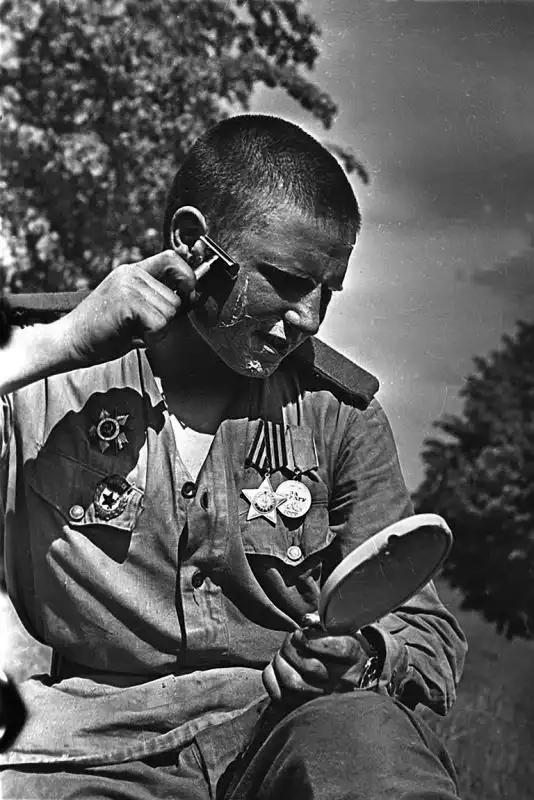
Guards Private Pavel Karpov of the Red Army shaves with an American Gillette razor supplied through Lend-Lease shortly before demobilization in Germany after the end of World War II in Europe.
A Soldier Preparing to Return Home:
This remarkable World War II photograph shows Guards Private Pavel Karpov of the Red Army shaving in Germany in June 1945 shortly before demobilization and return home after the defeat of Nazi Germany.
The war in Europe had ended only weeks earlier.
For millions of Soviet soldiers, the nightmare of the Eastern Front was finally over.
Unlike dramatic combat photographs, this image captures something far more intimate:
a tired veteran preparing to leave war behind and become an ordinary man again.
The End of the War in Europe:
By June 1945, Battle of Berlin and the collapse of Nazi Germany were already history.
Germany had surrendered on May 8, 1945.
For Soviet troops stationed inside defeated Germany, life slowly began changing from combat operations to occupation duty, processing prisoners, restoring order, and preparing for demobilization.
Millions of soldiers dreamed about only one thing:
going home.
Pavel Karpov:
The man in the photograph is identified as Pavel Karpov.
He wears several important Soviet military decorations:
- Guards Badge
- Medal “For Courage”
- Order of the Red Star
- Order of the Patriotic War 2nd Class
These awards indicate that Karpov was not a rear-area serviceman, but an experienced frontline soldier who had survived heavy combat.
The Meaning of the Soviet Guards Badge:
The Soviet Guards insignia carried enormous prestige inside the Red Army.
Units awarded “Guards” status had distinguished themselves in battle through:
- Exceptional bravery
- Combat effectiveness
- Heavy sacrifice
Serving in a Guards formation became a major source of pride among Soviet troops.
The Medal “For Courage”:
Among Soviet soldiers, the Medal For Courage was one of the most respected awards.
Unlike some decorations awarded for seniority or command achievements, the Medal “For Courage” was strongly associated with personal battlefield bravery.
Frontline soldiers valued it extremely highly.
An American Razor in Soviet Hands:
One fascinating detail in the image is the safety razor used by Karpov.
It was a Gillette razor supplied to the Soviet Union through the Lend-Lease program.
Lend-Lease is often remembered for:
- Tanks
- Aircraft
- Trucks
- Food supplies
But the program also delivered countless everyday items:
- Boots
- Soap
- Medicine
- Tools
- Razors and hygiene supplies
Such items greatly improved daily life for Allied soldiers.
Life After Years of War:
The simple act of shaving carried symbolic meaning.
After years spent:
- in trenches
- forests
- ruins
- frozen front lines
many soldiers wanted to restore some sense of normal life and personal dignity before returning home.
For Soviet veterans, the transition back to civilian life was emotionally complex.
Many had:
- lost relatives
- lost homes
- survived terrible battles
- spent years away from peaceful life
The Soviet Soldier’s Long Road:
By 1945 Red Army veterans had fought through:
- Moscow
- Stalingrad
- Kursk
- Belarus
- Poland
- Germany
Many soldiers had been continuously at war for three or four years.
The psychological exhaustion was immense.
This photograph quietly reflects that exhaustion far better than many combat images.
Demobilization After Victory:
Following the German surrender, the Soviet Union began gradually demobilizing millions of servicemen.
Priority often went to:
- Older soldiers
- Skilled workers needed in industry
- Men wounded multiple times
- Long-serving veterans
But the process took time, and many soldiers remained in Europe months or even years after victory.
A Human Moment After Catastrophe:
The image stands out because it shows not combat, but humanity.
No explosions.
No propaganda pose.
No dramatic battlefield scene.
Just a veteran carefully shaving before returning home after surviving one of the deadliest wars in human history.
Historical Photograph Information:
Location: Germany
Date: June 1945
Photographer: Unknown
Recommended Books About Soviet Soldiers in World War II:
1. Ivan’s War — Catherine Merridale
Excellent study of the everyday life of Soviet soldiers.
2. The Red Army at War — Artem Drabkin
Firsthand interviews with Soviet veterans.
3. When Titans Clashed — David Glantz & Jonathan House
Comprehensive operational history of the Eastern Front.
4. The Unwomanly Face of War — Svetlana Alexievich
Powerful oral histories from Soviet participants in the war.