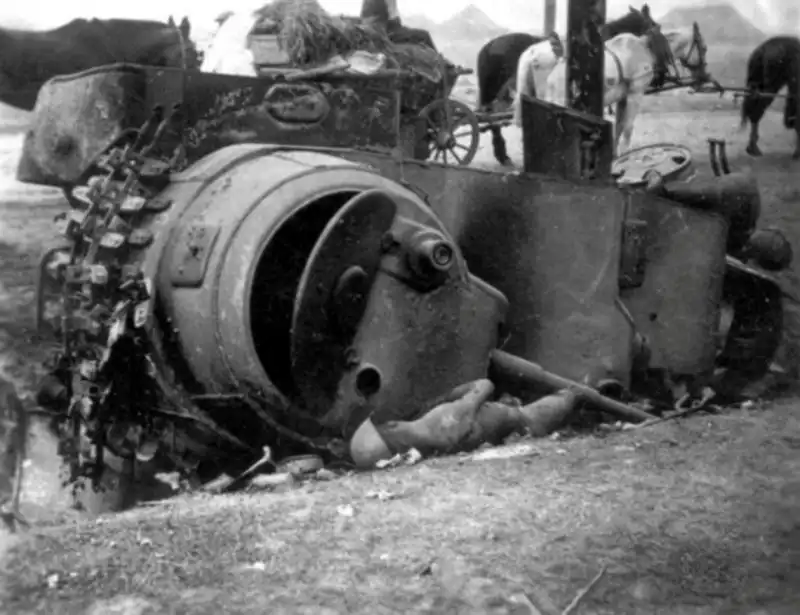
Destroyed Soviet BA-10 armored car with the burned remains of a Red Army crewman during the brutal fighting on the Eastern Front in 1941.
A Roadside Grave of the Eastern Front:
This horrifying World War II photograph shows a destroyed Soviet BA-10 armored car overturned in a ditch beside the burned remains of a Red Army crewman during 1941.
In the background, a German horse-drawn supply column calmly moves forward — a chilling contrast to the violent destruction in the foreground.
The image captures the merciless reality of the first year of the war between Nazi Germany and the Soviet Union.
Operation Barbarossa and the Soviet Disaster of 1941:
The photograph belongs to the opening phase of Operation Barbarossa, when German forces smashed deep into Soviet territory during the summer and autumn of 1941.
The Red Army suffered catastrophic losses:
- Entire mechanized corps destroyed
- Hundreds of thousands killed or captured
- Massive equipment losses
- Constant retreats under pressure
Roads across the Soviet Union became littered with abandoned or destroyed vehicles exactly like this one.
The Soviet Armored Car – BA-10:
The wrecked vehicle is a BA-10, one of the most important Soviet heavy armored cars of the late 1930s and early war period.
Built on a modified truck chassis, the BA-10 combined:
- Mobility on roads
- Machine guns
- A 45 mm cannon
- Reconnaissance capability
For its time, the BA-10 possessed relatively strong firepower for an armored car.
The Strengths and Weaknesses of the BA-10:
The BA-10 performed well in several roles:
- Reconnaissance
- Infantry support
- Road patrols
- Security operations
However, it also suffered from major limitations:
- Thin armor
- Poor off-road mobility
- Vulnerability to artillery and anti-tank fire
- Dependence on roads and firm terrain
During the chaos of 1941, many Soviet armored cars became trapped, abandoned, or destroyed while retreating.
The Burned Crewman:
The most disturbing detail in the image is the charred body of the Soviet crew member lying beside the wreck.
Armored vehicle crews during World War II often faced horrifying deaths when vehicles caught fire.
Fuel, ammunition, and confined interiors turned damaged vehicles into deadly traps.
In many cases:
- Crews burned alive
- Escape hatches jammed
- Exploding ammunition killed survivors attempting escape
Photographs like this reveal the human cost hidden behind battlefield statistics.
German Horse-Drawn Logistics:
One striking detail is visible in the background:
a German horse-drawn wagon column.
Despite the image many people have of a fully mechanized Wehrmacht, the German army still relied heavily on horses throughout the war.
In 1941 Germany used:
- Hundreds of thousands of horses
- Horse-drawn artillery
- Wagon-based logistics systems
The Eastern Front depended as much on animal transport as on tanks and trucks.
The Contrast Between Movement and Death:
The composition of the photograph is deeply symbolic.
In the foreground:
- destruction
- burned metal
- death
In the background:
- movement
- supply transport
- the continuation of the offensive
The war simply moved forward, leaving destroyed men and machines behind on the roadsides of the Soviet Union.
The Violence of the Eastern Front:
The German-Soviet war rapidly became one of the most brutal military conflicts in history.
The Eastern Front was characterized by:
- Massive casualties
- Extreme violence
- Destruction on an industrial scale
- Little mercy for combatants
Scenes like this occurred daily across thousands of kilometers of front line.
Soviet Armored Forces in 1941:
The Red Army possessed enormous numbers of armored vehicles at the start of the war, but many suffered from:
- Mechanical problems
- Poor maintenance
- Inadequate communications
- Lack of fuel and spare parts
- Tactical confusion
As German advances accelerated, Soviet crews were often forced into desperate fighting or chaotic retreats.
A Silent Battlefield Memorial:
Today, photographs like this serve as historical evidence of the terrible human cost of mechanized warfare.
The burned BA-10 and its fallen crewman became one more forgotten battlefield grave among millions created during World War II.
Historical Photograph Information:
Location: USSR
Date: 1941
Photographer: Unknown
Recommended Books About the Eastern Front:
1. Absolute War — Chris Bellamy
Comprehensive history of the Soviet-German war.
2. Barbarossa — Alan Clark
Classic account of the German invasion of the USSR.
3. Ivan’s War — Catherine Merridale
Focuses on ordinary Soviet soldiers and battlefield experiences.
4. When Titans Clashed — David Glantz & Jonathan House
Detailed operational history of the Eastern Front.