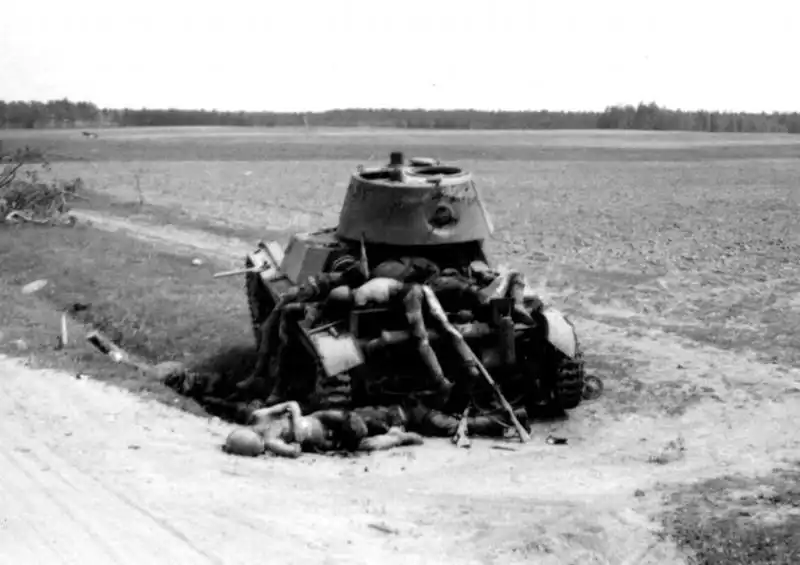
Destroyed Soviet XT-133 flamethrower tank and fallen Red Army soldiers during the catastrophic fighting of summer 1941 on the Eastern Front.
The Catastrophe of Summer 1941
This grim World War II photograph shows a destroyed Soviet XT-133 flamethrower tank surrounded by the bodies of fallen Red Army soldiers during the summer of 1941.
The image reflects the brutal reality of the opening months of the German invasion of the Soviet Union — a period marked by chaos, encirclements, massive casualties, and catastrophic Soviet losses.
Operation Barbarossa and the Collapse of the Front
On 22 June 1941, Nazi Germany launched Operation Barbarossa, the largest military invasion in human history.
The Wehrmacht attacked along an enormous front stretching from the Baltic Sea to the Black Sea.
During the first months of the campaign:
- Entire Soviet armies were encircled
- Thousands of tanks were destroyed
- Millions of soldiers became casualties or prisoners
- Front lines collapsed at terrifying speed
Photographs like this became tragically common across the Soviet Union during the summer of 1941.
The Flamethrower Tank – XT-133
The vehicle in the photograph is a Soviet XT-133, a flamethrower modification based on the famous T-26 light tank chassis.
The XT-133 was designed for:
- Assaulting fortified positions
- Clearing trenches
- Attacking bunkers
- Psychological warfare against enemy infantry
Instead of a standard main gun configuration, the vehicle carried flamethrower equipment capable of projecting burning fuel over significant distances.
Flamethrower Tanks on the Eastern Front
Flamethrower tanks were terrifying weapons.
Their use created intense fear because burning fuel attacks could:
- Ignite fortifications
- Force defenders from cover
- Cause devastating burns
- Spread panic among infantry
However, flamethrower tanks also had serious weaknesses:
- Limited fuel supply
- Thin armor
- High vulnerability to anti-tank fire
- Dangerous fuel storage
When hit in combat, such vehicles could become catastrophic fire traps for their crews.
The Vulnerability of the T-26 Chassis
By 1941, the T-26 platform was already outdated compared to newer German armored vehicles and anti-tank weapons.
Although reliable and widely produced during the 1930s, the tank suffered from:
- Thin armor protection
- Low mobility
- Weak survivability against modern anti-tank guns
During the first months of the invasion, enormous numbers of T-26-based vehicles were destroyed or abandoned.
Fallen Red Army Soldiers
Perhaps the most haunting aspect of the image is the presence of fallen Soviet soldiers surrounding the destroyed tank.
The photograph captures the brutal reality of Eastern Front warfare:
- Close-range combat
- Massive casualties
- Chaotic retreats
- Entire units destroyed in place
Unlike carefully staged propaganda images, photographs like this reveal the true violence of the campaign.
The Eastern Front Was a War of Extermination
The war between Nazi Germany and the Soviet Union quickly became one of the most brutal conflicts in human history.
The Eastern Front was characterized by:
- Enormous civilian casualties
- Mass executions
- Destruction of entire cities
- Starvation
- Ideological hatred
- Extreme battlefield violence
The summer of 1941 marked only the beginning of this catastrophe.
Why Summer 1941 Was So Devastating for the USSR
Several factors contributed to Soviet disasters during the opening phase of the war:
- Strategic surprise
- Poor communications
- Incomplete mobilization
- Luftwaffe air superiority
- Rapid German armored breakthroughs
- Organizational chaos
Despite fierce resistance in many areas, Soviet forces often found themselves overwhelmed.
Soviet Resistance Was Fiercer Than German Command Expected
Although the Red Army suffered catastrophic losses, German commanders quickly realized that Soviet resistance was far stronger than anticipated.
Even isolated Soviet units frequently continued fighting under hopeless conditions.
Vehicles like the XT-133 were often committed into desperate defensive battles as the front collapsed around them.
A Brutal Symbol of the Eastern Front
This photograph represents more than a destroyed tank.
It symbolizes:
- The disaster of 1941
- The human cost of mechanized warfare
- The desperation of the Red Army
- The unimaginable scale of the Eastern Front
Thousands of similar scenes unfolded across the Soviet Union during those first terrible months of the war.
Historical Photograph Information
Location: USSR
Date: Summer 1941
Photographer: Unknown
Recommended Books About the Eastern Front
1. Barbarossa — Alan Clark
Classic study of the German invasion of the Soviet Union.
2. When Titans Clashed — David Glantz & Jonathan House
Excellent operational history of the Eastern Front.
3. Ivan’s War — Catherine Merridale
Focuses on the experiences of ordinary Soviet soldiers.
4. Absolute War — Chris Bellamy
Comprehensive history of the Soviet-German war.