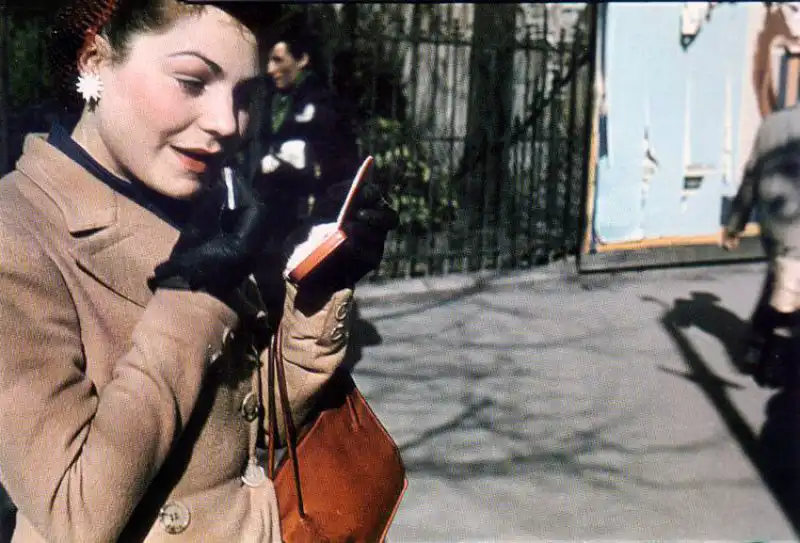
Rare color WWII photograph showing a young woman applying lipstick beside the Seine River in occupied Paris during 1943.
Beauty and Everyday Life in Occupied Paris
This unusual color photograph from World War II captures a young Parisian woman applying lipstick on the embankment of the Seine River during the German occupation of Paris in 1943.
At first glance, the image almost does not look like a wartime photograph at all.
There are no ruins, no soldiers, no explosions — only a quiet and intimate moment of ordinary civilian life.
That contrast is exactly what makes the photograph historically fascinating.
Paris Under Occupation
By 1943, Paris had lived under German occupation for three years.
The French capital existed in a strange reality where:
- German troops filled the streets
- Curfews restricted movement
- Food was rationed
- Fuel shortages affected daily life
- Political repression remained constant
Yet despite all this, ordinary people continued trying to preserve fragments of normal existence.
Fashion Survived the War
Even during occupation, Paris remained deeply connected to fashion and personal appearance.
Women continued to:
- Wear elegant clothes
- Style their hair
- Use cosmetics
- Visit cafés and parks
For many civilians, maintaining personal dignity and appearance became a psychological form of resistance against the grimness of wartime life.
The Seine River
The photograph was taken near the famous Seine River, one of the defining landmarks of Paris.
The riverbanks remained central to everyday Parisian life during the occupation, serving as places for:
- Walks
- Social meetings
- Quiet moments of escape
- Everyday routines
Even during wartime, the Seine continued flowing through a city trying to appear normal.
The Psychological Need for Normality
Historians often note that civilians living under occupation gradually adapted to abnormal conditions.
People still needed:
- Romance
- Leisure
- Beauty
- Routine
- Emotional stability
Small everyday acts — like applying lipstick or walking beside the river — helped preserve a sense of humanity during uncertain times.
Occupied Paris Was Different From the Eastern Front
Photographs like this frequently surprise modern viewers because they differ dramatically from images taken in:
- Stalingrad
- Warsaw
- Kiev
- Leningrad
Nazi Germany treated Paris differently from many occupied territories in Eastern Europe.
The city was viewed as:
- A prestigious European capital
- A cultural symbol
- A propaganda showcase
Because of this, much of Paris remained visually intact during the occupation.
The Complexity of Life Under Occupation
This image should not be mistaken for evidence that occupation was harmless.
Behind scenes of cafés, fashion, and sunny streets existed:
- Deportations
- Executions
- Collaboration
- Resistance activity
- Hunger and shortages
The apparent calmness of occupied Paris often concealed deep political and human tragedy.
Rare WWII Color Photography – Agfacolor
The vivid tones in this image were likely captured using Agfacolor film technology.
Color photography during World War II remained rare because:
- Film stock was expensive
- Processing was difficult
- Most wartime reporting used black-and-white film
As a result, surviving color photographs from the period provide especially powerful historical insight.
The Photographer – André Zucca
The photograph was taken by André Zucca, whose work became some of the most recognizable visual records of occupied Paris.
Zucca’s photographs remain controversial because they often depict:
- Stylish civilians
- Busy streets
- Leisure activities
- Everyday urban life
rather than the darker realities of occupation.
Yet precisely because of this, historians consider the images extremely valuable today.
A Moment of Peace During Wartime
What makes this photograph memorable is its quiet intimacy.
The young woman appears completely absorbed in a simple personal moment, while somewhere beyond the frame:
- Armies fought across Europe
- Bombers crossed the skies
- Millions of people suffered through war
That contrast between private life and global catastrophe gives the image extraordinary emotional power.
Historical Photograph Information
Location: Paris, France
Date: 1943
Photographer: André Zucca
Recommended Books About Occupied Paris
1. When Paris Went Dark — Ronald Rosbottom
One of the best books about daily life during the occupation.
2. France Under the Germans — Julian Jackson
Detailed historical study of occupied France.
3. Paris After the Liberation — Antony Beevor & Artemis Cooper
Explores Paris during and after the occupation.
4. Seven Ages of Paris — Alistair Horne
Excellent historical overview of the city and its transformations.