Rare color WWII photograph showing German female military auxiliaries near the Tomb of the Unknown Soldier under the Arc de Triomphe in occupied Paris, 1943.
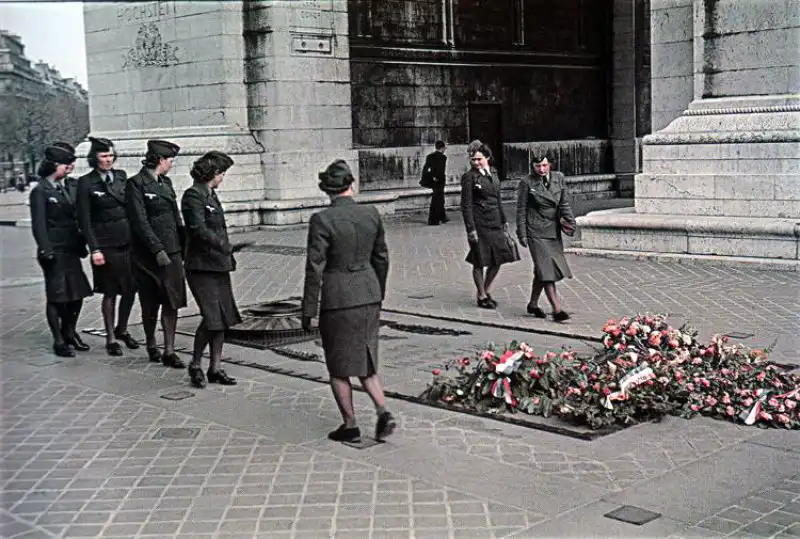
German Servicewomen in the Heart of Occupied Paris:
This rare color photograph from World War II shows German female military personnel standing near the Tomb of the Unknown Soldier beneath the Arc de Triomphe in occupied Paris during 1943.
The image is striking not because of combat or destruction, but because of its symbolism.
German military personnel stand confidently at one of the most important national monuments of France — a powerful visual representation of Nazi Germany’s domination over occupied Paris.
The Arc de Triomphe – Arc de Triomphe:
The women are photographed near the famous Arc de Triomphe, one of the most recognizable monuments in France.
Commissioned by Napoleon Bonaparte in the early 19th century, the monument became a symbol of:
- French national pride
- Military sacrifice
- Victory and remembrance
Underneath the arch lies the Tomb of the Unknown Soldier, dedicated to unidentified French soldiers killed during World War I.
The Tomb of the Unknown Soldier:
The eternal flame beneath the Arc de Triomphe was one of the most sacred national memorials in France.
Seeing uniformed German personnel at this location carried enormous symbolic weight during the occupation.
For many Parisians, images like this represented:
- National humiliation
- Foreign domination
- The collapse of France in 1940
At the same time, daily life in occupied Paris continued around such scenes.
German Female Military Auxiliaries:
The women in the photograph belonged to German military auxiliary communications units.
During World War II, Nazi Germany increasingly relied on women for non-combat military roles, including:
- Communications
- Administration
- Air defense support
- Clerical work
- Logistics
These auxiliaries freed male personnel for frontline service.
The "Blitz Brooch":
An interesting detail visible in the photograph is the so-called "Blitz brooch" worn on the women’s neckties.
This decorative insignia became associated with female communications personnel and auxiliary branches within the German military system.
Uniform details like these are valuable for historians because they help identify:
- Service branches
- Roles
- Rank categories
- Specialized wartime units
Occupied Paris as a Symbolic Showcase:
Nazi Germany treated Paris differently from many occupied cities in Eastern Europe.
The German leadership viewed Paris as:
- A prestigious European capital
- A propaganda showcase
- A cultural trophy
Because of this, the occupation often appeared outwardly calmer than the catastrophic destruction seen in places such as:
- Warsaw
- Stalingrad
- Minsk
- Kiev
However, beneath the surface, France still experienced:
- Repression
- Deportations
- Political persecution
- Resistance activity
- Food shortages
Color Photography and Wartime Propaganda – Agfacolor:
Like many famous photographs by André Zucca, this image was likely taken using Agfacolor film.
Color images from World War II remain rare because:
- Film stock was expensive
- Processing was difficult
- Most wartime photography remained black and white
That rarity makes these photographs especially valuable historical documents.
The Photographer – André Zucca:
The photograph was taken by André Zucca, one of the most famous photographers of occupied Paris.
His work became controversial after the war because many of his images depicted Paris as relatively calm and functional during the occupation.
Today historians value the photographs precisely because they document everyday life and the visual atmosphere of occupied France in extraordinary color detail.
Paris Between Occupation and Routine:
One of the most unsettling aspects of occupied Paris was how normal many scenes could appear.
Tourists, soldiers, shoppers, lovers, cafés, and military personnel often shared the same streets.
This strange coexistence between occupation and ordinary urban life gives photographs like this their lasting emotional power.
A Photograph Filled With Symbolism:
Every element in this image carries symbolic meaning:
- German uniforms in Paris
- French national monuments under occupation
- Female military auxiliaries far from the front
- Wartime propaganda aesthetics
- Civilian life continuing around military presence
The photograph captures the political reality of Europe in 1943 more effectively than many battlefield scenes.
Historical Photograph Information:
Location: Paris, France
Date: 1943
Photographer: André Zucca
Recommended Books About Occupied Paris and Nazi Europe:
1. France Under the Germans — Julian Jackson
Excellent research on occupied France and collaboration.
2. When Paris Went Dark — Ronald Rosbottom
One of the best books about civilian life in occupied Paris.
3. The Fall of Paris — Alistair Horne
Detailed account of France’s collapse in 1940.
4. Paris After the Liberation — Antony Beevor & Artemis Cooper
Covers the final years of occupation and liberation.