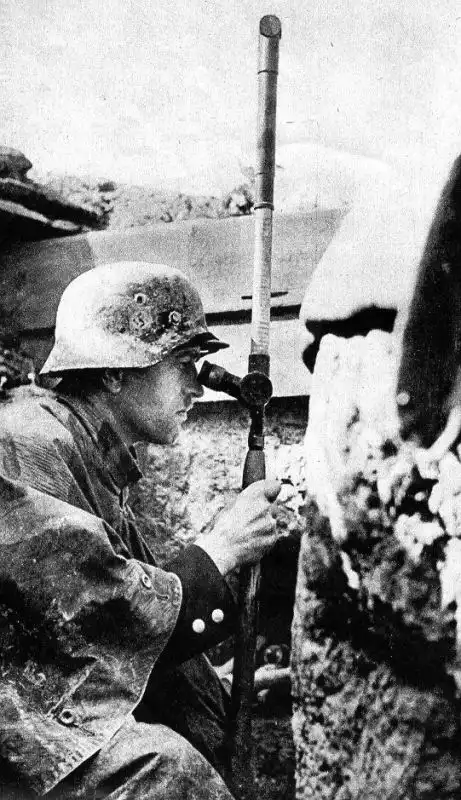
A German artillery observer uses a trench periscope near besieged Leningrad in 1942, carefully watching Soviet positions while avoiding sniper fire.
Watching a City Under Siege:
This striking wartime photograph shows a German artillery observer serving with the Polizei Division during the Siege of Leningrad in 1942.
Dressed in a camouflage smock and wearing a standard M40 steel helmet, the soldier carefully observes Soviet positions from the safety of a frontline trench. Rather than exposing his head above the parapet, he uses a trench periscope, reducing the risk of becoming a target for Soviet snipers.
The image captures a routine but essential aspect of modern warfare: observation. Behind every artillery strike stood soldiers whose task was to locate targets, monitor enemy movements, and direct fire onto the battlefield.
The Importance of Frontline Observers:
Artillery was one of the most powerful weapons of the Second World War, but guns were only as effective as the information they received.
Forward observers operated dangerously close to enemy positions. Their responsibilities included:
- Identifying targets.
- Reporting troop movements.
- Correcting artillery fire.
- Monitoring the effects of bombardments.
- Coordinating attacks and defensive operations.
Because of their importance, observers became priority targets for enemy snipers and artillery crews.
The use of periscopes, observation slits, and concealed positions helped increase their chances of survival.
The Siege of Leningrad:
The photograph was taken during the siege of Leningrad, one of the longest and most devastating urban sieges in military history.
German and Finnish forces gradually isolated the city in 1941, cutting most land communications with the rest of the Soviet Union. What followed was a prolonged struggle lasting nearly 900 days.
The siege became a battle not only between armies but also against starvation, disease, cold, and exhaustion. Food shortages reached catastrophic levels during the winter of 1941–1942, causing enormous civilian suffering.
Despite repeated bombardments and desperate conditions, the city continued to resist.
The Polizei Division on the Eastern Front:
The soldier in this photograph belonged to the Polizei Division, a formation that originated from German police units before being integrated into the Waffen-SS military structure.
The division participated in numerous operations on the Eastern Front and fought in the Leningrad sector during some of the most difficult periods of the campaign.
Like many German units deployed around Leningrad, its soldiers spent long periods in trench warfare, artillery duels, patrol actions, and observation duties rather than rapid offensive operations.
By 1942, the war around Leningrad had largely become a battle of endurance.
Life in the Trenches:
The photograph also illustrates the realities of static warfare on the Eastern Front.
When people imagine the German-Soviet War, they often picture massive tank battles and sweeping offensives. Yet soldiers frequently spent months living in trenches, dugouts, and fortified positions.
Observers, machine gunners, infantrymen, and artillery crews endured:
- Extreme weather conditions.
- Constant artillery fire.
- Sniper activity.
- Poor living conditions.
- Psychological strain from prolonged combat.
Even a simple task such as looking toward enemy positions could become a life-threatening activity.
A View Across the Front Line:
The observer shown here was looking toward a city that had become one of the central symbols of Soviet resistance.
From his perspective, Leningrad was a military objective under siege.
For the people inside the city, however, the front line represented a daily struggle for survival.
That contrast gives the photograph much of its historical significance. It captures not merely a soldier performing his duty but a moment within one of the greatest human tragedies of the Second World War.
A War of Patience and Survival:
Unlike photographs of attacks or dramatic combat, this image reveals the quieter side of warfare.
There are no explosions, no advancing troops, and no visible casualties. Instead, it shows a patient observer scanning the horizon through a periscope while remaining hidden from enemy marksmen.
Yet behind this seemingly calm scene stood one of the deadliest sieges in modern history, where artillery observers, infantrymen, civilians, and defenders alike became participants in a struggle that would last for years.
The photograph serves as a reminder that wars are often decided not only by great offensives but also by countless hours of observation, endurance, and survival.
Recommended Reading:
- The 900 Days
- Leningrad
- The Siege of Leningrad 1941–1944
- Barbarossa
- Russia at War
- Ivan's War
Photo details:
📍 Location: Leningrad region, USSR
📅 Date: 1942
📷 Photographer: Unknown