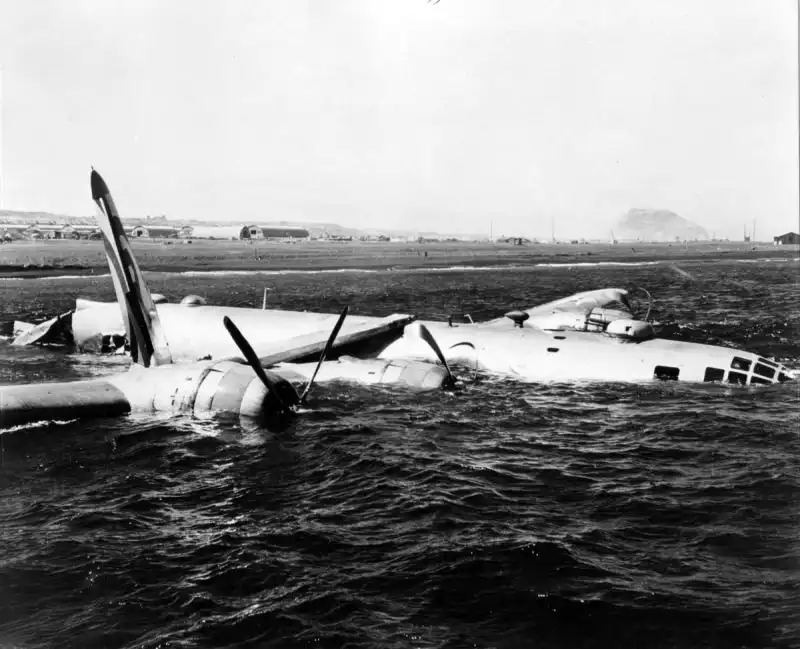
A damaged B-29 Superfortress lies wrecked in the waters off Iwo Jima after returning from a bombing mission against Japan in 1945.
A Bomber That Almost Made It Home:
This dramatic photograph captures the wreckage of an American Boeing B-29 Superfortress lying in the waters off Iwo Jima in 1945.
The aircraft had successfully completed a bombing mission against Japan and was attempting to return to base when disaster struck. The bomber crashed into the ocean near the island's shoreline, its entire tail section missing. In the distance rises Mount Suribachi, the volcanic peak that became one of the most recognizable landmarks of the Pacific War.
The image is a powerful reminder that for many aircrews, surviving enemy defenses was only part of the journey. The flight home could be just as dangerous.
The B-29 Superfortress:
The Boeing B-29 was one of the most advanced aircraft of the Second World War.
Designed for long-range strategic bombing, it featured:
- Pressurized crew compartments.
- Remote-controlled defensive gun turrets.
- Powerful Wright R-3350 engines.
- Long operational range.
- Heavy bomb-carrying capacity.
The aircraft allowed the United States to strike targets deep inside the Japanese Home Islands from bases in the Mariana Islands.
However, the B-29 was also a technically complex machine. Mechanical failures, engine fires, battle damage, and difficult weather conditions frequently endangered crews even when enemy fighters were absent.
Why Iwo Jima Mattered:
The capture of Iwo Jima in early 1945 remains one of the most controversial and costly operations of the Pacific War.
Located roughly halfway between the Mariana Islands and Japan, the island possessed airfields that could be used by American fighters and emergency landing aircraft.
Before the island was captured, a heavily damaged B-29 often had little chance of reaching safety after a mission over Japan.
After American forces secured Iwo Jima, the situation changed dramatically.
Thousands of damaged bombers eventually used the island's airfields for emergency landings. Many historians argue that the capture of Iwo Jima saved the lives of thousands of American airmen who otherwise might have been forced to ditch in the Pacific Ocean.
Missing Tail, Missing Chances:
The most striking detail visible in the photograph is the complete absence of the aircraft's tail assembly.
Several factors could cause such catastrophic damage:
- Mid-air structural failure.
- Severe battle damage from anti-aircraft fire.
- Collision with another aircraft.
- Loss of control during an emergency landing attempt.
- Crash impact forces that tore away the rear fuselage.
Without detailed records, the exact cause remains unknown. What is clear is that the crew managed to bring the crippled aircraft close enough to Iwo Jima that rescue became possible.
For many B-29 crews, reaching sight of the island was considered the final major hurdle on the journey home.
Mount Suribachi in the Background:
Visible on the horizon is Mount Suribachi, the extinct volcanic cone that dominates the southern end of Iwo Jima.
The mountain became world famous after American Marines raised the U.S. flag on its summit during the battle in February 1945.
That iconic image became one of the most recognized photographs of the Second World War.
By the time this B-29 crashed near the island, Suribachi had already become a symbol of the fierce fighting that secured Iwo Jima for American forces.
The Hidden Cost of Strategic Bombing:
Photographs of B-29 operations often focus on bombing raids, massive formations, and burning targets.
Yet every mission involved tremendous risks.
American crews faced:
- Japanese anti-aircraft artillery.
- Fighter interception.
- Mechanical failures.
- Long overwater flights.
- Fuel shortages.
- Navigation difficulties.
- Weather hazards.
Even after surviving combat over Japan, airmen could still lose their aircraft during the long return flight across the Pacific.
This photograph illustrates that reality perfectly.
A Wreck Beneath Suribachi:
The image combines two important stories of the Pacific War into a single frame.
In the foreground lies a destroyed B-29, a symbol of the strategic air campaign against Japan.
In the distance stands Mount Suribachi, a symbol of one of the bloodiest amphibious assaults fought by American forces.
Together they remind us that victory in the Pacific required enormous sacrifices both in the air and on the ground. For countless crews returning from bombing missions, the sight of Iwo Jima meant hope, survival, and the possibility of making it home.
For this particular Superfortress, however, the journey ended in the waters beneath the island's most famous landmark.
Recommended Reading:
- Iwo Jima
- The Rising Sun
- B-29 Superfortress Units of World War 2
- Hell from the Heavens
- Twilight of the Gods
- Retribution
Photo details:
📍 Location: Iwo Jima, Japan
📅 Date: 1945
📷 Photographer: Unknown