Damaged B-29 Superfortress "Gravel Gertie" after a crash landing on Iwo Jima following a bombing mission against the Japanese city of Saga on Kyushu, August 1945.
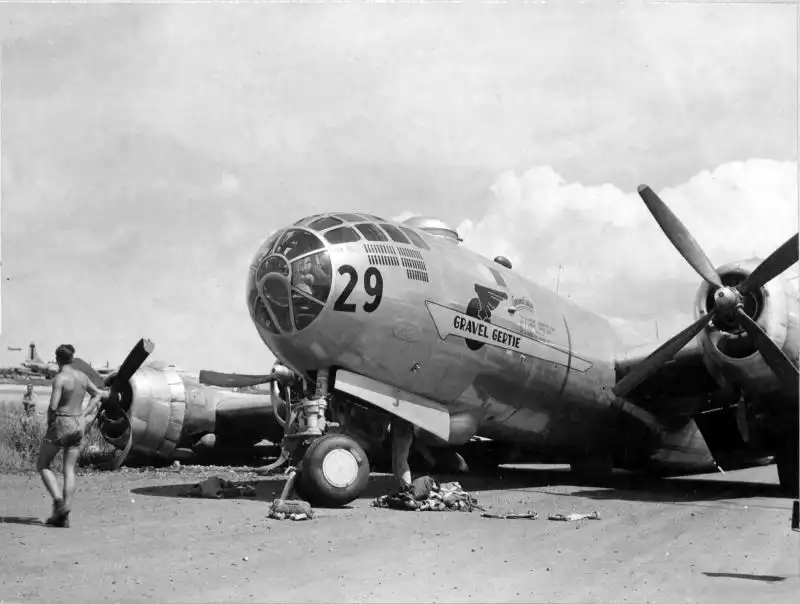
Damaged B-29 Superfortress "Gravel Gertie" After Crash Landing on Iwo Jima
This photograph shows the American Boeing B-29 Superfortress Gravel Gertie after a crash landing on Iwo Jima on 6 August 1945. Returning from a bombing mission against the Japanese city of Saga on Kyushu, the aircraft suffered a landing gear failure while touching down. Although the crew survived, the bomber was damaged beyond economical repair, bringing its operational career to an end.
What Was the B-29 Superfortress?
The Boeing B-29 Superfortress was the most advanced heavy bomber fielded by the United States during the Second World War. It featured pressurized crew compartments, remotely operated defensive gun turrets, advanced fire-control systems, and four powerful Wright R-3350 radial engines.
Designed for long-range operations across the Pacific, the B-29 enabled American forces to strike strategic targets deep inside the Japanese Home Islands from bases in the Mariana Islands.
By the summer of 1945, hundreds of B-29s were conducting almost daily raids against:
- industrial centers;
- airfields;
- transportation networks;
- ports;
- urban areas.
Why Iwo Jima Was Vital
Following its capture in early 1945, Iwo Jima became one of the most important emergency airfields in the Pacific. Situated roughly halfway between the Mariana Islands and Japan, it served as a refuge for damaged or fuel-starved bombers returning from combat missions.
Thousands of B-29 crews owed their lives to the island's airfields. Aircraft suffering from battle damage, engine trouble, fuel shortages, or mechanical failures could often reach Iwo Jima when returning to the Marianas was impossible.
Gravel Gertie became one of many Superfortresses that ended their final flight on the island.
The Mission Against Saga
On 6 August 1945, the bomber participated in a raid against the Japanese city of Saga on the island of Kyushu. During the final weeks of the Pacific War, American strategic bombing focused on transportation infrastructure, industrial facilities, military targets, and urban centers throughout Japan.
According to available information, the mission itself achieved little success. The aircraft survived enemy defenses but was ultimately lost because of a landing accident rather than combat damage.
Mechanical failures remained a significant problem throughout the B-29's service life. Despite its advanced design, the aircraft frequently experienced difficulties with its engines, hydraulic equipment, and landing gear.
The Name "Gravel Gertie"
Like many American bombers, the aircraft carried a personal nickname selected by its crew. Gravel Gertie was named after a character from Chester Gould's popular Dick Tracy comic strip.
Such names, often accompanied by nose art, reflected American bomber culture. Crews personalized their aircraft with references to comic characters, Hollywood actresses, wives, girlfriends, or humorous expressions, giving otherwise identical machines unique identities.
The Last Weeks of the Pacific War
The photograph was taken on 6 August 1945, during the closing days of the Second World War in the Pacific. American strategic bombing had devastated much of Japan's industrial capacity, while Allied naval forces controlled the surrounding seas.
Only days later, the Soviet Union entered the war against Japan, and within weeks the Japanese government accepted unconditional surrender.
This image therefore captures not only a damaged bomber but also one of the final operational episodes of the Pacific air campaign.
Historical Significance
Photographs such as this illustrate that many wartime aircraft were lost not only in aerial combat but also through accidents caused by mechanical failures or difficult landings after exhausting combat missions.
Gravel Gertie also highlights the strategic importance of Iwo Jima, whose emergency airfields saved thousands of American airmen during the final months of the Pacific War. Today the image remains an important visual record of the operational challenges faced by B-29 crews during the last phase of the conflict.
Historical Photograph Information
Location: Iwo Jima, Volcano Islands
Date: 6 August 1945
Photographer: Unknown
Recommended Reading
1. B-29 Superfortress Units of World War 2 — Robert F. Dorr
A comprehensive history of B-29 combat operations, aircraft, and crews during the Pacific War.
2. Mission to Tokyo — Robert F. Dorr
An excellent account of the strategic bombing campaign against Japan and the men who flew the Superfortress.
3. Iwo Jima — Richard F. Newcomb
A detailed history of the battle for Iwo Jima and the island's later role as an emergency airfield for B-29 bombers.
4. Twilight of the Gods: War in the Western Pacific, 1944–1945 — Ian W. Toll
A comprehensive study of the final campaigns of the Pacific War, including strategic bombing operations.
5. The Rising Sun — John Toland
A classic history of Japan during the Second World War from both Japanese and Allied perspectives.
6. Pacific Crucible — Ian W. Toll
An acclaimed history of the Pacific War that provides valuable background on the development of American naval and air power.