Portrait of Guards Lieutenant Nikolai Borozdnov, commander of a T-34 platoon that was among the first Soviet units to enter the occupied city of Orel during the summer of 1943.
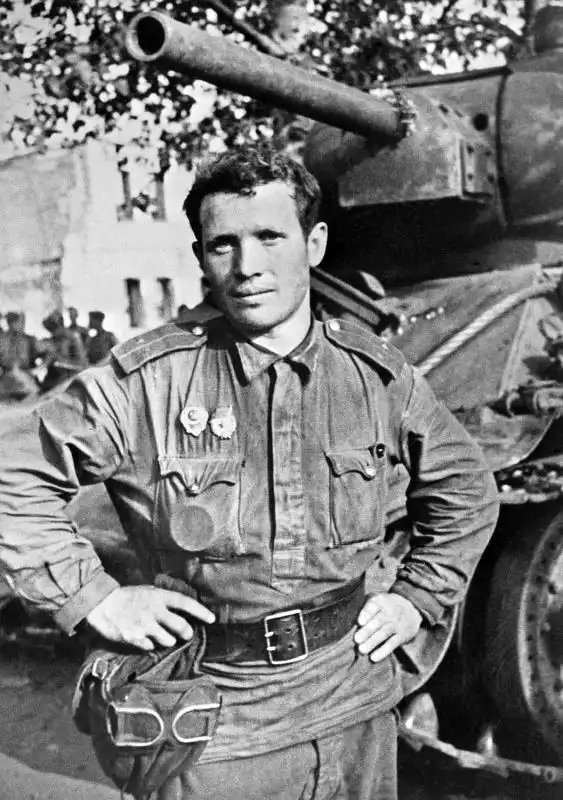
Guards Lieutenant Nikolai Borozdnov and His T-34 During the Liberation of Orel
This remarkable wartime portrait shows Guards Lieutenant Nikolai Pavlovich Borozdnov (1916–1944), platoon commander of the 347th Tank Battalion, 17th Guards Tank Brigade, standing beside his T-34 medium tank. During the Soviet summer offensive of 1943, Borozdnov's platoon became one of the first armored units to enter the occupied city of Orel, an important victory that followed the Battle of Kursk and marked another step in the Red Army's westward advance.
The portrait captures an experienced Soviet tank officer at a pivotal moment in the war, when the strategic initiative on the Eastern Front had permanently shifted to the Red Army.
Short Description
A portrait of Guards Lieutenant Nikolai Pavlovich Borozdnov, commander of a T-34 platoon that helped liberate Orel during the Soviet summer offensive of 1943 following the Battle of Kursk.
Alt text: Guards Lieutenant Nikolai Pavlovich Borozdnov stands beside his T-34 medium tank during the Soviet offensive near Orel in 1943.
The Road to Orel
After the failure of the German offensive during the Battle of Kursk in July 1943, the Red Army immediately launched Operation Kutuzov, a major offensive designed to eliminate the German-held Orel salient.
Orel occupied a strategically important position on the central sector of the Eastern Front. Capturing the city would shorten Soviet front lines, force the Wehrmacht into another withdrawal, and further weaken Germany's ability to conduct offensive operations in the region.
Tank formations played a decisive role throughout the offensive. Once infantry broke through German defensive lines, armored units advanced rapidly into the enemy rear, disrupting communications, cutting off retreat routes, and liberating occupied towns and cities.
Borozdnov's platoon was among the leading Soviet formations that entered Orel, securing his place in the historical record of the campaign.
Operation Kutuzov
Launched on 12 July 1943, Operation Kutuzov represented one of the Red Army's largest offensive operations of the war. While German forces were still heavily engaged around Kursk, Soviet armies attacked the Orel salient from several directions.
The offensive forced the Wehrmacht onto the defensive and eventually resulted in the liberation of Orel on 5 August 1943. The same day, Moscow celebrated the victory with the first wartime artillery salute of the Great Patriotic War, marking an important psychological and military milestone.
The liberation of Orel demonstrated that the Red Army had evolved into a force capable not only of defending its territory but also of conducting large-scale offensive operations with increasing effectiveness.
An Interesting Uniform Detail
The portrait contains several details that attract the attention of military historians.
Although Borozdnov held the rank of Guards Lieutenant, one of the stars normally worn on his shoulder boards appears to be missing. Under peacetime regulations such an irregularity would have violated uniform standards. Frontline service, however, often made such matters insignificant compared with the realities of combat.
His tunic also appears to be an older-pattern gymnastiorka manufactured before shoulder boards were reintroduced into the Red Army in January 1943.
Following the restoration of traditional shoulder boards, many officers simply modified existing uniforms rather than waiting for new issues. Wartime supply systems could not immediately replace millions of garments already in service, resulting in a mixture of old and new uniform styles throughout 1943 and 1944.
The T-34 Behind the Officer
Standing behind Borozdnov is the legendary Soviet T-34 medium tank, widely regarded as one of the most influential armored vehicles of the Second World War.
Its combination of:
- sloped armor protection;
- a powerful 76.2-mm main gun;
- wide tracks suitable for poor terrain;
- mechanical simplicity;
- efficient mass production.
made the T-34 the backbone of Soviet armored forces throughout much of the war.
By 1943, improvements in crew training, battlefield tactics, and industrial production allowed Soviet tank units to conduct increasingly complex offensive operations, transforming them into one of the Red Army's most effective weapons.
A Soldier Who Did Not Survive the War
The portrait radiates confidence, yet it also reminds us of the heavy losses suffered by Soviet armored units.
Nikolai Pavlovich Borozdnov was killed in action in 1944, less than a year after helping liberate Orel and only months before the Red Army entered Eastern Europe in force. Like countless Soviet officers who survived the desperate defensive campaigns of 1941 and 1942, he ultimately fell during the long offensive that carried Soviet forces toward Germany.
His story reflects the fate of many experienced tank commanders whose leadership contributed significantly to the Soviet advance but who did not live to witness the final victory in May 1945.
Historical Significance
Portraits such as this personalize the immense scale of the Eastern Front. Rather than depicting anonymous armies, they preserve the faces of the officers and soldiers whose decisions and courage shaped the outcome of individual battles.
Borozdnov represents a generation of Soviet tank commanders forged during the brutal fighting of the early war years and matured into effective battlefield leaders during the great offensives of 1943 and 1944.
His image remains an enduring reminder of the men who carried the Red Army from the defensive battles around Moscow and Stalingrad to the liberation of occupied Soviet territory.
Historical Photograph Information
Location: Orel Region, USSR
Date: Summer 1943
Photographer: Unknown
Source of Information
pobeda.tassphoto.com
Recommended Reading
1. The Battle of Kursk — David Glantz & Jonathan House
A comprehensive study of the Battle of Kursk, Operation Kutuzov, and the liberation of Orel.
2. When Titans Clashed — David Glantz & Jonathan House
One of the finest single-volume histories of the German-Soviet War, including the evolution of Soviet armored forces.
3. T-34: The Red Army's Legendary Medium Tank — Anthony Tucker-Jones
An illustrated history of the Soviet Union's most famous tank, covering its development, combat service, and wartime production.
4. Red Army Tank Commander — Vasiliy Bryukhov
Memoirs describing everyday life, combat experience, and leadership inside Soviet armored units.
Meta Description: Portrait of Guards Lieutenant Nikolai Pavlovich Borozdnov, commander of a T-34 platoon that helped liberate Orel during Operation Kutuzov in the summer of 1943 following the Battle of Kursk.