A German Wehrmacht comedy troupe performs a humorous stage act in women's clothing and makeup for Gebirgsjäger (mountain troops) stationed in Lapland during the war against the Soviet Union in 1943.
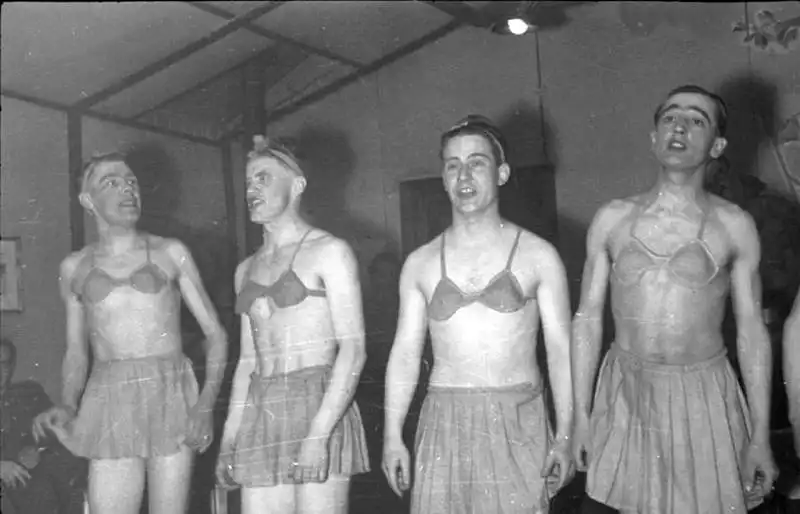
German Wehrmacht Soldiers Perform a Comedy Show for Mountain Troops in Lapland, 1943
This unusual World War II photograph shows German Wehrmacht soldiers entertaining their comrades with a theatrical comedy performance in Lapland during 1943. Wearing women's clothing, wigs, and theatrical makeup, the performers staged a humorous revue for German mountain troops (Gebirgsjäger) serving in the remote Arctic theater of the war against the Soviet Union.
The photograph was taken by the 680th Propaganda Company, one of the German military units responsible for documenting both combat operations and everyday military life. Rather than depicting battle, the image offers a rare glimpse into the recreational activities organized for soldiers stationed in one of the harshest environments of the Second World War.
Life on the Arctic Front
The northern front differed greatly from the better-known battlefields of the Eastern Front. German forces operating in Lapland and northern Finland spent long periods in isolated camps surrounded by forests, mountains, marshes, and tundra. Large-scale offensives were relatively rare compared with central Russia, but harsh weather, difficult terrain, and logistical challenges made daily life demanding.
Months could pass with little direct combat. Soldiers spent much of their time constructing defensive positions, maintaining equipment, patrolling remote areas, and coping with the severe Arctic climate. During the winter, temperatures frequently fell well below freezing, while the polar night reduced daylight to only a few hours or eliminated it altogether.
In such conditions, organized entertainment became an important way to relieve boredom and improve morale.
Military Entertainment During World War II
Concerts, theatrical productions, music performances, and comedy sketches were common in nearly every major army that participated in the Second World War. Both frontline units and rear-area formations organized performances whenever circumstances allowed.
Because women rarely served near frontline combat formations, male soldiers frequently played female roles in theatrical productions. Dressing in women's clothing was a longstanding tradition in military theater rather than an unusual occurrence. Such performances were intended purely for comic effect and reflected practical necessity rather than social commentary.
Similar productions were staged by German, Soviet, British, American, and many other armed forces throughout the war.
The Gebirgsjäger in Lapland
The audience in the photograph appears to consist largely of German Gebirgsjäger, the Wehrmacht's specialized mountain troops. These formations received extensive training for operations in mountainous terrain, forests, and Arctic conditions.
German mountain divisions played a central role in operations across northern Finland and Lapland, where they fought alongside Finnish forces against the Soviet Union. Their responsibilities included:
- holding remote defensive positions;
- patrolling wilderness regions;
- protecting supply routes;
- conducting reconnaissance missions;
- supporting offensive operations in difficult terrain.
Unlike soldiers serving in densely populated areas, many Gebirgsjäger spent months separated from civilian life, making organized recreation especially valuable.
The Role of the Wehrmacht Propaganda Companies
The image was produced by the 680th Propaganda Company (Propagandakompanie), one of several specialized units assigned to document military operations for newspapers, magazines, newsreels, and official archives.
Although propaganda companies often photographed combat, they also recorded many aspects of everyday military life, including ceremonies, equipment, landscapes, interactions with civilians, sporting events, and theatrical performances such as the one shown here.
Today, these photographs provide historians with valuable evidence about the daily routines, living conditions, and social life of German soldiers serving far from the main battlefields.
Morale Far from Home
Military historians have long recognized that morale played a critical role in sustaining armies during prolonged campaigns. Entertainment could not eliminate the hardships of war, but it provided temporary relief from stress, homesickness, and isolation.
For soldiers stationed in the Arctic, opportunities to laugh together, attend performances, or participate in amateur theater helped strengthen unit cohesion during long deployments under difficult conditions.
This photograph captures one of those rare moments when the realities of military service briefly gave way to humor.
Historical Significance
Unlike photographs showing combat, destruction, or military hardware, this image documents an often-overlooked aspect of wartime experience: everyday life behind the front lines. It reminds us that soldiers remained ordinary people who sought companionship, laughter, and entertainment even while serving in one of history's most devastating conflicts.
Such photographs broaden our understanding of the Second World War by preserving moments that military reports and operational maps rarely record.
Historical Photograph Information
Location: Lapland, Northern Europe
Date: 1943
Photographer: Theobald (680th Propaganda Company)
Sources of Information
- Bild 101I-103-0934-38
- Bundesarchiv Digital Picture Archive
Recommended Reading
1. Hitler's Arctic War — Chris Mann & Christer Jörgensen
A detailed overview of German and Finnish operations in the Arctic theater during World War II.
2. The German Army in World War II — Nigel Thomas
An illustrated history covering the organization, equipment, and everyday life of Wehrmacht soldiers.
3. The Wehrmacht: History, Myth, Reality — Wolfram Wette
A scholarly examination of the German armed forces and their role during the Second World War.
4. Finland at War: The Continuation and Lapland Wars 1941–45 — Vesa Nenye, Peter Munter, Toni Wirtanen & Chris Birks