A German Wehrmacht motorcycle dispatch rider on a Zündapp KS 500 sidecar motorcycle talks with Bulgarian peasant women tending livestock in the countryside during the German military buildup in the Balkans, spring 1941.
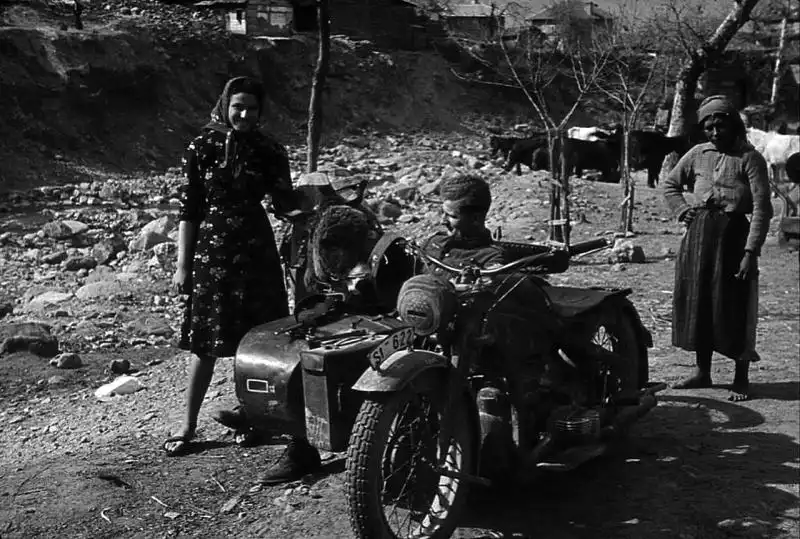
German Wehrmacht Dispatch Rider on a Zündapp KS 500 in Rural Bulgaria
This rare photograph from the spring of 1941 captures a German motorcycle dispatch rider speaking with local Bulgarian peasant women in the countryside. The women appear to be tending donkeys and other livestock while the soldier has stopped his motorcycle for a brief conversation, creating a peaceful scene far removed from the brutal battlefields that would soon engulf much of Europe.
Taken shortly before the German invasion of Yugoslavia and Greece, the image offers a glimpse into the everyday interactions between German military personnel and civilians during the concentration of Axis forces in the Balkans. Such encounters formed a lesser-known aspect of the campaign, contrasting sharply with the military operations that followed only weeks later.
The Zündapp KS 500 Motorcycle
The soldier is riding a German Zündapp KS 500, one of the Wehrmacht's most recognizable military motorcycles. Introduced in the late 1930s, the KS 500 was powered by a 494 cc two-cylinder boxer engine and became widely used for reconnaissance, communications, courier duties, and staff transport.
The motorcycle's sidecar greatly increased its versatility. It allowed the transport of an additional soldier, equipment, or radio gear while providing improved stability on rough roads. Although not intended for heavy combat, motorcycles like the KS 500 played a vital role in maintaining communications between advancing units.
Zündapp motorcycles served on nearly every front where German forces operated, from North Africa and the Balkans to the Soviet Union, where they became a familiar sight during the early years of the war.
Clues About the Unit
Several interesting details can be seen in the photograph. The license plate visible on the motorcycle bears the marking "St-622." The "St" registration code belonged to Styria, a region in southeastern Austria incorporated into Germany following the Anschluss of 1938.
The sidecar carries a tactical symbol associated with an infantry formation. At the same time, the rider's field cap appears to display the edelweiss insignia, traditionally worn by German mountain troops (Gebirgsjäger).
This combination creates an interesting historical puzzle. While the exact unit cannot be identified with certainty from the surviving photograph, it is possible that the rider served in an Austrian mountain formation or another unit that retained regional traditions after incorporation into the Wehrmacht. Several Austrian mountain divisions participated in operations throughout the Balkans during 1941.
Bulgaria and the German Military Buildup
Bulgaria formally joined the Axis on 1 March 1941 and permitted German forces to move across its territory. The country quickly became an important staging area for military operations against Yugoslavia and Greece.
Large columns of troops, vehicles, artillery, and supplies passed through Bulgarian towns and villages as Germany prepared for the Balkan Campaign. Although these movements were unmistakably military in nature, many surviving photographs also record ordinary conversations and moments of curiosity between soldiers and local civilians.
The photograph was taken during this transitional period, when the Balkans had not yet become an active battlefield but military preparations were rapidly accelerating.
Motorcycle Dispatch Riders in the Wehrmacht
Dispatch riders formed an essential part of German battlefield communications. Although radio technology was increasingly important, motorcycles remained indispensable because they could rapidly carry written orders, maps, reports, and urgent messages between headquarters and frontline units.
Their duties often included:
- delivering operational orders;
- maintaining communications between units;
- escorting officers;
- conducting reconnaissance;
- transporting small quantities of equipment or documents.
These missions frequently exposed dispatch riders to significant danger, especially during fast-moving campaigns where roads could quickly become contested.
Everyday Life Before the Fighting
One of the most remarkable aspects of this image is its calm atmosphere. There are no explosions, damaged vehicles, or visible signs of combat. Instead, the viewer sees an ordinary roadside conversation between people whose lives had been brought together by extraordinary historical events.
Within only a short time, German forces would launch simultaneous invasions of Yugoslavia and Greece, transforming the region into another active theater of the Second World War. The peaceful countryside visible in the photograph would soon witness the movement of large armies and the hardships associated with occupation and warfare.
Historical Significance
Unlike photographs taken during combat, this image documents the quieter side of military history. It illustrates how armies interacted with civilian populations while preparing for major operations and provides valuable evidence of German equipment, uniforms, and transport during the Balkan buildup of 1941.
The photograph also reminds us that history is shaped not only by battles and political decisions but also by countless brief encounters between ordinary people living through extraordinary times.
Historical Photograph Information
Location: Bulgaria
Date: Spring 1941
Photographer: Unknown
Recommended Reading
1. The German Campaign in the Balkans (Spring 1941) — U.S. Army Center of Military History
A detailed official study of Germany's invasion of Yugoslavia and Greece.
2. Hitler's Balkan Campaigns — Arnold Suppan
An examination of the political and military events surrounding the Axis advance into Southeastern Europe.
3. German Military Motorcycles of World War II — Frank V. de Sisto
A well-illustrated reference covering the motorcycles used by the Wehrmacht, including the Zündapp KS 500.
4. The Balkan 1940–41 Campaigns — Pier Paolo Battistelli
An accessible overview of the operations in Yugoslavia and Greece and the forces involved.