A destroyed column of Soviet T-26 light tanks and fallen Red Army infantrymen lie along a snow-covered road after a German ambush during the Soviet counteroffensive in the Battle of Moscow in the winter of 1941.
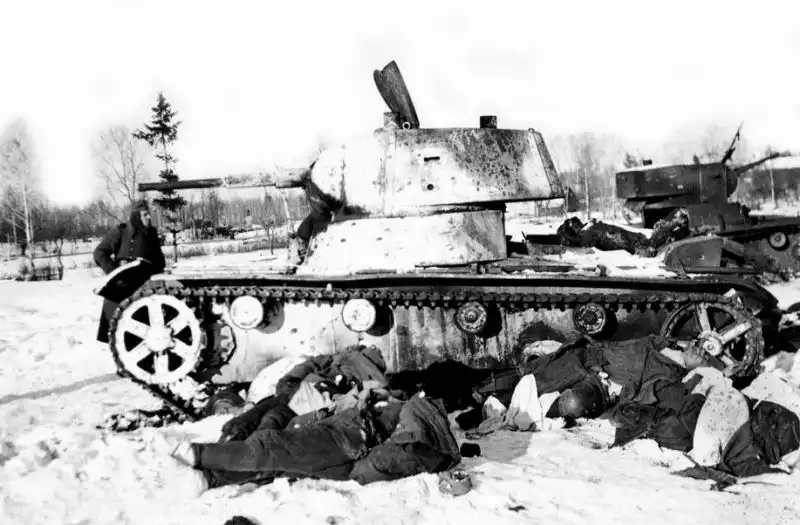
Soviet T-26 Tanks Destroyed in a German Ambush Near Moscow
This dramatic winter photograph captures the aftermath of a deadly clash during the Battle of Moscow. Along a snow-covered road lie several destroyed Soviet T-26 light tanks and the bodies of Red Army soldiers who were caught in a German ambush while advancing during the Soviet winter counteroffensive of 1941.
The image reflects the harsh reality of combat on the Eastern Front. Even as the Red Army began pushing German forces away from Moscow, every advance came at a terrible cost. Roads, villages, forests, and frozen fields became scenes of fierce fighting where victory was often measured in lives as much as territory.
The Battle of Moscow Turns
By late 1941, the German advance toward Moscow had begun to lose momentum. Months of continuous fighting, heavy casualties, logistical problems, and the arrival of winter severely weakened the attacking forces.
In December 1941, the Red Army launched a massive counteroffensive that surprised many German commanders. Fresh Soviet units, including divisions transferred from the Far East, attacked along a broad front and forced the Wehrmacht to abandon plans for the capture of the Soviet capital.
The fighting, however, remained extremely dangerous. German forces often established strong defensive positions and used ambush tactics against advancing Soviet troops.
The Soviet counteroffensive represented the first major strategic setback suffered by Germany during the Second World War. Although the offensive did not destroy Army Group Centre, it demonstrated that the Wehrmacht was not invincible and permanently altered the strategic balance on the Eastern Front.
The Role of the T-26 in 1941
The tanks visible in the photograph are Soviet T-26 light tanks, one of the most numerous armored vehicles in the Red Army at the beginning of the war.
Developed during the early 1930s, the T-26 had been a capable design for its time. Armed with a 45 mm gun, it could successfully engage most contemporary light armored vehicles and provide effective infantry support.
However, by 1941 the tank had serious shortcomings:
- thin armor vulnerable to anti-tank guns;
- relatively low speed;
- aging mechanical components;
- limited protection for the crew.
Despite these weaknesses, thousands of T-26s remained in frontline service because Soviet industry could not replace them quickly enough with newer designs such as the T-34 and KV series.
The Advance Guard's Dangerous Mission
According to the description accompanying the photograph, the fallen soldiers belonged to the advance guard of a Soviet formation.
Advance guards performed one of the most dangerous tasks on the battlefield. Their mission was to move ahead of the main force and identify enemy positions, obstacles, minefields, and potential ambushes.
This role offered little margin for error.
If the enemy was concealed nearby, the advance guard often absorbed the first and most devastating fire. In many cases, these soldiers and tank crews paid with their lives to reveal the location of hidden defenses and allow the main force to react.
Such losses, while tragic, frequently enabled following units to deploy, outflank enemy positions, or organize artillery support before suffering even greater casualties.
German Ambush Tactics on the Eastern Front
Throughout the winter fighting around Moscow, German troops frequently relied on defensive ambushes.
Anti-tank guns could be hidden among trees, behind buildings, or along road bends. Once Soviet vehicles entered the kill zone, concentrated fire could quickly disable the lead and rear vehicles, trapping the rest of the column.
In snowy conditions, visibility was often limited. Roads became predictable avenues of movement, making armored formations particularly vulnerable when advancing through forests or narrow corridors.
The destroyed T-26s in this photograph may represent the result of exactly such an encounter, although the precise circumstances cannot be confirmed from the surviving image alone.
Winter Warfare and Its Challenges
The Battle of Moscow was fought under some of the harshest conditions of the entire war.
Temperatures frequently dropped far below freezing. Engines struggled to start, lubricants thickened, weapons malfunctioned, and soldiers faced constant exposure to snow and ice.
For tank crews, winter brought additional difficulties:
- frozen fuel systems;
- reduced mobility off-road;
- mechanical breakdowns;
- poor visibility.
Yet both sides continued to launch attacks and counterattacks despite these conditions.
The snow visible in the photograph serves as a reminder that the men fighting here faced not only enemy fire, but also one of the most severe winters in modern military history.
A Scene Repeated Across the Front
Although this image captures a single battlefield incident, similar scenes occurred countless times during the winter of 1941–1942.
The Soviet counteroffensive succeeded in preventing the fall of Moscow and marked the first major strategic defeat suffered by Nazi Germany during the war. However, the victory was achieved through enormous sacrifice.
Thousands of Soviet soldiers and tank crews were killed in attacks against prepared German positions. Many never saw the eventual outcome of the campaign for which they fought.
Countless damaged vehicles remained abandoned in the snow until recovery units could reach them months later, while many fallen soldiers were buried only after the front had moved farther west.
Historical Significance
Photographs like this provide a powerful record of the brutal fighting that took place outside Moscow during one of the most important campaigns of the Second World War.
The wrecked T-26 tanks and fallen infantrymen illustrate both the weaknesses of early-war Soviet equipment and the determination of Red Army forces that continued to attack despite severe losses.
Their sacrifice contributed to a turning point that demonstrated Germany could be stopped and eventually defeated.
Today, such photographs remain valuable historical evidence, documenting not only military equipment but also the human cost of one of history's largest and bloodiest conflicts.
Historical Photograph Information
Location: Moscow Region, USSR
Date: Winter 1941
Photographer: Unknown
Recommended Reading
1. Moscow 1941: A City and Its People at War — Rodric Braithwaite
A detailed account of the defense of the Soviet capital and the experiences of civilians and soldiers.
2. Barbarossa Derailed — David Glantz
An in-depth examination of the German advance and Soviet resistance in 1941.
3. When Titans Clashed — David Glantz & Jonathan House
One of the best single-volume histories of the Eastern Front.
4. The Road to Stalingrad — John Erickson
A classic study of the Soviet war effort during the first critical years of the conflict.