A destroyed Soviet FAI-ZhD armored railcar lies beside a railway line during the summer of 1941, with members of its crew killed during the opening battles of the German invasion of the Soviet Union.
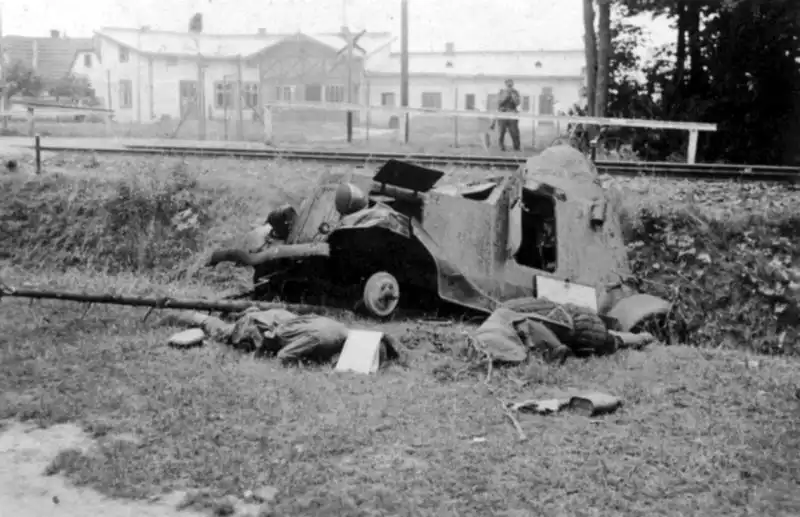
Soviet FAI-ZhD Armored Railcar Destroyed During the First Months of the War
This striking photograph from the summer of 1941 shows a destroyed Soviet FAI-ZhD armored railcar lying in a ditch beside a railway embankment somewhere in the western regions of the Soviet Union.
Near the wreck are the bodies of crew members who were killed during the fighting. In the background, a German soldier casually sits and eats a watermelon, creating a sharp contrast between the violence that has just occurred and the everyday routine of the advancing army.
The image is one of many visual records left behind by the rapid German advance during the opening phase of the war on the Eastern Front.
What Was the FAI-ZhD?
The FAI-ZhD was a railway version of the Soviet FAI armored car.
The designation stood for "Ford-A Izhorsky," reflecting its origins on the chassis of the Soviet-produced Ford-A automobile. The armored body was manufactured by the Izhora Works.
The railway modification was designed to operate alongside armored trains and perform:
- reconnaissance missions;
- railway patrol duties;
- communications tasks;
- protection of important rail infrastructure.
Although small and lightly armed, these vehicles gave armored train formations additional mobility and reconnaissance capability.
Why Are There No Rubber Tires?
One of the most noticeable details in the photograph is the absence of conventional rubber tires.
This is completely normal for the railway version.
To operate on rails, the vehicle used special metal railway wheel assemblies mounted over its standard wheels. These allowed the armored car to travel along railway tracks as a light armored draisine.
Such vehicles could move ahead of armored trains, scout damaged sections of track, and investigate suspicious activity along rail lines.
An Obsolete Vehicle by 1941
By the time Germany launched Operation Barbarossa in June 1941, the FAI family was already considered outdated.
The design dated back to the early 1930s and suffered from several limitations:
- thin armor;
- limited firepower;
- poor cross-country performance;
- aging mechanical components.
Many surviving vehicles had already accumulated years of service before the war began.
As newer armored cars entered service, older FAI variants were increasingly assigned to secondary duties, including railway security and support of armored train units.
The Open Engine Compartment
The photograph appears to show the engine compartment open.
While it is impossible to determine the exact circumstances from a single image, one plausible explanation is mechanical failure.
Many Soviet vehicles in 1941 suffered from:
- worn engines;
- shortages of spare parts;
- inadequate maintenance resources;
- damage caused by long operational marches.
If the vehicle became immobilized near the railway line, the crew may have attempted emergency repairs before being overtaken by German forces or attacked during combat.
Railways and the War of Movement
Railways played a crucial role during the first months of the German invasion.
Both armies depended heavily on rail transport for:
- fuel;
- ammunition;
- reinforcements;
- food supplies;
- evacuation of equipment.
Because of this, railway junctions and armored train units became important military targets.
Small reconnaissance vehicles such as the FAI-ZhD often found themselves operating close to rapidly changing front lines, where they were especially vulnerable to enemy fire and encirclement.
A Typical Scene of Blitzkrieg
The photograph captures a scene that became tragically common during the summer of 1941.
Destroyed vehicles, abandoned equipment, and fallen soldiers lined roads and railways across vast areas of the Soviet Union as German armored formations advanced eastward.
For many Soviet units, the fighting was marked by:
- chaotic withdrawals;
- disrupted communications;
- fuel shortages;
- repeated encirclements.
Thousands of soldiers were killed while attempting to slow the advance or protect critical transportation routes.
A Human Detail in the Background
Perhaps the most memorable aspect of the image is the German soldier eating a watermelon in the background.
The contrast is striking.
In the foreground lie the remains of a destroyed vehicle and its crew; behind them, an ordinary moment unfolds as if nothing unusual has happened.
Photographs like this remind us that war is often experienced differently by those on opposite sides of the battlefield. For one group, the fighting has ended forever. For another, it is simply another day on campaign.
Historical Significance
Although the FAI-ZhD was never produced in large numbers and played only a minor role compared to tanks and armored trains, photographs such as this preserve an important part of Soviet military history.
They document the lesser-known vehicles and soldiers who fought during the desperate opening months of the war and help illustrate the scale of the losses suffered by the Red Army in 1941.
Historical Photograph Information
Location: USSR
Date: Summer 1941
Photographer: Unknown
Recommended Reading
1. The Road to Stalingrad — John Erickson
A detailed examination of the Soviet Union's military struggles in 1941.
2. Barbarossa Derailed — David Glantz
An in-depth study of the opening phase of the German invasion.
3. Armored Trains of the Soviet Union — Wilfried Kopenhagen
A useful overview of Soviet armored train operations and supporting vehicles.
4. When Titans Clashed — David Glantz & Jonathan House
One of the most accessible and balanced histories of the Eastern Front.