A grim photograph from the summer of 1941 showing the bodies of Soviet soldiers lying unburied in a roadside ditch after the German advance into the Soviet Union.
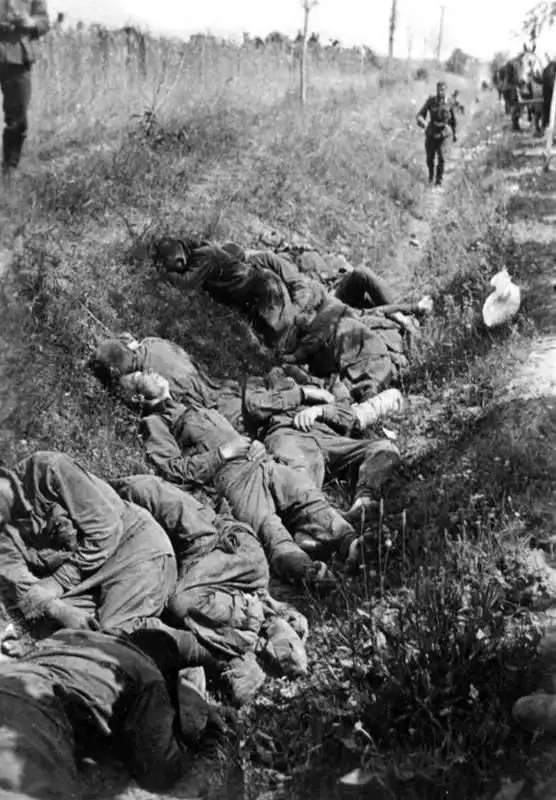
Fallen Soviet Soldiers Left Beside the Road During the German Invasion
This disturbing World War II photograph shows the bodies of Red Army soldiers lying in a roadside ditch somewhere in the Soviet Union during the summer of 1941.
According to the surviving description, the soldiers were found after German forces had passed through the area during the rapid advance of the opening months of the war. Several bodies appear to be missing belts, boots, and other leather equipment.
Perhaps the most unsettling detail is the presence of German soldiers posing for photographs beside the dead.
The image captures the brutal reality of the first months of the war on the Eastern Front, where death became an everyday part of the landscape.
The Chaos of Summer 1941
The summer of 1941 witnessed one of the greatest military disasters in modern history.
Following the launch of Operation Barbarossa on 22 June 1941, Soviet forces suffered a series of catastrophic defeats.
Entire armies were surrounded and destroyed in massive encirclement battles.
Thousands of Soviet soldiers were killed during:
- retreat operations;
- defensive actions;
- failed breakout attempts;
- roadside engagements;
- air attacks on marching columns.
In many areas, the speed of the German advance left little opportunity to recover or bury the dead.
Unburied Casualties of the Eastern Front
The scale of combat during 1941 overwhelmed both armies.
Battlefields, roads, forests, and fields often remained littered with the bodies of fallen soldiers long after fighting had moved elsewhere.
In some sectors:
- burial teams could not reach the area;
- local authorities had collapsed;
- civilians had fled;
- active combat continued nearby.
As a result, many soldiers remained unburied for weeks or even months.
The photograph preserves one such scene.
Missing Equipment
The description notes the absence of belts, boots, and other leather items.
During the war, equipment shortages affected every army on the Eastern Front.
Leather boots, belts, holsters, and straps were valuable military supplies. Such items could be removed by soldiers, civilians, scavengers, or recovery teams.
Without direct documentation, it is impossible to determine precisely who removed the equipment visible as missing in this photograph.
Photography and the German Soldier
Large numbers of German soldiers carried personal cameras during the early years of the war.
Many photographed:
- military victories;
- destroyed equipment;
- prisoners of war;
- occupied towns;
- battlefield scenes.
Images taken near the front often reflected the attitudes of the photographers and the atmosphere of the campaign.
Today, these photographs provide historians with important evidence about daily life, military operations, and the realities of occupation.
The Human Cost Behind Military Success
During the summer of 1941, German forces achieved remarkable operational victories.
Yet behind every advance lay enormous human losses.
For the Soviet Union, the opening months of the war resulted in:
- millions of military casualties;
- vast numbers of prisoners;
- destroyed cities and villages;
- civilian displacement on a massive scale.
The bodies visible in this ditch represent only a tiny fragment of that larger tragedy.
A Photograph Without a Battlefield
What makes this image particularly striking is the absence of combat.
The battle itself is over.
There are no tanks firing, no advancing infantry, and no visible explosions.
Instead, the viewer sees only the aftermath:
- abandoned bodies;
- discarded equipment;
- a roadside ditch transformed into a temporary grave.
The photograph reminds us that war is often defined not only by combat, but also by what remains once the fighting has passed.
Remembering the Fallen
Millions of Red Army soldiers died defending the Soviet Union during World War II.
Many never received individual graves or formal identification.
Photographs such as this serve as historical testimony to the sacrifices made during the desperate campaigns of 1941 and help preserve the memory of those whose names have been lost to history.
Historical Photograph Information
Location: USSR
Date: Summer 1941
Photographer: Unknown
Recommended Reading
1. Barbarossa: How Hitler Lost the War — Jonathan Dimbleby
A detailed study of the German invasion and its consequences.
2. Ivan's War — Catherine Merridale
An acclaimed account of the experiences of ordinary Soviet soldiers.
3. The Road to Stalingrad — John Erickson
A classic history of the Eastern Front's early campaigns.
4. Russia at War — Alexander Werth
A valuable contemporary perspective on the Soviet wartime experience.