A haunting photograph from occupied Karelia showing the bodies of Soviet prisoners of war who died from exhaustion and starvation in captivity during the winter of 1941–1942.
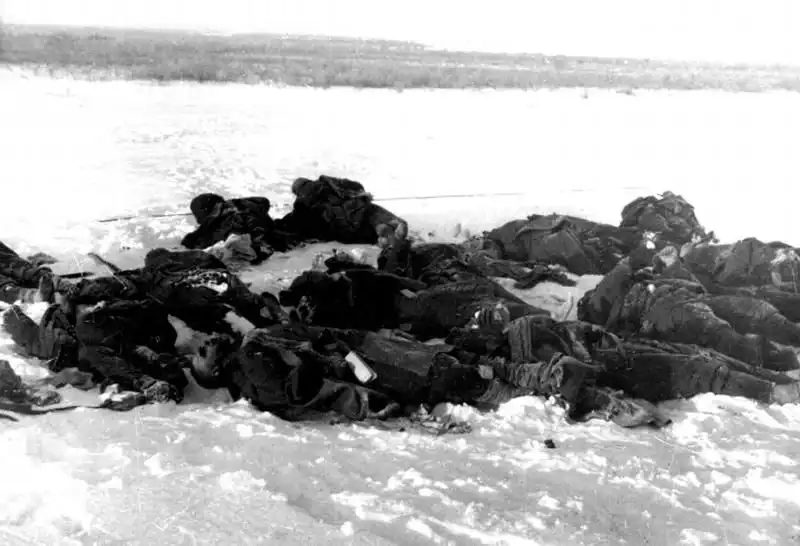
Soviet POWs Left Unburied on the Ice of a Frozen River
This disturbing World War II photograph depicts the bodies of Soviet prisoners of war lying on the ice of a frozen river in occupied Karelia during the spring of 1942.
According to the historical description accompanying the image, the dead were Red Army soldiers captured during the fighting of 1941. They reportedly perished from exhaustion, starvation, disease, and the harsh conditions that prevailed in prisoner-of-war camps during the first year of the war.
Several of the bodies appear to have been stripped of felt boots and items of winter clothing, leaving them exposed to the severe northern climate.
The image is one of the many grim reminders of the suffering endured by prisoners on the Eastern Front.
Captivity During the First Year of the War
The opening months of Operation Barbarossa produced enormous numbers of prisoners.
Entire Soviet formations were surrounded during major encirclement battles, resulting in hundreds of thousands of Red Army soldiers falling into enemy hands.
The logistical systems of the Axis powers were unprepared to accommodate such vast numbers of captives. Food shortages, inadequate shelter, poor sanitation, and exposure to extreme weather contributed to catastrophic mortality rates among prisoners during 1941 and 1942.
For many captured soldiers, survival became a daily struggle.
Winter Conditions in Karelia
The climate of Karelia is among the harshest in Europe.
Long winters, deep snow, frozen waterways, and sub-zero temperatures created severe challenges not only for military operations but also for prisoners and civilians.
Men weakened by:
- hunger;
- illness;
- physical exhaustion;
- inadequate clothing.
Were particularly vulnerable to the cold.
During the winter of 1941–1942, thousands of prisoners across the Eastern Front succumbed to the combined effects of malnutrition and exposure.
Prisoner-of-War Camps in the North
Northern prisoner camps often faced additional difficulties due to their remote locations.
Transport networks were limited, supplies were scarce, and medical facilities were frequently inadequate.
The result was a humanitarian crisis that affected large numbers of prisoners captured during the first stages of the war.
Historical records show that mortality among Soviet POWs during the early war years was exceptionally high compared with many other prisoner populations of the conflict.
The Significance of the Missing Winter Clothing
One striking detail visible in the photograph is the absence of boots and some items of warm clothing on several of the dead.
The exact circumstances are unknown.
Throughout the war, clothing shortages were widespread. Valuable winter garments could be removed for reuse by guards, civilians, laborers, or other prisoners. In many cases, documentation simply does not survive, making it impossible to determine precisely what happened after death.
The missing clothing serves as another reminder of the desperate conditions that existed in wartime northern Europe.
A Scene of Extreme Human Tragedy
Unlike battlefield photographs showing combat, this image captures the aftermath of suffering that occurred far from the front lines.
There are no weapons being fired and no visible battle.
Instead, the photograph records:
- death from deprivation;
- the consequences of captivity;
- the effects of winter;
- the vulnerability of prisoners cut off from assistance.
It is a stark illustration of how war kills not only through combat, but also through hunger, disease, and neglect.
Soviet Prisoners of War During World War II
The fate of Soviet POWs remains one of the major humanitarian tragedies of the Second World War.
Millions of Soviet soldiers were captured during the conflict. A large number died in captivity as a result of starvation, disease, exposure, forced labor, and inadequate living conditions.
Photographs such as this preserve evidence of those losses and help historians understand the broader human cost of the war beyond the battlefield itself.
Historical Photograph Information
Location: Karelia, USSR
Date: Spring 1942
Photographer: Unknown
Source Information
Source of information about the photograph: Albumwar2 Archive.
Recommended Reading
1. Ivan's War — Catherine Merridale
A powerful study of the experiences of Soviet soldiers during World War II.
2. Russia at War — Alexander Werth
A classic account of the Soviet wartime experience.
3. Barbarossa: How Hitler Lost the War — Jonathan Dimbleby
An extensive history of the German invasion of the Soviet Union.
4. The Eastern Front 1941–1945 — Chris Bellamy
A comprehensive examination of military operations and their human consequences.