A grim photograph from occupied Soviet Karelia showing local civilians forced to collect and transport the bodies of fallen Red Army soldiers for burial following the battles of 1941.
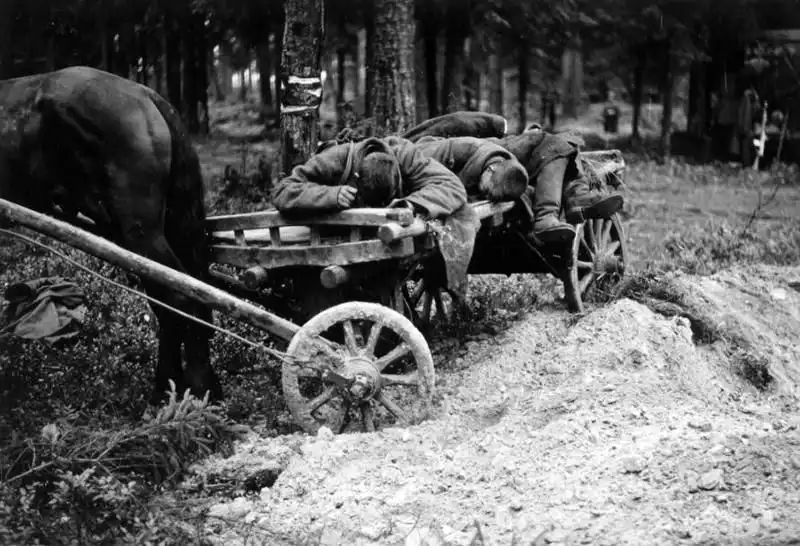
Forced Burial of Fallen Soviet Soldiers in Occupied Karelia
This somber World War II photograph captures a cart loaded with the bodies of fallen Red Army soldiers in occupied Soviet Karelia during August 1941.
According to the description accompanying the image, local peasants were compelled by German or Finnish occupation authorities to collect the dead from recent battlefields. The bodies were then transported for burial in mass graves within the forests of northwestern Soviet territory.
The photograph provides a stark reminder of the human cost of the opening months of the war on the Eastern Front.
The Battles of Karelia in 1941
Following the launch of Operation Barbarossa in June 1941, fighting quickly spread across vast areas of the Soviet Union.
In the north, Finnish forces advanced into parts of Karelia alongside broader Axis operations against the USSR. The region witnessed intense combat as Soviet troops attempted to slow the advance and defend strategic routes, settlements, and transportation networks.
The result was a landscape scattered with destroyed equipment, abandoned positions, and thousands of casualties.
The Burden Placed on Civilians
Military units often lacked the manpower and resources to recover all of the dead immediately after major battles.
As front lines moved, local civilians were frequently ordered to assist occupation authorities with difficult and unpleasant tasks, including:
- collecting bodies from battlefields;
- digging burial pits;
- transporting the dead;
- clearing roads and damaged infrastructure;
- recovering abandoned equipment.
For many rural communities, these duties became part of daily life during wartime occupation.
Mass Graves on the Eastern Front
The scale of combat in 1941 frequently made individual burials impossible.
Across the Eastern Front, soldiers from all armies were often buried in:
- temporary battlefield graves;
- roadside cemeteries;
- forest clearings;
- large communal burial sites.
Many graves were marked only by simple wooden crosses or improvised signs. Others remained unidentified for decades after the war.
Even today, search teams continue to recover and identify the remains of soldiers lost during the campaigns of 1941–1945.
Karelia's Forests and the War
The dense forests, swamps, and lakes of Karelia created unique challenges for military operations.
Movement was often restricted to narrow roads and forest tracks, making supply lines vulnerable and battlefield recovery operations difficult.
As a result, many casualties remained where they fell until civilians or military burial details could reach the area.
The forest visible in the photograph was typical of the terrain that dominated military operations throughout the region.
A Photograph of War's Aftermath
Unlike images showing active combat, this photograph depicts what remained after the fighting had ended.
The battle itself is absent from the frame. There are no explosions, no gunfire, and no movement.
Instead, the viewer sees the consequences:
- fallen soldiers;
- exhausted civilians;
- improvised transportation;
- the grim necessity of burial.
It is a powerful illustration of how war continues to affect people long after the shooting stops.
Remembering the Fallen
Millions of Soviet soldiers lost their lives during the Second World War.
Many died in the chaotic campaigns of 1941, when entire armies were encircled and destroyed during the rapid Axis advance.
Photographs such as this preserve the memory of those whose final resting places were often unknown and whose stories were never recorded.
Historical Photograph Information
Location: Karelia, USSR
Date: August 1941
Photographer: Unknown
Recommended Reading
1. Barbarossa: How Hitler Lost the War — Jonathan Dimbleby
A detailed account of the German invasion of the Soviet Union.
2. The Road to Stalingrad — John Erickson
A classic study of the Eastern Front's opening campaigns.
3. Russia at War — Alexander Werth
A valuable contemporary perspective on the Soviet wartime experience.
4. The Eastern Front 1941–1945 — Chris Bellamy
Comprehensive military history of the largest land conflict in history.