A horrifying 1941 photograph showing dead Soviet civilians and soldiers beside a destroyed convoy during the German invasion of the Soviet Union.
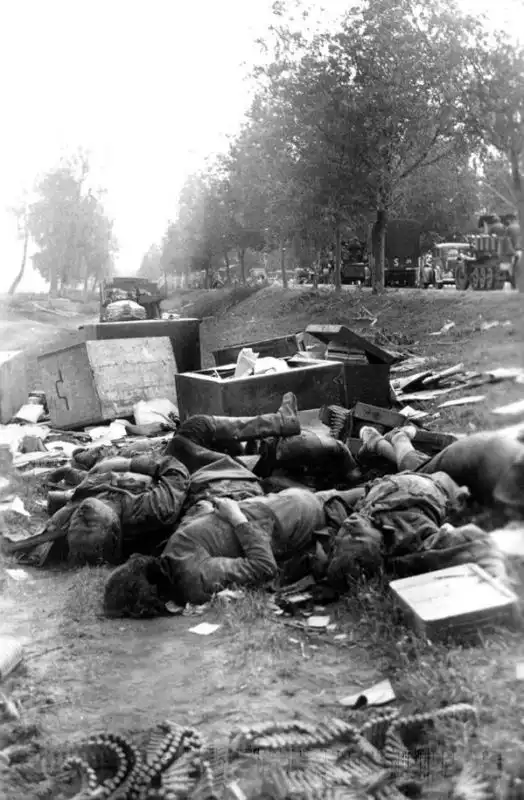
Civilians and Soldiers Killed During the German Advance Into the Soviet Union
This brutal World War II photograph captures the aftermath of a destroyed Soviet road convoy during the summer campaign of 1941.
Dead Soviet soldiers, civilians, women, and children lie beside a wrecked GAZ-AA truck after an attack carried out during the rapid advance of German forces into the Soviet Union.
Their bodies have been thrown into a roadside ditch while German mechanized columns continue moving eastward along the road almost as if nothing had happened.
The image is one of countless scenes of chaos, death, and destruction created during the opening months of Operation Barbarossa.
The Catastrophe of Summer 1941
When Nazi Germany invaded the Soviet Union on 22 June 1941, the scale of the attack shocked the world.
More than three million German and Axis troops crossed the Soviet border in the largest land invasion in human history.
During the first months of the campaign:
- entire Soviet armies were encircled
- thousands of vehicles were abandoned or destroyed
- roads became clogged with refugees
- civilians attempted to flee advancing German forces
Photographs like this reveal the human consequences of that military collapse.
Civilians Trapped Inside the War
One of the most disturbing details of the photograph is the presence of women and children among the dead.
In the summer of 1941, Soviet civilians often fled eastward together with retreating military units.
Roads were crowded with:
- refugee wagons
- trucks loaded with families
- wounded soldiers
- livestock
- military equipment
- retreating Red Army formations
German aircraft and mechanized units frequently attacked roads and transport columns suspected of carrying troops or supplies.
The distinction between civilian and military traffic often disappeared completely during the chaos of retreat.
The GAZ-AA Truck
Visible in the photograph is a destroyed Soviet GAZ-AA truck.
The GAZ-AA became one of the most important transport vehicles of the Soviet war effort.
Produced in huge numbers before and during the war, the truck served as:
- troop transport
- cargo carrier
- ambulance
- artillery tractor
- evacuation vehicle
Because of its simplicity and reliability, the GAZ-AA appeared on nearly every Soviet front.
Thousands were destroyed during the catastrophic retreats of 1941.
The Nature of the Eastern Front
The war between Nazi Germany and the Soviet Union quickly became one of the most brutal conflicts in modern history.
Unlike many campaigns in Western Europe, the fighting on the Eastern Front was marked by:
- mass executions
- destruction of civilian populations
- starvation
- ideological hatred
- enormous military casualties
Nazi ideology viewed the war in the East as a racial and colonial struggle rather than a conventional military campaign.
This mentality contributed directly to the extreme violence inflicted upon Soviet civilians.
Roads of Death During Barbarossa
Throughout the summer and autumn of 1941, Soviet roads became scenes of disaster.
Destroyed vehicles, dead horses, abandoned equipment, and civilian corpses often remained for days or weeks along major retreat routes.
German soldiers themselves frequently photographed such scenes.
For advancing Wehrmacht units, these images symbolized victory and Soviet collapse.
For modern viewers, they reveal the terrible human price paid during the opening phase of the war.
The Human Cost Behind the Statistics
The Eastern Front produced casualties on a scale difficult to comprehend.
Millions of Soviet civilians died during the war from:
- executions
- bombings
- starvation
- forced labor
- massacres
- disease
Photographs like this are important because they show individuals rather than statistics.
Behind every destroyed convoy were real families attempting to survive one of the deadliest invasions in history.
A Silent and Terrifying Image
There is almost no visible emotion in the photograph itself.
The German columns continue moving.
The bodies remain abandoned in the ditch.
The destruction appears routine.
That silence is precisely what makes the image so disturbing.
The scene reflects how quickly industrial war could reduce human lives to wreckage left beside the road.
Historical Photograph Information
Location: Soviet Union
Date: 1941
Photographer: Unknown
Recommended Books About the Eastern Front
1. Barbarossa: How Hitler Lost the War — Jonathan Dimbleby
Detailed history of the German invasion of the Soviet Union.
2. Ivan's War — Catherine Merridale
A powerful study of ordinary Soviet soldiers during World War II.
3. Russia at War — Alexander Werth
Classic eyewitness account of the Soviet experience during the war.
4. The Road to Stalingrad — John Erickson
Comprehensive analysis of the Eastern Front from 1941 onward.