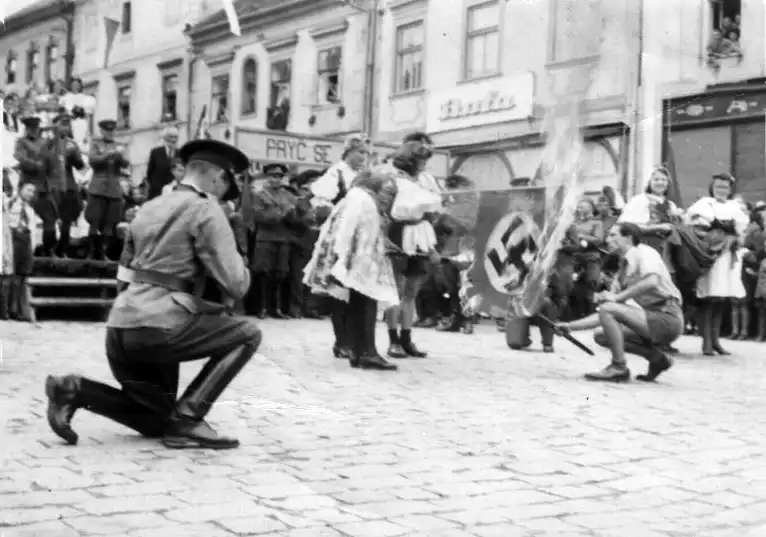
Residents of a liberated Czech town burn a Nazi flag before Red Army soldiers during celebrations marking the end of German occupation in the summer of 1945.
The Fall of Nazi Occupation in Czechoslovakia:
This emotional World War II photograph captures civilians in liberated Czechoslovakia burning a Nazi flag in a public ceremony after the collapse of German occupation in 1945.
The people gathered in the town square are dressed in traditional national clothing while soldiers and officers of the Red Army observe the event.
Above the administrative building already flies the restored national flag of Czechoslovakia — a powerful symbol that German rule had finally ended.
Liberation of Czechoslovakia:
By the spring and summer of 1945, Nazi Germany was collapsing on every front.
Soviet forces advanced deep into Central Europe during a series of offensives that liberated:
- Poland
- Hungary
- Austria
- Czechoslovakia
- eastern Germany
The liberation of Czechoslovakia came after years of German domination that began following the destruction of the Czech state in 1939.
Large parts of the country had been transformed into the German-controlled Protectorate of Bohemia and Moravia.
Public Destruction of Nazi Symbols:
The burning of Nazi flags became a common scene across liberated Europe during 1944–1945.
For civilians who had endured years of occupation, terror, censorship, and collaborationist rule, destroying Nazi symbols represented:
- revenge
- liberation
- national rebirth
- political defiance
- emotional release
Ceremonies like this were often spontaneous and deeply symbolic.
The public destruction of swastika banners demonstrated that German power had finally disappeared.
Traditional Clothing and National Identity:
One remarkable detail in the photograph is the presence of civilians wearing traditional Czech national costumes.
During wartime occupation, expressions of national identity were often suppressed or politically dangerous.
After liberation, public displays of:
- folk dress
- national flags
- patriotic songs
- cultural ceremonies
became powerful acts of restored independence.
The Role of the Red Army:
Soviet forces played a major role in the liberation of much of Czechoslovakia.
Heavy fighting occurred during the final months of the war as German forces attempted to hold defensive positions in Central Europe.
The arrival of Soviet troops often marked:
- the collapse of German authority
- the release of prisoners
- the return of local administrations
- the restoration of public political life
The Red Army suffered enormous casualties during operations in Eastern and Central Europe in 1945.
The Final Months of the War in Europe:
Even after Berlin fell, combat continued in several regions of Europe.
German formations in Czechoslovakia fought on into May 1945, and some attempted to retreat westward to surrender to American rather than Soviet forces.
The liberation of Czech cities and towns therefore occurred amid:
- continuing combat
- political uncertainty
- refugee movements
- collapsing German communications
Yet for ordinary civilians, liberation also brought moments of celebration like the one captured here.
Symbolism of the Town Square:
The public square shown in the image became a stage for political transformation.
Only a short time earlier, Nazi banners and occupation authorities had dominated such places.
Now the scene had completely changed:
- the swastika was being burned
- the Czech national flag was flying again
- German occupation had ended
- liberated civilians openly celebrated victory
The photograph preserves that dramatic reversal of power.
Occupation and Resistance:
German occupation of Czechoslovakia involved:
- political repression
- executions
- forced labor
- arrests of resistance members
- economic exploitation
Although armed resistance inside the Protectorate was more limited than in some occupied countries, underground networks and sabotage operations continued throughout the war.
The assassination of Reinhard Heydrich in 1942 became one of the most famous acts of resistance in occupied Europe.
A Rare Human Moment After Years of War:
Unlike battlefield photographs filled with destruction, this image captures a moment of public relief and emotional release.
There is anger in the burning flag — but also celebration, survival, and exhaustion after six years of war.
Historical Photograph Information:
Location: Czechoslovakia
Date: Summer 1945
Photographer: Unknown
Recommended Books About Liberation in Central Europe:
1. The End: The Defiance and Destruction of Hitler’s Germany — Ian Kershaw
Excellent account of the final collapse of Nazi Germany.
2. Prague in Black — Chad Bryant
History of Nazi occupation in the Czech lands.
3. Bloodlands — Timothy Snyder
Study of war and occupation in Eastern and Central Europe.
4. The Second World War — Antony Beevor
Comprehensive overview of the final campaigns in Europe.