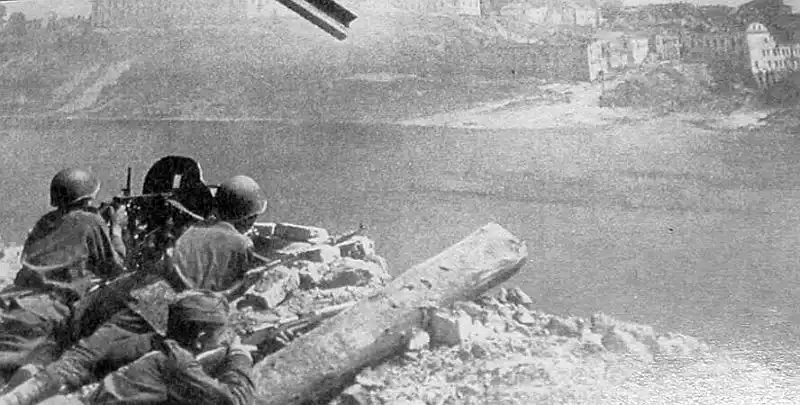
Soviet infantry entrenched along the Eastern bank of the Western Dvina River fires a Maxim machine gun toward German positions during the liberation of Vitebsk in June 1944.
Red Army Soldiers Fight for Vitebsk:
This powerful World War II photograph shows Soviet infantrymen firing a PM M1910 Maxim machine gun across the Western Dvina River during the liberation of Vitebsk from German occupation.
The soldiers are positioned in defensive earthworks on the riverbank while directing suppressive fire toward German-held positions on the opposite shore.
The image was taken during the Vitebsk–Orsha Offensive, one of the key phases of the massive Soviet summer offensive of 1944.
Operation Bagration:
The fighting around Vitebsk formed part of the gigantic Soviet offensive known as Operation Bagration.
Launched in June 1944, Operation Bagration became one of the most devastating defeats suffered by the Wehrmacht during World War II.
The Red Army attacked German Army Group Center across a broad front in Belarus, destroying entire German formations and liberating vast territories occupied since 1941.
The offensive involved:
- massive artillery bombardments
- coordinated infantry assaults
- armored breakthroughs
- air support
- partisan sabotage behind German lines
The Battle for Vitebsk:
Vitebsk was an important German stronghold in Belarus.
German commanders considered the city a key defensive position protecting approaches deeper into occupied territory.
During the Soviet offensive, Red Army forces surrounded large parts of the German garrison.
Heavy fighting erupted around:
- river crossings
- fortified villages
- trench systems
- bridges and roads
The liberation of Vitebsk became part of the rapid collapse of German defenses in Belarus during the summer of 1944.
Fighting Along the Western Dvina River:
The Western Dvina River represented a significant natural obstacle during military operations.
Rivers were often heavily defended because they restricted movement and exposed attacking troops to enemy fire.
Machine guns played a vital role during river combat by:
- suppressing enemy firing points
- protecting crossings
- covering infantry movement
- preventing counterattacks
The Maxim machine gun shown in the photograph was especially useful for sustained fire support during these engagements.
PM M1910 Maxim — An Old Weapon Still Fighting:
By 1944 the Maxim machine gun was already an old design, yet it remained widely used throughout the Soviet military.
Its water-cooled barrel allowed long periods of continuous fire without overheating.
Soviet soldiers valued the weapon because it:
- functioned reliably in mud and rain
- tolerated poor battlefield conditions
- delivered dense suppressive fire
- remained effective in defensive combat
Although heavy and difficult to transport, the Maxim continued serving on every major front of the war.
Soviet Infantry Tactics in 1944:
Unlike the chaotic retreats of 1941, Soviet infantry by 1944 operated with far greater experience and coordination.
Red Army units had developed effective combined-arms tactics integrating:
- artillery
- armor
- infantry
- aviation
- engineering units
Machine gun crews formed a crucial element of Soviet battlefield doctrine, especially during assaults on fortified German positions.
The Collapse of German Defenses in Belarus:
Operation Bagration shattered German military power in the central sector of the Eastern Front.
Entire German corps were:
- surrounded
- destroyed
- captured
- forced into retreat
The scale of the defeat rivaled the catastrophe suffered by Germany at Stalingrad.
For Soviet troops, the liberation of Belarus marked both a military victory and revenge for years of brutal occupation.
A Human Glimpse of Frontline Combat:
This photograph captures an intense but ordinary moment of war:
- soldiers crouched in trenches
- machine gun crews maintaining fire
- infantry fighting across a river barrier
There is no parade or staged propaganda here — only exhausted frontline troops doing dangerous work under combat conditions.
Liberation After Years of Occupation:
By June 1944 much of Belarus had suffered under German occupation for nearly three years.
Entire villages had been destroyed, while civilians endured:
- executions
- starvation
- deportations
- anti-partisan reprisals
The Soviet advance through Belarus therefore carried enormous political and emotional significance.
Operation Bagration and the Road to Victory:
The liberation of Vitebsk was one of the first major successes of Operation Bagration, which changed the strategic situation on the Eastern Front.
After the destruction of German Army Group Center, Soviet forces continued advancing westward toward Poland and Germany.
The offensive demonstrated the transformation of the Red Army from the forces that had suffered catastrophic defeats in 1941 into a highly experienced military organization capable of conducting large-scale operations.
The soldiers operating the Maxim machine gun on the banks of the Western Dvina River were part of this enormous military effort.
The Importance of the Maxim Machine Gun in River Warfare:
River crossings were among the most dangerous operations of World War II.
Attackers were often exposed while moving through open terrain, making suppressive weapons essential.
Heavy machine guns such as the PM M1910 Maxim provided continuous fire that allowed infantry units to:
- pin down enemy positions
- support advancing troops
- protect bridgeheads
- repel German counterattacks
Although newer automatic weapons were entering service, the reliability and endurance of the Maxim ensured that it remained an important battlefield weapon until the end of the war.
A Photograph of Soviet Combat Experience:
This image represents more than a single firefight along a river.
It reflects the enormous changes that had taken place in the Soviet military between 1941 and 1944.
The exhausted soldiers, the earthworks, and the heavy machine gun all illustrate the reality of frontline warfare — where victory depended on discipline, endurance, and the ability of ordinary soldiers to continue fighting under extreme conditions.
The Western Dvina River became one of many obstacles crossed by the Red Army during its advance toward Berlin.
Historical Photograph Information:
Location: Vitebsk, Belarus, USSR
Date: June 26, 1944
Photographer: Unknown
Source Information:
Source of information about the photograph: evitebsk.com

Recommended Books About Operation Bagration:
1. Belorussia 1944 — Steven Zaloga
Detailed study of the Soviet offensive in Belarus.
2. When Titans Clashed — David Glantz & Jonathan House
Excellent overview of the Eastern Front and the military transformation of the Red Army.
3. Russia’s War — Richard Overy
Comprehensive history of the Soviet war effort during World War II.
4. The Road to Berlin — John Erickson
Classic account of Soviet operations from 1943–1945 and the final defeat of Nazi Germany.