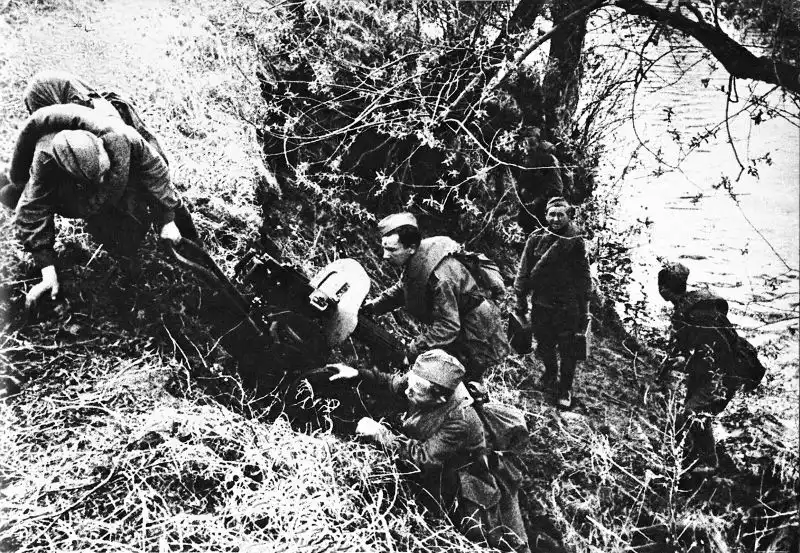
A Soviet Maxim machine gun crew struggles to haul its heavy weapon across a steep riverbank during the August 1945 offensive against the Japanese Kwantung Army in Manchuria.
Soviet Machine Gunners Advance Against Japan:
This striking World War II photograph captures five Soviet infantrymen struggling to drag a heavy PM M1910 Maxim machine gun across a steep riverbank in the Far East during August 1945.
The image was taken during the Soviet offensive against the Japanese Kwantung Army shortly after the defeat of Nazi Germany in Europe.
Covered in equipment and ammunition, the exhausted soldiers demonstrate the brutal physical labor required of machine gun crews during wartime.
The Soviet Entry Into the War Against Japan:
After Germany surrendered in May 1945, the Soviet Union transferred enormous military forces eastward across Siberia.
In August 1945, the USSR launched a massive offensive against Japanese forces in:
- Manchuria
- Korea
- Sakhalin
- the Kuril Islands
The operation became one of the largest and fastest military offensives of the entire war.
Soviet troops attacked the Japanese Kwantung Army from several directions simultaneously, overwhelming defensive positions with:
- tanks
- artillery
- aircraft
- mechanized infantry
The PM M1910 Maxim Machine Gun:
The weapon shown in the photograph is the famous water-cooled Maxim heavy machine gun.
Originally developed before World War I, the Maxim remained in Soviet service throughout World War II because of its:
- reliability
- sustained fire capability
- durability
The weapon was mounted on a wheeled carriage and used water cooling around the barrel, allowing long periods of continuous fire.
However, this firepower came at a price — enormous weight.
The Burden of the Machine Gun Crew:
The photograph clearly shows how physically demanding machine gun service was.
A full Soviet Maxim machine gun crew usually consisted of five men:
- commander
- gunner
- assistant gunner
- ammunition carrier
- ammunition carrier
Together they had to transport:
- the heavy machine gun itself
- the wheeled mount
- ammunition belts
- spare barrels and tools
- water for cooling
Crossing difficult terrain with this equipment was exhausting even under normal conditions.
Heavy Weapons of World War II:
The weight of the Soviet Maxim machine gun demonstrates how demanding early heavy machine guns were to operate.
The complete combat configuration weighed approximately 66 kilograms, making it considerably heavier than later German general-purpose machine guns such as:
- MG 34
- MG 42
German wartime doctrine increasingly favored lighter and more mobile machine guns, while the Soviet Union continued using older but extremely reliable heavy systems in large numbers.
Despite its age, Soviet soldiers respected the Maxim because it:
- rarely jammed
- tolerated dirt and mud well
- could maintain prolonged suppressive fire
Terrain and Logistics:
This photograph highlights a reality often overlooked when discussing mechanized warfare.
Even during the final stages of World War II, much of combat still depended on ordinary soldiers physically carrying weapons and supplies through:
- mud
- rivers
- forests
- mountains
- broken terrain
Heavy crew-served weapons dramatically slowed infantry movement.
In regions like Manchuria and the Soviet Far East, poor roads and difficult geography made transportation especially challenging.
The Soviet Offensive in Manchuria:
The Soviet campaign against Japan is sometimes overshadowed by the atomic bombings of Hiroshima and Nagasaki, but it played a decisive role in ending the war.
The Red Army destroyed much of the Kwantung Army in only a few weeks.
Soviet troops advanced rapidly through:
- mountain ranges
- deserts
- forests
- fortified regions
The campaign demonstrated the enormous operational experience the Soviet military had gained during the war against Germany.
Human Effort Behind Victory:
Photographs like this remind us that victory in World War II depended not only on famous tanks and aircraft, but also on ordinary infantrymen carrying impossible loads through terrible conditions.
The soldiers in this image are anonymous, yet their labor reflects the daily reality faced by millions of wartime troops.
A Rare View of the Far Eastern Campaign:
Compared to the Eastern Front in Europe, photographs from the Soviet-Japanese campaign are relatively uncommon.
This image is valuable because it captures:
- frontline movement during the offensive
- Soviet infantry organization
- heavy weapon transport
- the difficult terrain of the Far East theater
It also shows that even in 1945, armies still relied heavily on weapons designed decades earlier.
Historical Photograph Information:
Location: Soviet Far East
Date: August 1945
Photographer: Unknown
Recommended Books About the Soviet War Against Japan:
1. August Storm — David Glantz
The definitive English-language study of the Soviet invasion of Manchuria.
2. The Rising Sun — John Toland
Comprehensive history of Japan during World War II.
3. Russia’s War — Richard Overy
Excellent overview of the Soviet military experience in World War II.
4. The Second World War — Antony Beevor
Detailed global history covering both European and Pacific theaters.