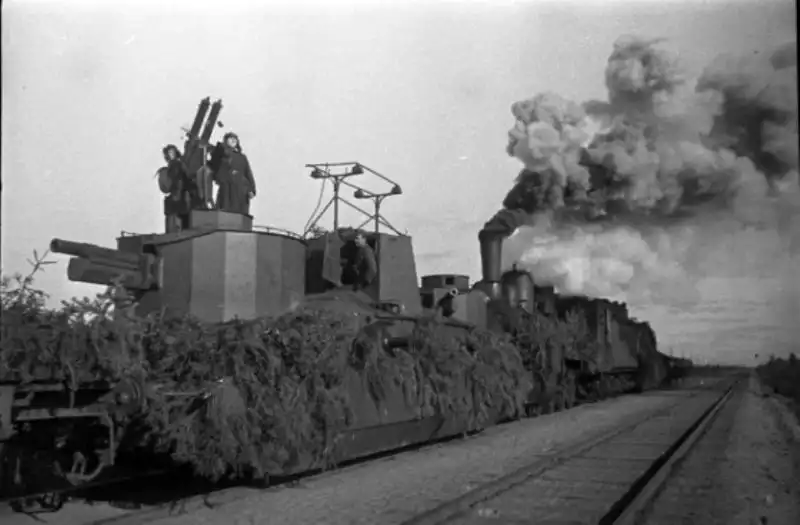
A camouflaged Soviet armored train equipped with a twin Maxim anti-aircraft machine gun mount during the desperate fighting on the Eastern Front in 1941.
Armored Fortress on Rails:
This fascinating World War II photograph shows a Soviet armored train disguised with freshly cut tree branches somewhere in the USSR during 1941.
The image is especially notable because of the visible twin anti-aircraft PM M1910 Maxim machine gun mount installed on top of an armored artillery turret.
In front of the locomotive stands a rare D-2 armored railcar, a motorized armored railway vehicle produced in Bryansk during the 1930s.
The photograph captures one of the lesser-known but highly important weapons of the Eastern Front — the Soviet armored train.
Soviet Armored Trains in World War II:
Armored trains played a major role during the early years of the war between the Soviet Union and Nazi Germany.
The enormous railway network of the Soviet Union made rail transport essential for:
- troop movement
- ammunition supply
- evacuation operations
- artillery transport
- rapid reinforcement of threatened sectors
Because railroads were so important, both sides used armored trains to defend key lines and stations.
Soviet armored trains acted as:
- mobile artillery batteries
- anti-aircraft platforms
- infantry support vehicles
- reconnaissance units
- rapid reaction forces
Camouflage Against German Aircraft:
The freshly cut branches covering the train reveal how dangerous German air superiority had become during 1941.
Aircraft of the Luftwaffe constantly searched for Soviet rail traffic:
- supply trains
- troop transports
- locomotives
- armored formations
To survive, Soviet crews often disguised trains using:
- branches
- camouflage nets
- mud
- improvised paint schemes
This kind of field camouflage became extremely common during the first months of the German invasion.
The Twin Maxim Anti-Aircraft Mount:
The most eye-catching detail in the image is the twin Maxim anti-aircraft installation mounted above the armored turret.
The water-cooled Maxim machine gun was originally developed before World War I, yet it remained one of the most important Soviet support weapons during World War II.
Twin and quadruple Maxim mounts were frequently used for air defense because they could create dense streams of fire against:
- low-flying aircraft
- strafing fighters
- dive bombers
Although outdated compared to newer automatic cannons, Maxim anti-aircraft mounts were still dangerous against aircraft flying at low altitude.
D-2 Armored Railcar — A Mobile Scout Vehicle:
The railcar visible ahead of the locomotive is identified as a D-2 armored motor railcar built in 1934.
Unlike ordinary armored train wagons, the D-2 could move independently and function as a separate combat vehicle.
These armored railcars were mainly used for:
- reconnaissance missions
- railway patrols
- escort duty
- rapid response operations
The vehicles were assigned to Soviet armored trains and also served with units responsible for guarding important railway infrastructure.
Rail Warfare on the Eastern Front:
Railroads became vital strategic targets during Operation Barbarossa.
German forces attempted to:
- destroy railway junctions
- cut supply lines
- isolate Soviet armies
- cripple industrial transport
At the same time, Soviet armored trains often fought directly near the front line.
Some armored trains participated in:
- artillery duels
- anti-tank combat
- infantry support operations
- urban defense battles
Because they depended on rail lines, however, armored trains were vulnerable if tracks were destroyed or surrounding territory was captured by enemy forces.
Improvised but Deadly:
One striking feature of Soviet wartime equipment was the mixture of improvisation and heavy firepower.
Armored trains combined:
- artillery
- machine guns
- armor plating
- anti-aircraft defenses
- transport capability
In many sectors during 1941, these trains became mobile fortresses supporting retreating Soviet troops.
The Harsh Reality of 1941:
The year 1941 was catastrophic for the Soviet Union.
German forces advanced hundreds of kilometers into Soviet territory, capturing huge numbers of prisoners and destroying thousands of Soviet vehicles.
Despite these disasters, Soviet industry and military units continued fighting with remarkable determination.
Armored trains like the one shown here became symbols of stubborn resistance during the darkest months of the war.
A Rare Glimpse of Soviet Rail Armor:
Photographs of Soviet armored trains are relatively uncommon compared to images of tanks or aircraft.
This image is valuable because it clearly shows:
- wartime camouflage techniques
- anti-aircraft armament
- the rare D-2 armored railcar
- the improvised nature of Soviet rail warfare
It also demonstrates how seriously Soviet commanders viewed the threat from German aviation.
Historical Photograph Information:
Location: USSR
Date: 1941
Photographer: Unknown
Recommended Books About Soviet Armored Warfare:
1. When Titans Clashed — David Glantz & Jonathan House
A classic overview of the Eastern Front.
2. Armored Trains — Wilfred Fung
Detailed history of armored trains in twentieth-century warfare.
3. Barbarossa — Alan Clark
Covers the opening phase of the German invasion of the Soviet Union.
4. Russia at War — Alexander Werth
A powerful firsthand account of the Soviet war experience.