Red Army infantry armed with Mosin–Nagant rifles advance alongside T-26 light tanks during fierce fighting against German defensive positions in the summer of 1941.
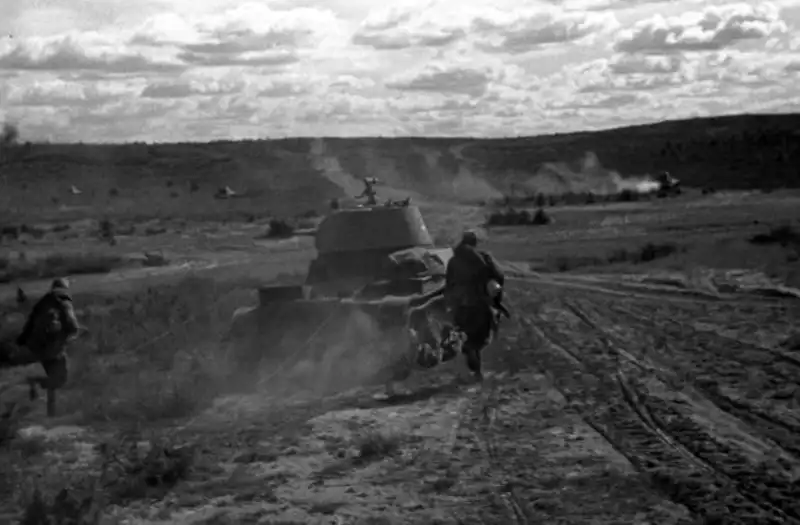
Soviet Infantry and Tanks Advance Into Battle:
This dramatic World War II photograph shows soldiers of the Red Army attacking a German-held elevation during the chaotic opening months of the German invasion of the Soviet Union.
The Soviet infantrymen advance with fixed bayonets on their Mosin–Nagant rifles while supported by T-26 light tanks moving toward enemy defensive positions.
The image captures the desperate intensity of combat during the summer of 1941 — a period when Soviet forces were fighting to stop the rapid advance of the German Wehrmacht.
Operation Barbarossa:
The photograph was taken during the first months of Operation Barbarossa.
On June 22, 1941, Nazi Germany launched the largest land invasion in human history.
Millions of German and Axis troops crossed into Soviet territory along a massive front stretching from the Baltic Sea to the Black Sea.
The opening weeks of the invasion were catastrophic for the Soviet Union:
- huge encirclements
- destroyed armies
- massive equipment losses
- collapsing front lines
Despite these disasters, Soviet resistance remained fierce.
T-26 — An Aging Soviet Tank:
The T-26 was one of the most common Soviet tanks at the beginning of the war.
Originally developed in the early 1930s, the vehicle had been designed primarily for infantry support.
By 1941 the T-26 already suffered from serious weaknesses:
- thin armor
- low speed
- vulnerability to German anti-tank guns
- outdated design
However, thousands still served in Soviet armored units during the first year of the war.
In many sectors, these tanks fought against more modern German armored formations under extremely difficult conditions.
Soviet Infantry Tactics in 1941:
The soldiers in the photograph are armed with Mosin–Nagant rifles fitted with bayonets — a common sight in early-war Red Army formations.
During the summer battles of 1941 Soviet infantry often fought under severe disadvantages:
- lack of artillery support
- weak communications
- poor coordination
- limited anti-tank weapons
- shortage of trained officers
Yet Soviet troops repeatedly launched counterattacks against advancing German forces.
Many of these assaults became brutal close-range engagements.
German Defensive Positions:
The photograph describes Soviet troops assaulting a height occupied by the Wehrmacht.
Elevated terrain held enormous tactical importance during World War II because it allowed defenders to:
- observe enemy movement
- direct artillery fire
- dominate surrounding ground
German forces frequently organized strong defensive positions on hills and ridgelines to slow Soviet attacks.
The Violence of the Eastern Front:
Images like this reveal the brutal nature of the Eastern Front.
Unlike the more mobile campaigns in Western Europe, fighting in the Soviet Union often involved:
- mass infantry assaults
- close combat
- enormous casualties
- repeated attacks against fortified positions
The war between Germany and the Soviet Union rapidly became one of total destruction.
The Human Cost of 1941:
The summer and autumn of 1941 were among the deadliest periods in Soviet history.
Entire Soviet divisions disappeared in encirclements, while millions of soldiers were:
- killed
- wounded
- captured
- cut off behind enemy lines
At the same time, many Red Army units continued fighting despite catastrophic losses.
The determination shown by Soviet troops during these early battles later became an important part of Soviet wartime memory.
Bayonets and Close Combat:
The fixed bayonets visible in the photograph are especially symbolic.
Although World War II is remembered for tanks and aircraft, much of the fighting on the Eastern Front still occurred at close range using:
- rifles
- grenades
- machine guns
- bayonets
Infantry assaults against prepared positions remained extremely dangerous and costly.
A Snapshot of the War’s First Summer:
This photograph preserves a moment from the chaotic opening phase of the German-Soviet war:
- Soviet troops still relying heavily on prewar equipment
- older tanks fighting alongside infantry
- massive battles unfolding across the Soviet countryside
Within months, both sides would suffer casualties on a scale unprecedented in modern warfare.
Historical Photograph Information:
Location: USSR
Date: Summer 1941
Photographer: Unknown
Recommended Books About the Eastern Front:
1. Barbarossa — Alan Clark
Classic account of the German invasion of the Soviet Union.
2. When Titans Clashed — David Glantz & Jonathan House
Excellent overview of the German-Soviet war.
3. Ivan’s War — Catherine Merridale
Powerful study of ordinary Soviet soldiers during World War II.
4. Russia at War — Alexander Werth
Detailed wartime observations from the Eastern Front.