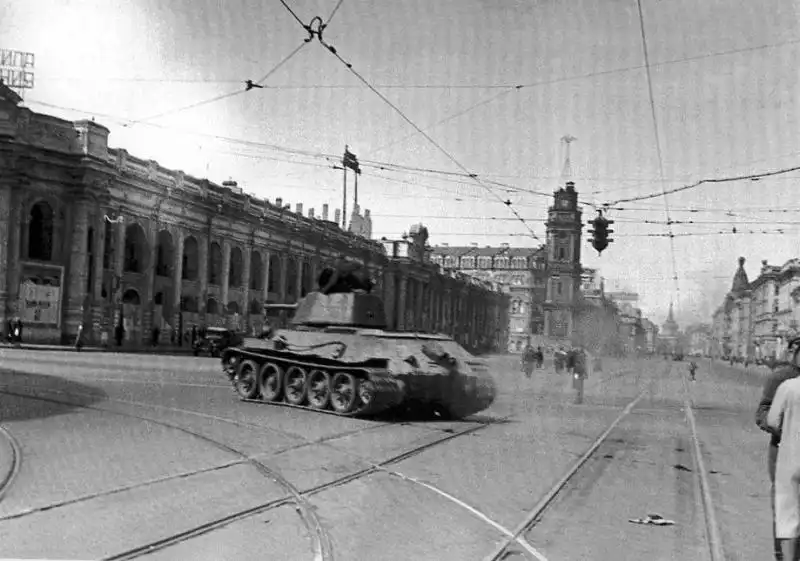
A Soviet T-34 tank moves through the intersection of Nevsky Prospect and Sadovaya Street in besieged Leningrad during the spring of 1943. The image reflects how reinforcements and military equipment continued to arrive in the city after the partial breakthrough of the blockade.
A Tank in the Heart of a Besieged City:
This wartime photograph shows a Soviet T-34 medium tank driving through the intersection of Nevsky Prospect and Sadovaya Street in Leningrad during the spring of 1943.
The vehicle is heading toward the front line that surrounded the city during the long Siege of Leningrad. The presence of a battle tank on one of the most famous streets of the city illustrates how closely the front approached Leningrad and how heavily militarized the urban environment had become during the blockade.
For civilians moving through the city, such sights had become increasingly common. Military trucks, artillery units, and armored vehicles frequently passed through the streets as reinforcements were moved toward defensive positions around the city.
The T-34 Tank:
The T-34 was one of the most important armored vehicles used by the Soviet Union during the Second World War.
Introduced in 1940, the tank quickly became famous for its combination of:
- strong sloped armor
- powerful 76 mm main gun (later upgraded to 85 mm)
- wide tracks suited for rough terrain
- relatively high mobility
These features made the T-34 extremely effective against many early German tanks and allowed Soviet forces to maintain strong armored units even during difficult periods of the war.
Although the tank became widely associated with major battles such as Stalingrad and Kursk, T-34 units also played an important role in the fighting around Leningrad.
Tanks in Besieged Leningrad:
Interestingly, T-34 tanks were not produced inside besieged Leningrad. Most Soviet tank production had been evacuated eastward during the first months of the war.
However, the appearance of T-34 tanks in the city in 1943 was not unusual.
After the partial breakthrough of the siege in January 1943, Soviet forces managed to open a narrow land corridor connecting Leningrad with the rest of the country. This operation, known as Operation Iskra, allowed the Soviet command to restore limited transportation links.
Through this corridor it became possible to move troops, supplies, and military equipment into the city.
The Ladoga Railway Line:
One of the most important developments after the breakthrough was the construction of a railway line along the southern shore of Lake Ladoga.
This railway connection allowed trains to bring essential supplies directly into Leningrad. Despite the constant danger posed by German artillery positions on the Sinyavino Heights, the line remained operational.
Along this railway route the Soviet authorities transported:
- food and essential supplies
- fresh military units
- armored vehicles and artillery
- ammunition and fuel
At the same time, trains leaving the city carried wounded soldiers and civilians who were not involved in the defense or industrial work of the city.
This rail connection became a crucial lifeline that significantly improved the situation in Leningrad during 1943.
Nevsky Prospect During the Siege:
Nevsky Prospect was the main avenue of Leningrad and one of the most important streets in the entire city.
During the siege, however, the avenue became part of a wartime landscape shaped by air raids, artillery strikes, and constant military movement.
Civilians walking along Nevsky Prospect often had to take shelter during bombardments. Buildings along the avenue were damaged by shellfire, and barricades or defensive structures occasionally appeared near major intersections.
The image of a T-34 tank moving through this historic street demonstrates how the city’s civilian spaces were transformed into a logistical route for the defense of Leningrad.
The Long Road to Liberation:
Although the partial breakthrough of the blockade in 1943 improved the situation, the siege itself did not end immediately.
Leningrad remained under threat from German artillery and air attacks for another year. Only in January 1944, after a major Soviet offensive, was the siege finally lifted.
By that time the city had endured 872 days of blockade, making it one of the longest and most devastating sieges in modern history.
Despite unimaginable hardships, the city survived. Military units, factory workers, and ordinary civilians all contributed to the defense of Leningrad.
The photograph of a T-34 tank moving through Nevsky Prospect captures a moment when the city, though still surrounded, had begun to regain strength and hope.
Historical Photograph Information:
Location: Leningrad, USSR
Date: Spring 1943
Photographer: Nikolai Khandogin
Recommended Books on the Siege of Leningrad:
Readers interested in the military and civilian history of the siege may find the following works useful:
1. The 900 Days: The Siege of Leningrad — Harrison E. Salisbury
A classic historical account based on extensive interviews and archival research.
2. Leningrad: State of Siege — Michael Jones
A powerful narrative describing the experiences of civilians trapped in the city during the blockade.
3. The Siege of Leningrad 1941–1944 — David M. Glantz
A detailed military study explaining the operations around the city and the eventual Soviet breakthrough.
4. Leningrad: The Epic Siege of World War II, 1941–1944 — Anna Reid
A modern historical work based on diaries and personal testimonies from people who lived through the siege.