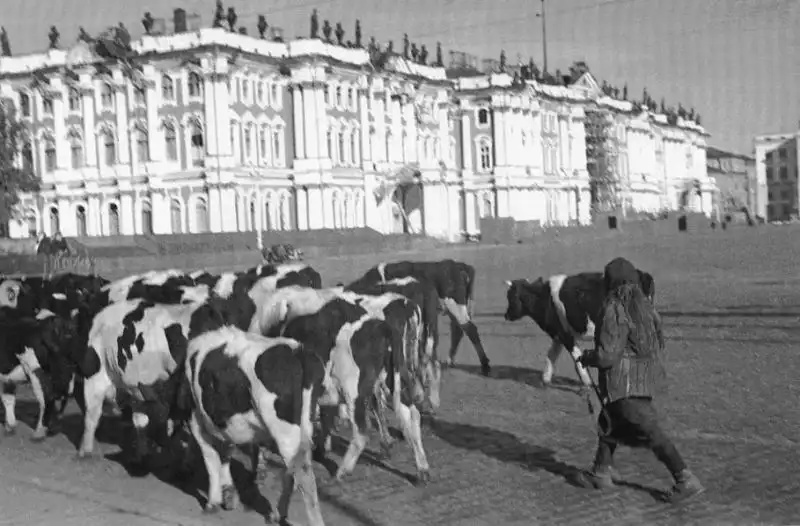
Cattle driven by residents from front-line areas stand on Palace Square in besieged Leningrad during the autumn of 1941. The photograph reflects the desperate efforts of the city to secure food supplies in the first months of the Siege of Leningrad.
An Unusual Scene in the Heart of Leningrad:
This remarkable wartime photograph shows cattle gathered on Palace Square in Leningrad during the autumn of 1941, shortly after German and Finnish forces encircled the city.
The animals were driven into the city by civilians fleeing from nearby front-line areas. Residents attempted to bring livestock with them before advancing German troops could capture or destroy valuable food resources.
The sight of cattle standing on Palace Square, one of the most famous historical squares in Russia and home to the Winter Palace, would have been unimaginable in peacetime. Yet during the early months of the Siege of Leningrad, such extraordinary scenes became part of daily life.
The Encirclement of Leningrad:
The siege began in September 1941, when German forces advancing from the south linked with Finnish troops approaching from the north. Together they cut off most land routes connecting Leningrad with the rest of the Soviet Union.
By early September, the city was effectively surrounded.
The loss of surrounding agricultural regions created an immediate food crisis. Leningrad had depended heavily on food deliveries from nearby rural areas, and the sudden disruption of supply routes threatened millions of civilians with starvation.
In response, authorities and civilians alike tried to save whatever food resources could still be brought into the city.
Livestock Brought Into the City:
As the front line approached the outskirts of Leningrad, residents of nearby villages and suburban districts began driving livestock toward the city.
Cows, horses, sheep, and goats were herded along roads leading into Leningrad in the hope that they could be preserved as a source of food. Bringing animals into the city was a desperate but practical attempt to protect valuable agricultural resources from falling into German hands.
Public squares, courtyards, and empty spaces sometimes became temporary holding areas for livestock.
The presence of cattle on Palace Square, one of the symbolic centers of imperial Russia, perfectly illustrates the extraordinary transformation of the city during wartime.
Food Shortages and the Coming Famine:
Despite such efforts, the food situation in Leningrad rapidly deteriorated.
By late autumn 1941 the city faced catastrophic shortages. The blockade prevented regular deliveries of grain, meat, and other essential supplies.
Ration cards were introduced, but the daily food allowance steadily decreased as stocks dwindled. By the winter of 1941–1942, rations for civilians dropped to extremely low levels.
During this period the population of Leningrad endured one of the most severe urban famines in modern history.
Palace Square During the Siege:
Palace Square had long been a central symbol of Russian history. It had witnessed major political events, imperial ceremonies, and revolutionary demonstrations.
During the siege, however, the square became part of a city struggling simply to survive.
Military vehicles crossed the square, air raid alarms sounded regularly, and anti-aircraft defenses were installed throughout the city center. Civilians moved quickly through the streets, always aware of the danger posed by artillery fire and air raids.
Against this backdrop, scenes such as cattle being gathered on the square reflected the improvisation and desperation of a population cut off from normal supply networks.
A Symbol of Survival:
The photograph taken by Nikolai Khandogin captures a moment that illustrates both the chaos and the determination of the city during the first months of the siege.
Bringing livestock into Leningrad could not solve the enormous food crisis facing the city. Yet it represented an effort by ordinary people to preserve whatever resources were still available.
Images like this help historians understand how civilians attempted to adapt to the rapidly changing conditions of wartime.
Today the photograph remains a powerful reminder of the unusual and often surreal scenes that unfolded in Leningrad during the long siege.
Historical Photograph Information:
Location: Leningrad, USSR
Date: September 1941
Photographer: Nikolai Khandogin
Recommended Books on the Siege of Leningrad:
Readers interested in learning more about the dramatic history of the blockade may find the following works valuable:
1. The 900 Days: The Siege of Leningrad — Harrison E. Salisbury
A classic historical study based on interviews and archival material.
2. Leningrad: State of Siege — Michael Jones
A powerful narrative focusing on the human experience of civilians trapped inside the city.
3. The Siege of Leningrad 1941–1944 — David M. Glantz
A detailed military analysis of the operations surrounding the city.
4. Leningrad: The Epic Siege of World War II, 1941–1944 — Anna Reid
A modern historical account based on diaries and personal testimonies.