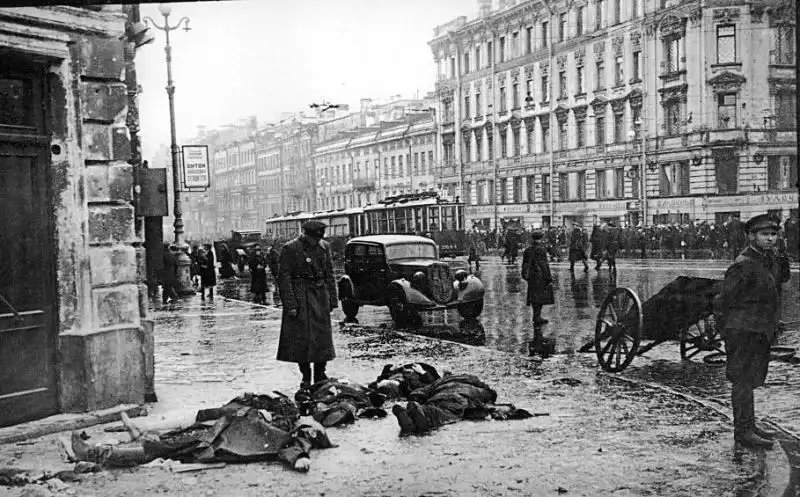
One of the first civilian casualties of German artillery bombardment lies on the corner of Nevsky and Ligovsky avenues in besieged Leningrad. The photograph captures the tragic beginning of the long Siege of Leningrad in September 1941.
The First Days of the Siege:
This powerful wartime photograph shows the tragic aftermath of one of the first artillery bombardments of besieged Leningrad in September 1941.
The scene was captured at the intersection of Nevsky Prospect and Ligovsky Avenue, one of the busiest and most recognizable locations in the historic center of the city. On the pavement lies one of the first civilian victims of German artillery fire.
For the residents of Leningrad, this moment marked the beginning of a long and devastating ordeal. What initially appeared to be sporadic shelling soon developed into a relentless campaign of bombardment that would last for years.
Artillery Fire Reaches the City:
German forces began regular artillery bombardments of Leningrad on 4 September 1941, shortly after completing the encirclement of the city.
From positions south of Leningrad, German heavy artillery units were able to strike deep into the urban center. Shells frequently landed in residential districts, industrial areas, tram lines, and major city streets.
Even the most famous avenues of the city were not spared. Nevsky Prospect, the central artery of Leningrad, repeatedly came under fire during the early stages of the siege.
For civilians moving through the city, daily life suddenly became extremely dangerous. Artillery shells could strike without warning, turning ordinary streets into deadly zones within seconds.
A City Under Constant Attack:
During the long siege, Leningrad was subjected to both intense aerial bombardment and heavy artillery shelling.
According to official wartime records, between 4 September 1941 and 22 January 1944 the city endured an enormous number of attacks. Registered strikes included:
- 107,158 aerial bombs dropped on the city
- 148,478 heavy artillery shells
These figures illustrate the massive scale of destruction inflicted upon the city during the blockade.
Residential buildings, hospitals, cultural institutions, and transportation infrastructure were repeatedly damaged or destroyed. Streets were often littered with debris, shattered glass, and bomb craters.
Civilian Life Under Fire:
Unlike many front-line cities, Leningrad remained heavily populated throughout the siege. Millions of civilians continued to live inside the encircled city despite constant bombardment and severe shortages of food and fuel.
People still had to walk through the streets to reach workplaces, food distribution points, hospitals, and shelters.
Because of this, artillery strikes frequently resulted in civilian casualties. Shells exploding on crowded avenues or tram stops could cause devastating losses within seconds.
The image taken at Nevsky and Ligovsky avenues captures one of these tragic moments when ordinary city life was suddenly interrupted by the violence of war.
The Human Cost of the Siege:
The Siege of Leningrad lasted 872 days, making it one of the longest and most destructive sieges in modern history.
The city endured:
- constant artillery bombardment
- repeated air raids
- severe food shortages
- brutal winter conditions
Hundreds of thousands of civilians died from starvation, cold, disease, and bombardment. Entire families disappeared during the harsh winters of 1941–1942.
Yet despite these unimaginable hardships, the city continued to function. Factories produced weapons, hospitals treated the wounded, and cultural institutions attempted to preserve a sense of normal life.
A Photograph That Captures the Beginning:
Photographs taken in September 1941 are especially significant because they document the very beginning of the catastrophe that would later define the Siege of Leningrad.
At that moment, few people could imagine that the blockade would last for nearly two and a half years.
The victim seen in this photograph represents one of the earliest civilian casualties of the artillery bombardments that soon became a daily reality for the inhabitants of the city.
Today such images serve as stark reminders of the human suffering caused by siege warfare during the Second World War.
Historical Photograph Information:
Location: Leningrad, USSR
Date: September 1941
Photographer: David Trakhtenberg
Recommended Books on the Siege of Leningrad:
Readers who wish to learn more about the dramatic events of the siege may find the following works useful:
1. The 900 Days: The Siege of Leningrad — Harrison E. Salisbury
A classic historical account based on eyewitness testimony and archival sources.
2. Leningrad: State of Siege — Michael Jones
A vivid narrative focusing on the daily lives and struggles of civilians trapped inside the city.
3. The Siege of Leningrad 1941–1944 — David M. Glantz
A detailed military study of the operations surrounding the city and the strategic decisions made during the blockade.
4. Leningrad: The Epic Siege of World War II, 1941–1944 — Anna Reid
A modern historical study drawing on diaries and personal accounts from the siege.