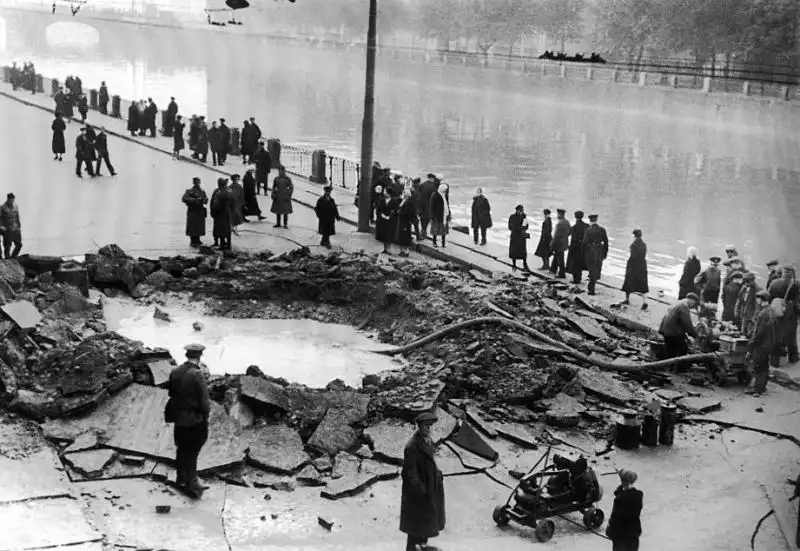
A massive bomb crater filled with water on the Fontanka embankment in besieged Leningrad. The photograph captures the destructive power of German air raids and artillery bombardment during the first weeks of the Siege of Leningrad in 1941.
A City Under Relentless Bombardment:
This wartime photograph shows a huge bomb crater filled with water on the Fontanka embankment in Leningrad during the dramatic early weeks of the Siege of Leningrad in September 1941.
The explosion left a deep cavity in the stone embankment, quickly filled by water from the nearby canal. Scenes like this became common across the city as German aviation and artillery relentlessly attacked Leningrad’s streets, factories, bridges, and residential districts.
For the citizens of the city, bomb craters were not unusual sights. Entire squares, tram lines, and intersections were scarred by explosions. Many of these craters remained visible for months, sometimes turning into temporary ponds after rain or snowmelt.
This image is a stark visual reminder of the destructive force unleashed against the city during one of the most devastating sieges in modern history.
The Beginning of the Siege:
The Siege of Leningrad began in the summer of 1941 as German and Finnish forces advanced rapidly through the Soviet Union during Operation Barbarossa.
By early September, the situation around the city had become critical.
On 4 September 1941, German forces began regular artillery bombardments of Leningrad. Within days the city was under constant fire. Shells struck residential neighborhoods, factories, bridges, and cultural landmarks.
Between 9 and 17 September 1941, German troops attempted to storm the city. By 12 September, they had advanced to within 10 kilometers of Leningrad.
From such a distance, even relatively small field guns could reach parts of the city.
Artillery That Reached the City:
German forces deployed numerous heavy weapons around Leningrad. Among them were:
- 150 mm field artillery
- 173 mm heavy mortars
- 210 mm siege mortars
These weapons were capable of devastating entire buildings with a single shell. Their fire constantly threatened both civilians and critical industrial facilities inside the city.
The proximity of the front line meant that even regimental artillery could reach urban districts. Leningrad was effectively within range of nearly every type of artillery deployed by the besieging armies.
For residents of the city, this meant daily danger. Streets, tram routes, embankments, and apartment blocks were frequently damaged or destroyed by shellfire.
The Shadow of the Giant Guns:
Some reports from the wartime period mention that German super-heavy railway artillery, including the famous “Dora” and “Schwerer Gustav” guns, was spotted near Taytsy station south of Leningrad.
These enormous artillery systems were among the largest weapons ever built. Designed by the Krupp company, they fired shells of approximately 800 mm caliber (sometimes listed as 807 mm).
The guns were originally constructed to destroy heavily fortified targets and were famously used during the Siege of Sevastopol in 1942.
According to some historical sources, one of these railway guns was transferred toward the Leningrad sector later in the war. Even if they were rarely fired there, the mere presence of such weapons illustrated the massive scale of the siege warfare surrounding the city.
Leningrad on the Brink:
By mid-September 1941, the fate of Leningrad hung in the balance.
German troops managed to approach to within 4–7 kilometers of the city limits, essentially reaching its suburbs. The frontline trenches were dangerously close to major industrial and historical landmarks.
At the closest points:
- the front line lay only 4 km from the Kirov Factory, one of the most important Soviet tank production plants
- it was about 16 km from the Winter Palace, the historic heart of the city
The Soviet leadership prepared for the possibility that the city might fall. Key factories were wired for demolition, and ships of the Baltic Fleet were prepared to be scuttled to prevent capture.
At this critical moment, Georgy Zhukov was appointed to organize the defense of the city.
Desperate Measures to Hold the Line:
The Soviet command took extremely harsh measures to stop the German advance.
Zhukov issued strict orders stating that any unauthorized retreat or abandonment of defensive positions around the city could result in immediate execution. The goal was clear: prevent panic and force units to hold their positions at all costs.
These brutal measures, combined with the determination of Soviet soldiers and civilians, helped stabilize the front.
The defenders of Leningrad fought with extraordinary determination. Despite repeated attacks, German forces were unable to capture the crucial Pulkovo Heights, a strategic elevation south of the city.
Control of these heights was vital. If German artillery observers had gained them, they could have directed devastating fire onto the very center of Leningrad.
A City That Refused to Fall:
Although German forces came extremely close to the city, they ultimately failed to capture it.
Instead, Leningrad was surrounded and subjected to a long and brutal siege that lasted 872 days, from September 1941 until January 1944.
During this time the city endured constant bombardment, starvation, and freezing winters. Hundreds of thousands of civilians died, making the Siege of Leningrad one of the greatest tragedies of World War II.
Photographs like this bomb crater on the Fontanka embankment capture just a single moment from that long ordeal. Yet they reveal the scale of destruction that the city endured while continuing to resist.
Historical Photograph Information:
Source: Central State Archive of Film and Photo Documents (TsGAKFFD)
Location: Leningrad, USSR
Date: 9 September 1941
Photographer: Boris Vasyutinsky
Recommended Books on the Siege of Leningrad:
Readers interested in learning more about the dramatic events surrounding the siege may find the following historical works useful:
1. The 900 Days: The Siege of Leningrad — Harrison E. Salisbury
One of the most famous and detailed accounts of the siege, based on eyewitness testimonies and archival material.
2. Leningrad: State of Siege — Michael Jones
A powerful narrative describing the human suffering, courage, and survival of the city during the blockade.
3. The Siege of Leningrad 1941–1944 — David M. Glantz
A military analysis of the operations around Leningrad and the strategic decisions made by both sides.
4. Anna Reid – Leningrad: The Epic Siege of World War II, 1941–1944
A modern historical study that combines archival sources with personal diaries from the siege.