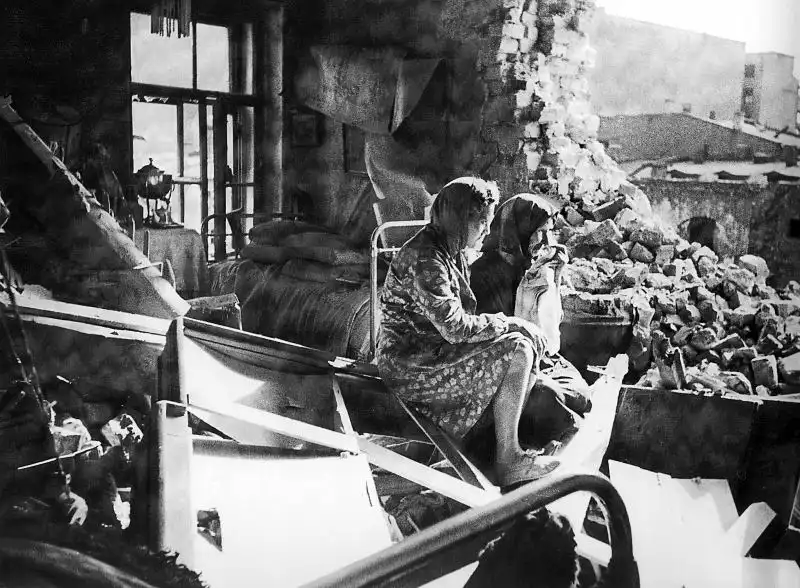
Soviet women Anisya Matveevna Amelkina and her daughter Valentina sit among the ruins of their apartment destroyed by German artillery shelling in besieged Leningrad during the Siege of Leningrad in 1943. The photograph reflects the harsh reality of civilian life during one of the longest sieges in modern history.
Life Inside a Destroyed Apartment:
This wartime photograph shows Soviet women sitting inside a Leningrad apartment heavily damaged by German artillery shelling during the Siege of Leningrad.
The women in the image are Anisya Matveevna Amelkina and her daughter Valentina. They sit quietly among the debris of their home, surrounded by broken walls, shattered plaster, and the remains of their damaged apartment. Despite the destruction, several pieces of furniture survived the artillery strike.
Scenes like this became tragically common during the siege. Thousands of apartments across Leningrad were damaged or destroyed by artillery fire and aerial bombardments, yet many residents continued living in partially ruined buildings because there were few alternatives.
Artillery Bombardment of Leningrad:
Throughout the Siege of Leningrad, the city was constantly exposed to German artillery shelling.
German batteries positioned south of the city regularly fired heavy shells into residential districts, factories, and central streets. These attacks caused enormous destruction and created a constant threat for civilians.
Residential buildings, schools, hospitals, and historical structures were frequently damaged. For the inhabitants of Leningrad, artillery fire became part of everyday existence, with people learning to recognize the sounds of distant guns and incoming shells.
In many cases, civilians had only a few moments to seek shelter before explosions struck.
Homes Turned Into Ruins:
When artillery shells hit residential areas, the consequences were devastating. Entire walls collapsed, ceilings were destroyed, and staircases disappeared under piles of rubble.
Many families lost their homes within seconds. However, because Leningrad remained under siege and housing was extremely limited, residents often had no choice but to continue living inside damaged buildings.
Windows were covered with boards or cloth to protect against wind and snow, while destroyed walls were repaired with whatever materials were available.
The photograph of Anisya Amelkina and her daughter inside their ruined apartment demonstrates the difficult conditions faced by ordinary civilians who continued their lives despite constant danger.
Civilian Endurance During the Siege:
The Siege of Leningrad, lasting from September 1941 to January 1944, became one of the most devastating urban sieges in history.
The city endured:
- constant artillery bombardment
- repeated air raids
- catastrophic food shortages
- extreme winter conditions
Despite these hardships, millions of civilians remained in the city and continued working in factories, hospitals, and civil defense organizations.
Women played a vital role in maintaining daily life during the siege. Many worked in industrial plants producing weapons and ammunition, while others supported hospitals, transportation systems, and food distribution efforts.
Photographs like this reveal the human side of the blockade — the determination of ordinary people to survive under extraordinary circumstances.
A Photograph Published During the War:
This photograph was published in the Soviet newspaper “Leningradskaya Pravda” on 20 August 1943.
Wartime newspapers often published images like this to demonstrate both the destruction caused by enemy bombardments and the resilience of the city’s inhabitants.
By 1943, the situation in Leningrad had improved somewhat after the partial breakthrough of the blockade earlier that year. However, German artillery attacks and air raids continued to threaten the city.
Such photographs became important historical records documenting the sacrifices of the civilian population.
A Symbol of Survival:
The image of a mother and daughter sitting calmly in a destroyed apartment tells a powerful story about survival during wartime.
Despite the destruction surrounding them, the women remain composed among the fragments of their former home.
Their presence in the ruined room reflects the determination of Leningrad’s citizens to continue living despite hunger, bombardments, and unimaginable hardships.
Today, photographs like this remain valuable historical documents that help illustrate the daily experiences of civilians during the long Siege of Leningrad.
Historical Photograph Information:
Source: Leningradskaya Pravda newspaper, No. 196 (8611), 20 August 1943
Location: Leningrad, USSR
Date: Spring 1943
Photographer: David Trakhtenberg
Recommended Books on the Siege of Leningrad:
Readers interested in the civilian experience during the siege may find the following works valuable:
1. The 900 Days: The Siege of Leningrad — Harrison E. Salisbury
A classic historical account describing the blockade through eyewitness testimonies and archival sources.
2. Leningrad: State of Siege — Michael Jones
A vivid narrative focusing on the daily struggle of civilians trapped inside the city.
3. Leningrad: The Epic Siege of World War II, 1941–1944 — Anna Reid
A modern historical study based on personal diaries, letters, and archival documents.
4. The Siege of Leningrad 1941–1944 — David M. Glantz
A detailed military analysis of the operations that shaped the long blockade of the city.