German soldiers rest beneath a tree during the Battle of France while a comrade photographs the peaceful scene beside an Opel Blitz truck towing an anti-tank gun.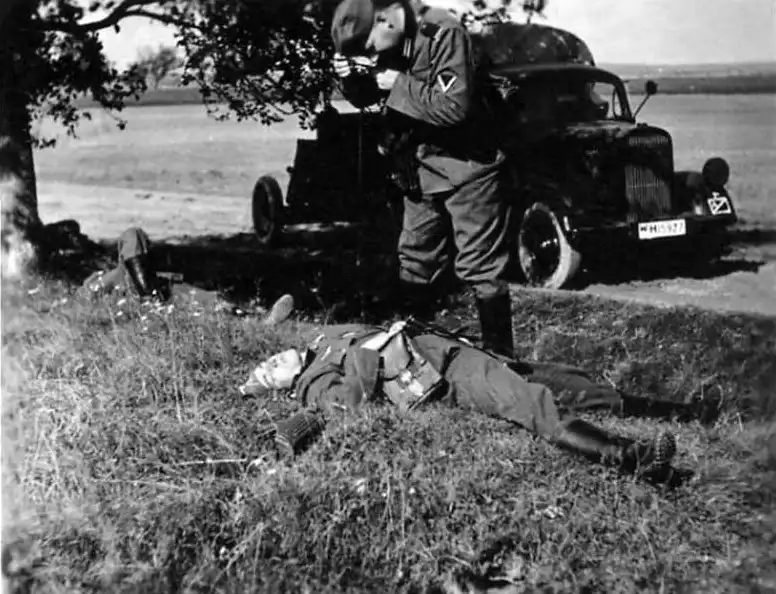
A Quiet Moment in a Fast-Moving Campaign:
This remarkable photograph captures an unusually peaceful scene during one of the most dramatic military campaigns of the Second World War.
A German soldier photographs several of his comrades sleeping peacefully beneath a tree somewhere in France during June 1940. Exhausted by days of rapid movement and military operations, the soldiers have taken advantage of a brief pause to rest on the grass.
In the background stands an Opel Blitz truck towing a 3.7 cm PaK 35/36 anti-tank gun, reminding the viewer that this seemingly tranquil moment exists in the middle of an active military campaign.
The Human Side of War:
Photographs of combat often focus on explosions, attacks, and destruction. Yet soldiers spent far more time marching, waiting, maintaining equipment, and resting whenever circumstances allowed.
The sleeping men appear completely relaxed, suggesting that their unit was operating behind the immediate front line. Their confidence reflects the military situation of June 1940, when German forces were advancing rapidly across France.
The Battle of France:
The German invasion of France began on 10 May 1940. By exploiting the Ardennes and bypassing the Maginot Line, German armored formations shattered Allied defenses and forced the evacuation at Dunkirk. Paris fell on 14 June, and France signed an armistice on 22 June 1940.
Opel Blitz and the Mobility of the Wehrmacht:
The Opel Blitz became the backbone of German logistics. It transported supplies, infantry, and artillery while allowing fast-moving formations to maintain their momentum during the campaign.
The 3.7 cm PaK 35/36 Anti-Tank Gun:
The gun visible behind the truck appears to be the famous 3.7 cm PaK 35/36. Introduced before the war, it was light, reliable, and easy to conceal. During the campaigns in Poland and France it proved effective against most contemporary tanks.
Its reputation changed after the invasion of the Soviet Union, where heavier Soviet armor exposed its limitations. German crews jokingly nicknamed it the "door knocker" because it often failed to penetrate newer tanks.
Rest Between Campaigns:
Rapid advances demanded enormous physical endurance. Soldiers often marched for hours, performed maintenance, guarded supply routes, and seized every opportunity to sleep. Short breaks beneath roadside trees or beside vehicles became an ordinary part of military life.
A Photograph Taken Before the Long War:
In June 1940 Germany appeared almost unstoppable. Few could foresee that the conflict would continue for another five years and eventually end in Germany's defeat.
The Contrast Between Peace and War:
The greatest strength of this photograph lies in its contrast. At first glance it resembles an ordinary summer afternoon, yet every object in the frame reminds us that these men were participants in one of history's most destructive wars.
Historical Significance:
This image illustrates an often-overlooked aspect of wartime experience: long periods of waiting and rest between operations. Such photographs complement dramatic combat images by showing the daily routines that occupied most soldiers' time.
It also documents the equipment that enabled the German army's early successes, including the Opel Blitz truck and the PaK 35/36 anti-tank gun, both of which became iconic symbols of the 1940 campaign.
Historical Photograph Information:
Location: France
Date: June 1940
Photographer: Unknown
Recommended Reading:
1. The Fall of France — Julian Jackson
A comprehensive history of the 1940 campaign and the collapse of France.
2. Blitzkrieg Legend — Karl-Heinz Frieser
An influential study challenging myths surrounding German operational doctrine.
3. The Blitzkrieg Myth — John Mosier
An examination of the origins and reality of the Blitzkrieg concept.
4. Panzer Commander — Hans von Luck
Memoirs describing service in German armored formations.
5. The German War — Nicholas Stargardt
A social history of Germany and its soldiers during World War II.
6. France 1940 — Philip Nord
An accessible account of France during the dramatic events of 1940.