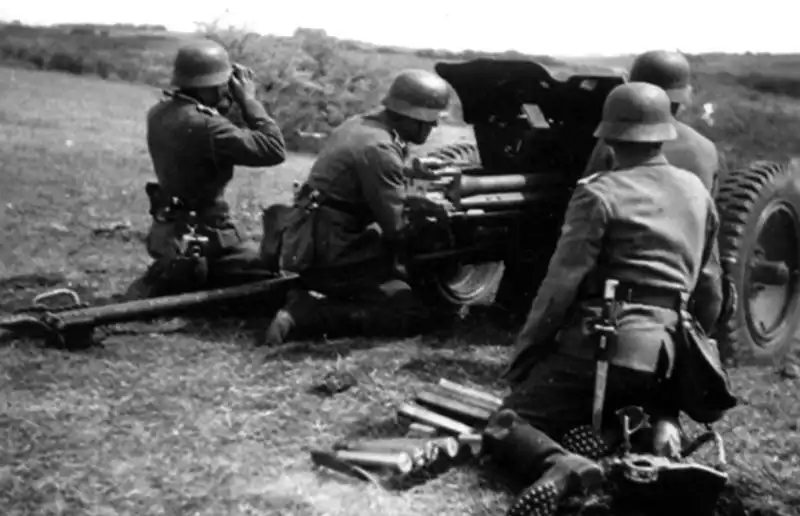
A German crew of the 37mm PaK 35/36 anti-tank gun waits for Soviet armored vehicles. The image reflects early-war anti-tank tactics and the limitations of German weapons in 1941.
Waiting for the Tanks
This photograph shows a German crew operating a 37mm PaK 35/36 anti-tank gun, positioned and waiting for an expected Soviet armored attack during the summer of 1941.
The scene captures a tense moment typical of the early Eastern Front, with soldiers concealed in prepared positions, ready to engage advancing Soviet armor using one of the Wehrmacht's standard anti-tank weapons.
The PaK 35/36 – Standard but Already Obsolete
At the outbreak of the German invasion of the Soviet Union, the PaK 35/36 remained the principal anti-tank gun of the German Army. Introduced during the 1930s, it had performed effectively in earlier campaigns against lightly armored opponents in Poland and Western Europe.
Its principal characteristics included:
- 37 mm caliber
- Lightweight construction and excellent mobility
- Low profile that made camouflage easier
- Rapid deployment by a small gun crew
However, by 1941 the weapon was already showing its age. The appearance of modern Soviet tanks such as the T-34 and the heavily armored KV series exposed the limitations of its armor-piercing capability.
The "Door Knocker" Nickname
German soldiers sarcastically nicknamed the PaK 35/36 the "door knocker" (Heeresanklopfgerät) because its shells often bounced harmlessly off the armor of newer Soviet tanks.
Combat reports from the Eastern Front describe numerous situations in which:
- Repeated hits failed to disable a single tank
- Crews were forced to aim for weak points such as vision ports, turret rings, or rear armor
- Successful engagements depended heavily on favorable circumstances and crew skill
One frequently cited combat report describes a T-34 surviving 23 hits before a final shot struck a vulnerable area and disabled the vehicle, illustrating just how inadequate the weapon had become against modern armor.
Attempts to Improve Effectiveness
To compensate for the gun's declining effectiveness, Germany introduced new types of ammunition.
- High-explosive anti-tank (HEAT) rounds
- Over-caliber hollow-charge projectiles (Stielgranate 41) launched with a special blank cartridge
These developments improved penetration considerably against heavily armored targets, but they could not completely overcome the limitations of the small 37 mm gun.
As Soviet armor continued to improve, the PaK 35/36 rapidly disappeared from front-line anti-tank units and was replaced by more powerful weapons.
Mobility Versus Firepower
Despite its shortcomings, the PaK 35/36 retained several important advantages.
- Easy to transport by hand or light vehicle
- Quick to deploy in concealed ambush positions
- Still effective against armored cars and lightly armored vehicles
During the opening months of Operation Barbarossa, these qualities allowed German forces to achieve success against older Soviet armored vehicles, even though the weapon struggled against the newest tank designs.
A Weapon of the Early War
This photograph captures a transitional period in anti-tank warfare. The PaK 35/36 had been designed for the armored vehicles of the 1930s but suddenly faced a battlefield dominated by better-protected and more advanced Soviet tanks.
The experience of 1941 accelerated German development of more powerful anti-tank guns, including the 50 mm PaK 38 and later the highly effective 75 mm PaK 40, which eventually replaced the aging 37 mm weapon in frontline service.
Historical Photograph Information
Location: USSR
Date: Summer 1941
Photographer: Unknown
Recommended Books
Panzerjäger: Anti-Tank Warfare on the Eastern Front — Robert Forczyk. A detailed examination of German anti-tank tactics, doctrine, and weapons used against Soviet armor.
German Anti-Tank Guns 1939–45 — Terry Gander. A technical and historical overview of Germany's anti-tank artillery throughout the war.
When Titans Clashed — David Glantz & Jonathan House. A balanced study of the Eastern Front that places German anti-tank operations in their broader operational context.
Weapons of the Wehrmacht — Chris Bishop. An illustrated reference covering the principal weapons and equipment used by the German armed forces during World War II.